
Translated material
Criminal, backstage and bodily
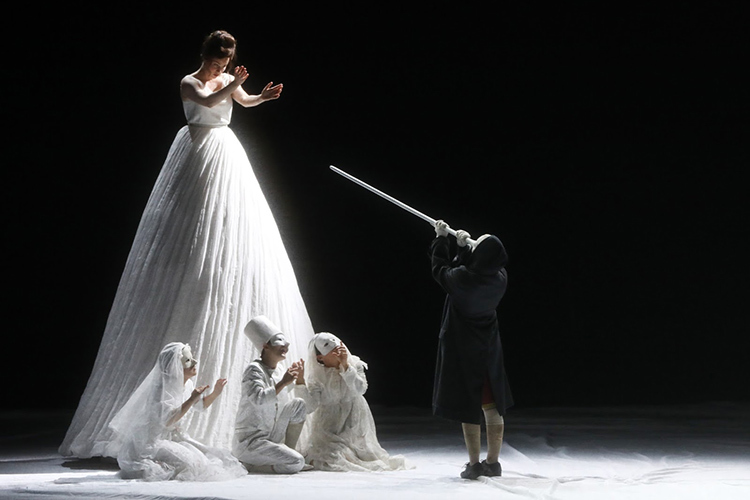
Programming the festival - the more heavy opera - depends on such a number of circumstances that the final poster always seems almost random. Of course, in the formation of Festival d'Art Lyrique in the ex-en-prove such less accidents. The reputation, infrastructure that arose over many years, a regiment of affordable, loyal and professional performers from the festival academy, the interest of the festival venues, as well as the ethical and managerial adequacy of the authorities, which agrees in any economic and political situation and disdain financial blackmail methods, all this creates the conditions for artistic planning that seem to seem to be greenhouse. Even if they are not such, they allow the festival to form trends, phenomena and names that determine the existence of the lyrical genre around the world. The 2017 program, the center of which was Carmen in the production of Pablo Eras-Casado and Dmitry Chernyakov, allows you to formulate several such points of attention in the artistic policy of the festival.
The criminal unexpectedly became the central figure. Or, more precisely, the conditions and consequences of social transgression, violations of the social norm, morality, conventions, laws and ordeal, associated with this. Such a plot would be inevitable in the case of a romantic repertoire. But this is the paradox: the program has neither German romantics, nor the Italian opera of the 19th century, neither gods, nor heroes, nor myths, nor riots. And although the festival still seeks to show different opera eras, the 19th century is represented only by the genre “Carmen”.
No matter how different these criminals are, they are united by the stubbornness, with which they realize their provocative work.
In addition, in the program: the opera unknown to the public Francesco Kavalli Erismen in the production of the propagandist of the baroque music Leonardo Garcia Alarcon and last year's resident of the festival in Avignon Jean Bellorini; The story of the chief opera seducer and provocateur Don Juan in the version of the conductor of Zheremi Rorer and director Jean-Franesu Sivadier, who works mainly in the dramatic theater specializing in Mozart; Igor Stravinsky’s neoclassic “The Adventures of the Hold” from the director of the successful “Magic Flute” of 2014 by Simon McBberny (Daniel Harding was supposed to be behind the remote control, but he damaged his hand at the last moment, the situation saved the Norwegian maestro Avind Gulberg Jensen); And, finally, the new Opera Pinocchio Opera Philip Busmans, the composer-resident of the La Monnaie theater in Brussels and the long-standing ally of the director of the festival in the ex-en-service of Bernard Fokrul. Pinocchio was created in collaboration with the director-screenser Joel Parath and conductor Emilio Pomariko.
Different circumstances of the action allow us to formulate the central character differently and emphasize different stages of his adventures. Don Zhuan, remaining an eternal projection of fears and moral hysteria of his environment, receives Leporello as a superiractive accomplice (they even commit the murder of the commander in four hands). And thereby loses the halo of a single hero and turns into a tricster that resembles a troll rather than a seducer-with mercury plasty and an indistinct (or optional) motivation.
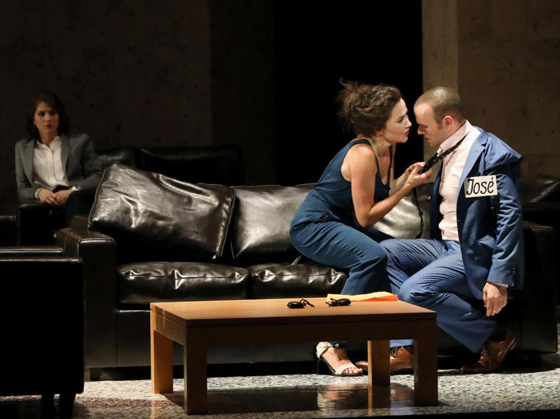 © Festival d'Ax -en-Provence Scene from the opera Carmen
Pinocchio commits a series of violations of the order of the human hostel: through the denial of study, undeserved enrichment, criminal plans ... As a result, he spends some time behind bars-even as a result of an unfair sentence-and returns to his father in order to become a real boy from Pinocchio. However, such social benevolence in the play of Busmans - Pore still implies cunning and mulezh (usually called "vital ingenation").
The short ascent of Tom Reikwell in the Faustian history of the "Dya adventure" ends with remorse and insanity. Even in Carmen Eras-Casado/Chernyakov, the central character becomes the killer of Don Hose.
No matter how different these criminals are, they are united by the stubbornness, with which they realize their provocative work. This feature rhymes completely different characters in the most unexpected way. Don Juan does not want to come to terms with the commander even at the cost of his life. Pinocchio stubbornly denies his poverty, when the bandits in the caps of the Ku-Kluks-clan promise not to kill if he recognizes it. Tom Reikwell goes to the very end, playing a hopeless card party with the devil Nick Shedow to win and go crazy.
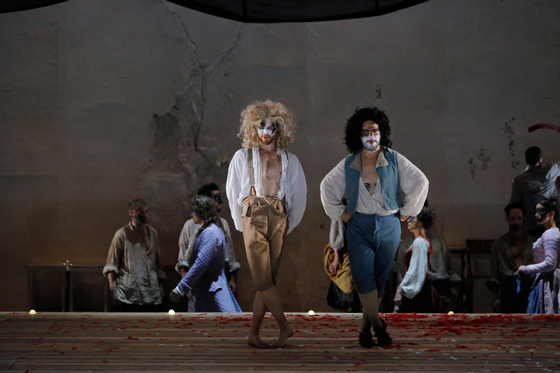 © Festival d'Ax -en-Provence scene from the opera Don Juan
The authors of all performances fundamentally avoid the assessments of this libertin-prisoner-canopy-revolutionary. And thereby create the most adequate conditions of perception, take the courage to leave the viewer alone with their doubts. The authors are not mistaken about the fate of these characters - they will never survive in this society, and the final moralizer ensembles in Don Zhuan and the Dya’s Adventures demonstrate it unequivocally. Even the unreasonable passion of “Don Hose” is inappropriate in the performance of Eras-Casado/Chernyakov. It causes only pity and neglect. In the final, no one except Michaela and Carmen pays any attention to Don Hose.
The second plot of the festival in the ex-en-prove this year was the theater in the theater. Realism or any attempt “as in life” is canceled. The scenography of Don Juan represents the theater scene with an open backstage, and the director instead of looking for argumentation of the actions and actions of his hero, he emphasizes their staging character. Pinocchio is played out as a street Shapito number with an appropriate clown aesthetics in makeup and costumes, a light partner based on local spots, and an orchestration using folk instruments. “Dyas adventures” are fully created using projections, gaps and tears on the snow -white surfaces of the paper cube, which is the scene. And Carmen completely turns into a role -playing game.
And this technique does not become the banality of “The whole world - theater” (although even the authors in materials for performances are saved by this now empty phrase). This is the statement of the theater as part of reality, as the conditions for the release of reality.
“Carmen” in this regard has become the most complete statement. But the “intervention” of reality to the theater - precisely due to the emphasis, stagnation, distance in relation to “life” - is persistently, almost cruelly. So the grotesque objects of the interior of Baba-Turkishka in the "Dyas adventures" break through the paper and stick out in pieces from all sides.
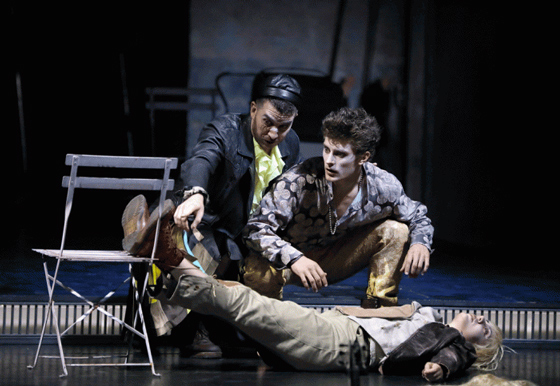 © Festival d'Ax -en-Provence scene from the opera Erismen
And one more common property - the festival allows you to evaluate the new quality of the opera artist, about the conservatism of which they love to talk so much. However, Rezhper uncompromisingly formulated new requirements for the singer. And the performances of the festival in the ex-envans of this year demonstrate such bodily involvement of opera soloists, which can already be called dance. Breke Jozefa Orlinski (in Erismen), the gymnastic tricks of Philip Slai (Don Juan), the dance stretching of Clue Brio (Pinocchio), fearlessness Stefani d'Ustrak (Carmen), jumping in heels along soft sofas, switch attention from the exceptional (or dominant) perception of the voice to the character with all of him bodily.
Purists will find a ton of reasons for claims - there is not enough breathing, microphones become a necessary condition for execution, the balance between soloists and the orchestra is a problem where you are not waiting, the pace changes. Of course, no one cancel the independent expressiveness of ideal performance. Nevertheless, new conditions create a fundamentally new experience in the audience perception. It is precisely the bodily extremity of modern stage existence that seems to be an important factor in the work for both heavy “stars” and for young performers. It becomes part of the search and the condition for professional adequacy.