
Translated material
Mental disorder as a way of cognition
We publish a summary of the discussion in the philosophical club "Vinzavod " about mental disorders as the resources of scientific and philosophical knowledge. Your beloved Samizdat learned that the philosopher Svetlana Bardina and psychologist Irina Sirotkin think about paranoia, apofenia and dissociation as cultural phenomena and how they propose to distinguish a philosopher from a madman.

Karl Yaspers had a patient whose medical history began in this way. At some point, he was very interested in Edmund Husserl, whom he appreciated for clarity and insight of thinking. After some period of passion for phenomenology, the young man realized that until he signs in his philosophical attitude to the world, he cannot do anything else. Soon he was disappointed in Husserl and was carried away by the problem of endless regression in causality. Then he switched to the position of skepticism. Yaspers describes the essence of his conversations with friends who came to visit him, after hospitalization: “I cannot affirm the truth of any proposal and even this proposal itself. It is pointless to talk with me and it’s pointless to think, unless I think in order to enjoy the process of thinking itself. ” Friends told him that, on the one hand, these thoughts seem to them irrefutable and logical and even cause some admiration, but on the other hand, the implementation of such a position is possible only in a crazy house. As Jaspers describes this moment, the patient is embarrassed, caught on and says: "Oh yes, I'm really in a crazy house."
This story poses several questions for us, some of which - "Is radical skepticism really possible only in a crazy house?" and "is there any connection between the enthusiasm of philosophy and progressive schizophrenia?" I don’t know if the coincidence, but I know several cases when the Husserl becomes at the early stage of the disease.
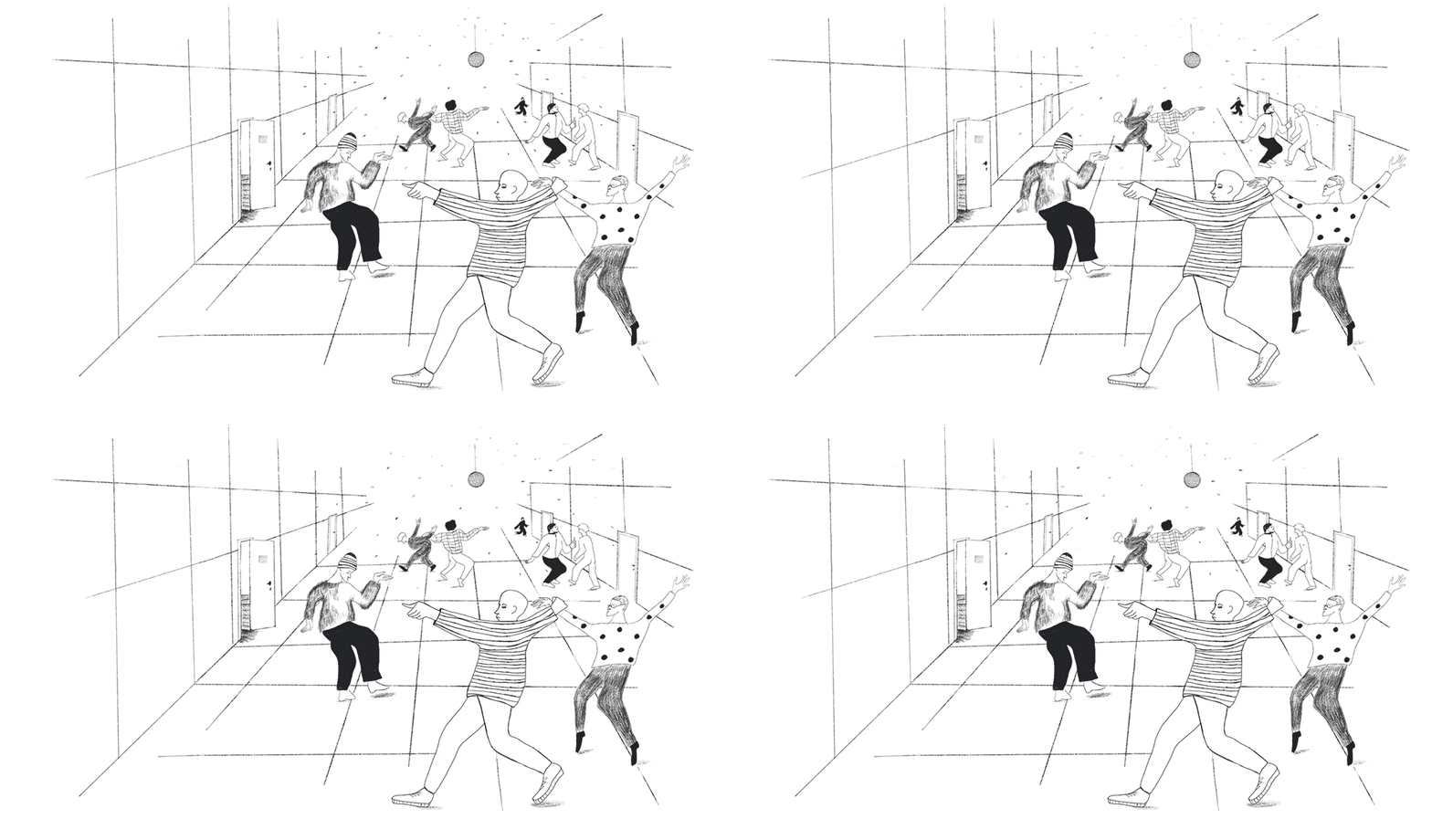
But in this story I am interested in something else. It shows that whatever the disease is, some content that manifest itself as a result of the disease give the impression of irrefutable and logical thoughts and can even cause intellectual admiration. And in this case, such thoughts were a radical doubt.
Today's event is also related to doubt: the reason for him was the exhibition “Shadows of doubt”, which took place several years ago. At this exhibition, artists tried to comprehend reality through the prism of doubt, suspicion and skepticism.
The ability to doubt that it seems undoubted to ask questions where no one does it, and, on the other hand, to make connections between phenomena for which the connection is not obvious is what characterizes the new theory - and on the other hand, a certain form of insanity. The parallel between a mental disorder and the generation of a new theory is quite banal. The idea of a genius of madness was repeated so many times that it is embarrassing to remember it. Of course, you should not understand this parallel literally - and not always, when we see a non -standard thinking person, we should suspect from him a diagnosis.
I will now try to show that in the case of some mental illness in order to understand what is happening, we need a metaphor for the scientific revolution. Then I will try to make a reverse transition and show that in order to understand some scientific studies, a comparison with a mental disorder will be useful to us.
Why the "scientific revolution"?
There are some group of mental disorders that are combined under the heading of Delusional Misidentification Syndromes . For example, this is a disorder in which a person believes that his reflection is a separate person with his subjectivity. Or when a person considers himself dead or sick deadly disease. The disorder that I will talk about now is Caprah syndrome . This is a disorder in which a person believes that his close friend, member of the family, or even his favorite cat is replaced by his double. And sometimes a person believes that he himself is replaced by a double and someone, completely similar to him, performs all sorts of bad actions.
So, take a specific case. The patient says that some aliens were replaced by his wife and says: "This is not my wife." How is this explained? The most banal version suggests that he has a hallucination and he makes an empirical mistake of perception . But further communication always shows that this is not so with visual perception of everything is in order. Another version that was very fashionable two decades ago was that the patient had a violation of emotional perception, he correctly reads visual information, but does not experience the emotions that should be experienced in relation to his wife. And, trying to explain this, he says that she was replaced. This also does not seem convincing, because, without experiencing warm feelings for his relative, replacing aliens is not what we will think about first.
It is possible to go the other way in the interpretation of this syndrome - not from perception, but from the meaning. Perhaps he is distorted by the perception of the meaning of the words, and when he says: “This is not my wife” is not a mistake, and he means something meaningful by this. And the next move, which he does, causes a distortion of the entire system of basic installations. What are "basic installations"? These are some of the undoubted reasons that every person has: the world exists, I am a person, I woke up today. They differ from ordinary facts, because in ordinary facts we can easily doubt and make mistakes, and if we begin to doubt that the world around us exists, this will lead to too serious consequences - and, in general, the entire system of our statements can be rebuilt as a result of this. Here the metaphor of the scientific revolution helps us a lot. Fortunately, more than half a century ago, some assumptions were put forward in the philosophy of science about how scientists work that can be applied to how the worldview of the mentally ill works.
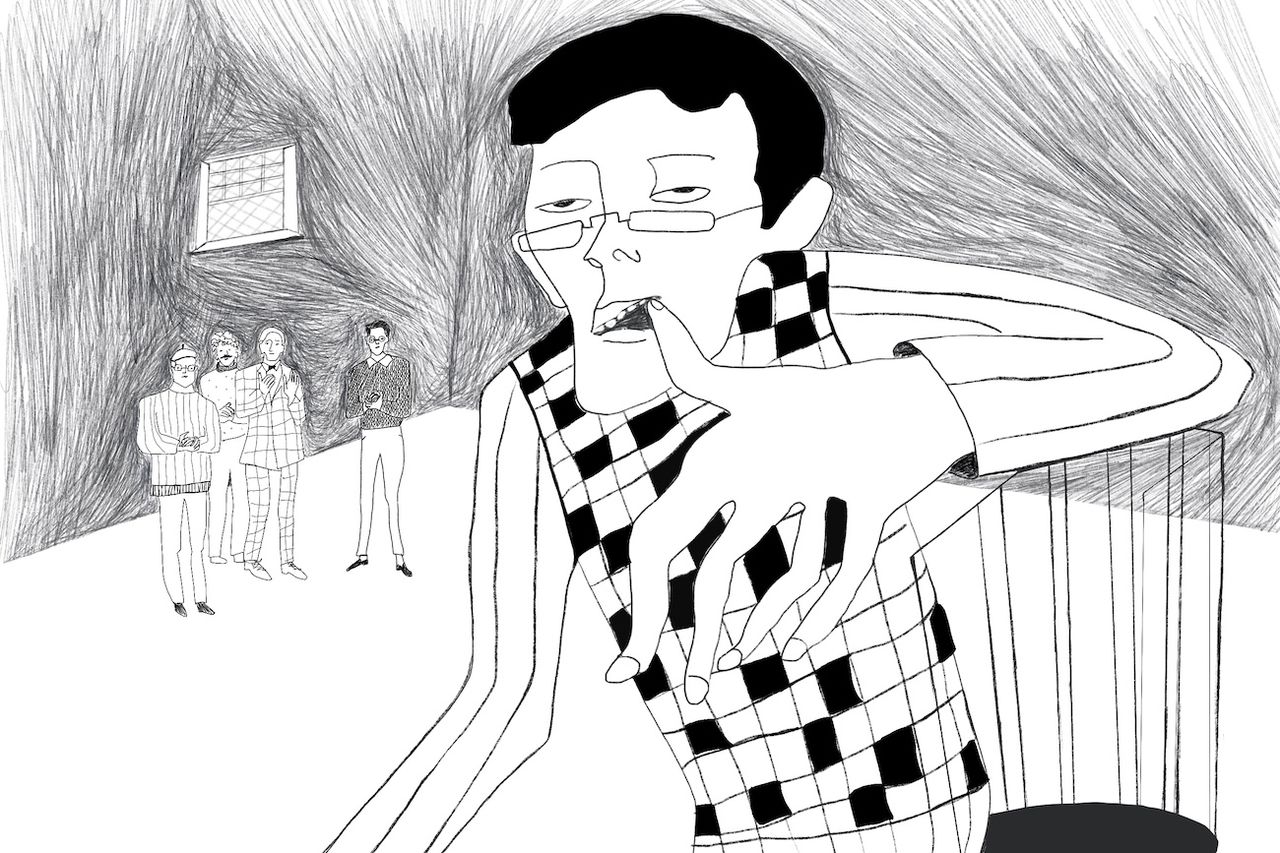
When a change in the paradigm occurs in science, then not specific sentences change, but samples and methodological attitudes change, according to which facts about the world are evaluated. And if we take the situation before and after changing these attitudes, then it cannot be said that some sentences are erroneous, they are simply irreducible . For example, the terms “mass” in relativistic physics and classical mechanics are irreducible to each other, and we cannot say that the sentences in classical mechanics are erroneous.
If we look from this position at what is happening with a patient with a captra syndrome, we will see that he has a peculiar change in the paradigm. He does not change specifically perception, but his system of attitudes and terms changes, with the help of which he evaluates, describes and sees the world. This metaphor is useful, but it has reservations. On the one hand - yes, this is a scientific revolution, but it is solipsist. Because the change of attitudes that occurs in the scientific community is extremely social: it occurs within the framework of the scientific community and is completely determined by these processes. The revolution that occurs in the world of a mentally ill occurs exclusively in his head. The second argument, which seems to me more important, is that the scientific revolution that occurs in the world of the patient with the Syndrome of Kapra is much more radical than any turn that took place in science.
The thing is that the basic true attitudes of scientific discipline are still basic and fundamental within the discipline itself. And this is understandable for any scientist, even for the one who is used to performing several decades research in a frame. Here, such beliefs fall into doubt that no one has to doubt. If we think about it, then phrases like “I have no double”, “I know that I am a living person” are phrases in which we, in principle, cannot doubt. But we cannot doubt them not because we have proved them many times, checked, because we have some kind of system that showed that this is true. But because if we begin to doubt them, we cannot continue to live normally, as before. Therefore, the scientific revolution that occurs inside the patient seems to me more fundamental and radical than any scientific discovery. But, perhaps, among scientific research we can distinguish no less radical than madness.
Critical sociology
Sociology is a good example, because sociologists themselves do not object to their activities to be compared with mental pathology. In particular, Luke of Boltanski writes that the real founder of sociology is Emil Creelin , a French psychiatrist who was diagnosed with paranoia . Why is this event so important?
Actually, Boltansky believes that this event has turned many branches of knowledge, not only psychiatry itself. First of all, it influenced the development of the detective genre, because when we try to create a convincing image of the detective investigating the crime, it should always be a little paranoid, it should be asked by questions and suspicions where normal people do not do this. Because if he asked questions and suspicions where it was normal, there would be no plot and intrigue tie. And Bolthansky assumes that in this sense there is no difference between a detective investigation and a sociological study. Moreover, he says that a sociologist can doubt not only as a detective, but also as a hero of a spy novel. He has such a wide register of suspicions. All of them see that behind the reality of our social interactions there is another, another reality that actually explains what is happening.
You could argue that any scientist sees some other reality behind events visible. But there is another feature, and it is not connected with paranoia, but with doubts in the basic installation and with the change of paradigm.
How does the work of a sociologist and a critical sociologist do?
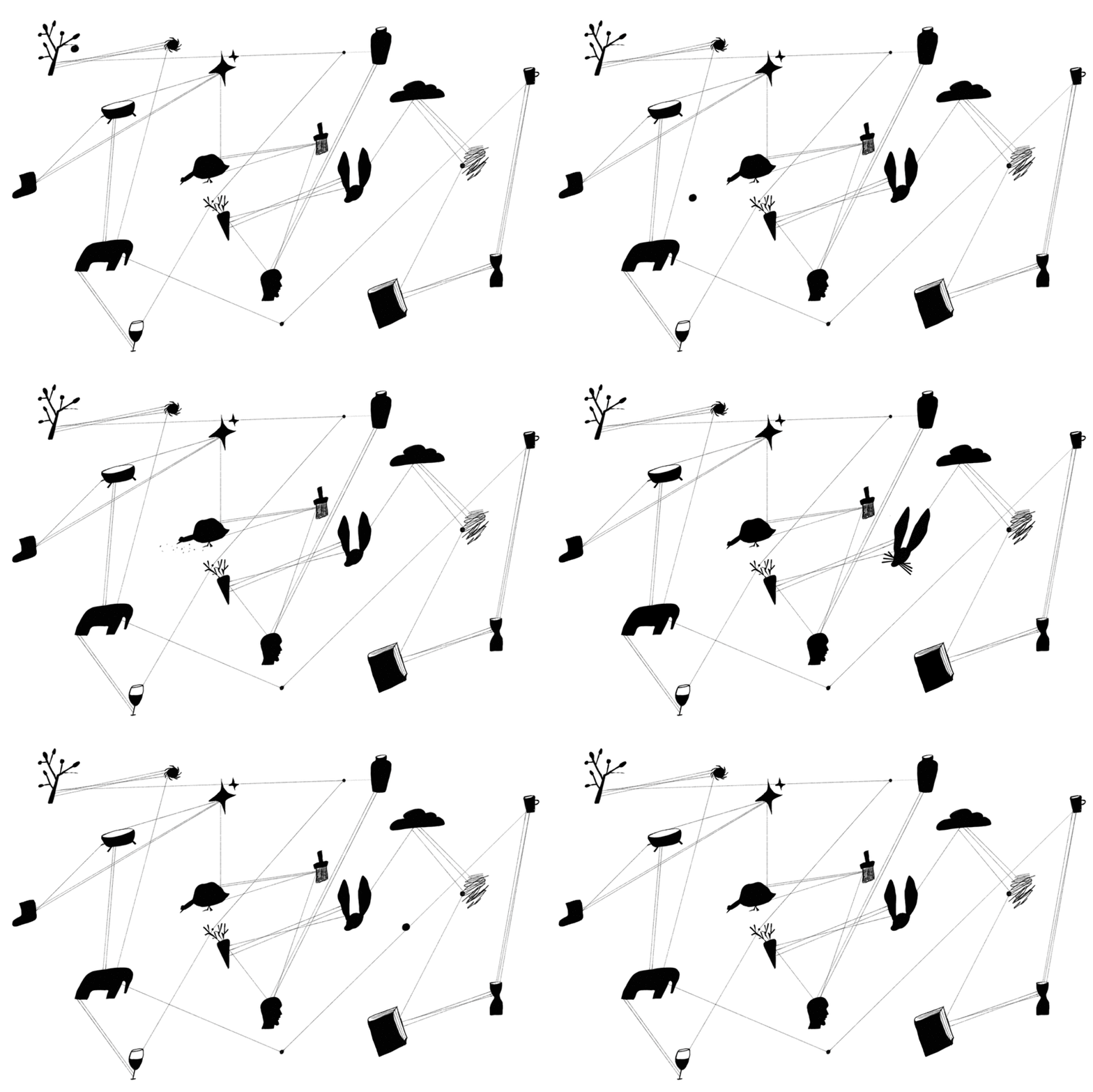
The sociologist is supposed to explain some phenomena of social life. But most of these phenomena do not represent a problem for anyone, so in order to be able to conduct such a study, you have to develop the ability to doubt that it seems undoubted, and ask suspicions. And the sociologist, having learned to see the problem where no one sees it, and ask doubts where no one doubts, can learn how to problematize reality and explain it through interests, classes, groups, fields and so on. There is another snag. If that is undoubted, which he begins to doubt, ceases to be undoubted for everyone else, this ceases to be the fact that should be exposed as a strange and explored. Therefore, such a researcher is in a paradoxical situation. In one case, he must doubt the undoubted, then to explore it later; On the other hand, he needs to hold him as undoubted, otherwise it will cease to be what we need to suspect and explore. In a sense, this madness is even more than the madness that occurs with the patient. The patient at least honestly goes to the end, he makes his solipsist change of paradigm and further pronounces statements that are convincing and logical in this picture of the world. But such a researcher of social life should exist in two paradigms. On the one hand, to consider something undoubted, granted, and on the other hand-strange, incomprehensible and requiring explanation. I think this is not the only example of a researcher who is in such a crazy situation. In principle, in the same situation, almost any psychoanalyst and, possibly, a phenomenologist who withstands a natural installation will be located.
In any case, when we have a scheme in which the researcher has to, on the one hand, doubt the undoubted, and on the other hand, to keep him, I think, this is an example of a scientific revolution within a discipline that worthy of the best samples of madness in terms of its fundamental and oddity.
Madness or method?
Returning to the patient of Karl Yaspers, it seems to me that the criterion for distinguishing between such a doubting patient of the psychiatry and the doubting philosopher Descartes is very simple and is hidden in history itself. Friends say to him: “The implementation of your position is possible only in a crazy house” - the keyword is “realization”. When we take a philosopher who practices a radical doubt, even if he, unlike Descartes, remains in the position of radical skepticism, he very well understands where his position can be realized. It can be implemented in a book, in an article, at a conference, in a discussion. But the patient thinks like this: “At first I will understand how everything works in this world from a philosophical position, and only then I will figure out how to live in this world.” The most sad or joyful in such situations is that the very position, which is associated with a mental disorder, but which is a philosophical, can be insanely logical and insanely interesting. But there is some confusion of contexts. And when a philosophical position begins to be realized so, it puts a certain limit between what can be a form of knowledge or ignorance. If skepticism is possible as a form of knowledge, then it is impossible as a form of life.
Roughly speaking, if you are a famous philosopher and teacher of the Swedish princess, then your radical doubts are rational. And if you are a patient of a psychiatric hospital, then how much do you radically doubt, you will still be a madman.
Each society has its own mental disorders and is what it excludes as crazy. Perhaps, in some societies, those philosophical positions, and not only philosophical - those delusional positions that are unambiguously disqualing in our country, seem more inscribed in life and allow us to find students. Perhaps then some other position, which now seems logical, impressed us, as it is now impressing the attempt to realize radical skepticism into life.
There was an anthropological study in which the researcher ended up in a community where everyone was paranoid. If you prepared food, then everyone stood and checked if the neighbor was walking to poison. If there was crop failure, then the neighbors were suspected, digging vegetables at night. And it was normal, everyone was used to living like that. The diagnosis of paranoia would not be made by them, because it was the norm of life. And in this village there was his local “fool”: he did not suspect anyone of anything.
Before the division into madmen and normal, to the moment that Foucault writes about, Diogenes lived in a barrel and was revered by a philosopher: today he would be arrested for vagrancy. We all know very well people who were, maybe, they are not as eloquent as Diogenes, but lived - holy fools. Vasily Blessed, who lived in a ditch on Red Square, was both crazy and a philosopher in one person. It was a time when wisdom spoke with the mouth of the madmen. There was Ivan Koreis, to whom all of Moscow gathered as an oracle and as a sage, a philosopher. In general, probably this continues now, and we - probably the rational part of society - are trying to ignore it. And wisdom, rational, irrational and madness are so intertwined that only very sophisticated philosophers like Descartes can separate one from the other.
The great man Norbert Wiener , the creator of cybernetics, said that there are two main strategies for clarifying the truth - this is a scientist’s strategy and a policeman strategy. A scientist who studies molecules understands that complex problems arise, but he does not consider the version that molecules deliberately mislead him. At the same time, as a policeman, he must constantly keep this opportunity in his head. And none of these strategies is wrong, they simply should be applied adequately. Because a scientist who should explore the molecules as a policeman will simply spend a lot of time in vain, and a policeman who will investigate the crime as a scientist may not investigate anything in fools.
Thanks to Vladimir Semenovich for a deep comment. In this song, he spoke about psychiatry as a whole and about our topic - conspiracy and paranoia, revealing the kinship of both.
I do not know if any of you was in a psychiatric hospital; Vysotsky, of course, was, and I spent one night there. I went to Vologda in the last century, and there was no hot water in the Vologda hotel. On the train, I met my classmate: I graduated from the mental hospital of Moscow State University, and she worked in the Vologda Psychiatric Hospital. Она сказала: «Ну зачем тебе останавливаться в гостинице, в которой горячей воды нет? Давай к нам, в сумасшедший дом, у нас там палата для невротиков на двоих, с телевизором, холодильником, горячей водой, душ». И так я попала в эту легендарную больницу, в которой работал когда-то Платон Васильевич Луначарский и его брат Анатолий Васильевич Луначарский. Тишина, сосновый бор на берегу реки. Мои впечатления совпали с впечатлениями Мишеля Фуко, когда он впервые пришёл в психиатрическую больницу.
Высоцкий и Фуко
Фуко тоже из нашей команды, он тоже там побывал, он побывал в знаменитой парижской больнице Святой Анны «Хопиталь Сантан», и меня тоже туда занесло, когда я собирала материалы по истории французской психиатрии. Фуко попал туда в двадцать два года после неудачной попытки самоубийства, отец наказал ему пойти и проконсультироваться с психиатром. Когда у него спрашивали, какие впечатления у него были в больнице, были ли так ужасны последствия, как он описывал в своей книге «История безумия в классическую эпоху», он говорит «Нет, там не было ужасно». В Святой Анне всё было тихо, санитарно-гигиенично, он не к тому готовился, когда туда шёл.
И, возможно, после этого родилась идея, которая стала центральной не только для «Истории безумия», главный тезис которой: «В современную эпоху безумцев заставили замолчать». Раньше в сумасшедшем доме было шумно, но весело, скажем, с юмором. Но после того как появились врачи-психиатры и медикаменты, прочие меры смирения и лечения, там стало очень тихо. И свою книгу Фуко начинает с описания того, как во время французской революции в сумасшедший дом зашёл один офицер. В этой больнице был прогрессивный врач, директор Филипп Бине, который расковал больных, они немного успокоились, перестали безумствовать. И французский офицер смотрит по сторонам и говорит: «Не вижу сумасшедших». Так вот Фуко начинает с этого свою книгу и говорит, что его гипотеза такова, что безумие стало частью этой медицинской системы.
Это не значит, что к безумию стали относиться гуманнее, это значит, что его стали подавлять и усмирять другими способами, более приемлемыми для модернистской ментальности. Из этого родилась центральная идея философии Фуко: идея власти и сопротивления этой власти.
Я хочу провести параллель между Фуко и Высоцким. С одной стороны, это апофения: случайное совпадение, между которыми человек ищет логическое основание — а я хочу доказать вам, что основания для этого есть, ведь Высоцкий и Фуко были современниками и умерли с разницей в четыре года. Фуко был старше, он родился в 1925 году, а Высоцкий — в 1938 году. И это сопоставление я могу провести на том основании, что оба были и философами, и перформерами.
Фуко с самой первой лекции, которую прочитал, стал любимцем публики. На его лекции собирались тысячи человек — столько парижан не собирались ни на одно интеллектуальное событие. Посмотрите на его артистизм, на его манеру держать микрофон, держать мысль, держать публику. Он был великим перформером, что, конечно, относится и к Высоцкому. Что интересно, Высоцкий и Фуко вполне могли бы встретиться, они могли бы встретиться в Париже, поскольку Высоцкий там был и записывался на радио France. Он был мужем Марины Влади, которая жила во Франции. Они могли встретиться в парижском бистро или они могли встретиться в Нью-Йорке, в котором Фуко тоже часто бывал в семидесятые годы, а Высоцкий там дал концерт. И, конечно, было бы интересно быть мухой на стене в этом кафе, где Фуко и Высоцкий вели бы свои беседы о безумии, или о власти, или о сопротивлении власти.
Я уже говорила, что Высоцкий был в психиатрической больнице, или Канатчиковой даче, или больнице Кащенко, или Алексеевской больнице, которой вернули её первоначальное название. И это совершенно безмятежное место, где ничто не нарушает покой посетителя. Там разбиты сады, есть музеи и библиотеки, и о существовании безумцев ничего не напоминает. Также есть у сиделок и нянечек такая установка, которую я слышала собственными ушами: «Когда дождь, мы на улицу никого не выпускаем, не то грязи нанесут». И это шокирует. И, конечно, Высоцкий это знал и отразил в своей песне, выдавая желаемое за действительное, описывая бунт в палате. Эта реальность была совсем другой. А какой была реальность, он пишет в другом стихотворении, «История болезни» — это огромная длинная баллада из трёх частей, в которой он реалистично описывает, что с ним происходило в Кащенко.
Я процитирую маленькое четверостишие, которое резонирует с книгой Фуко «Дисциплинировать и наказывать: рождение тюрьмы». Книга была опубликована в 1975 году, а в 1976 году Высоцкий пишет на основе своих впечатлений стихотворение «История болезни»: «Здесь не камера — палата, здесь не нары, а скамья; не подследственный, ребята, а исследуемый я». Но это метафорическое выражение того, что подследственный и исследуемый — одно и то же лицо, что это вещи одного порядка.
Мы можем дальше продолжать мою апофению, у Высоцкого и Фуко было гораздо больше общего, чем мы привыкли думать. Они любили секс, алкоголь, наркотики и гоночные машины: Фуко гонял по Парижу на «Ягуаре», а у Высоцкого был BMW, который далеко не у всех был в Москве. И обоих постигла ранняя смерть от излишеств.
Расстройство нашего времени
Карл Ясперс читал в 1914 году курс, посвящённый гениальным безумцам, и кроме Ван Гога и Стриндберга там были другие, например Сведенборг и Гёльдерлин. В заключении, которое называется « Шизофрения и культура нашего времени », он предполагает, что каждой эпохе свойственна своя форма душевной болезни. К этому времени представление о душевной болезни уже расслоилось, и Крепелин провёл идею, что душевные болезни, как и внутренние болезни, — не просто набор симптомов, а определённая нозологическая форма . Истерия — один диагноз, шизофрения — другой диагноз, маниакально-депрессивный синдром — третий, и каждый диагноз отвечает определённой эпохе. Ментальность восемнадцатого века была ментальностью истерии , говорит Ясперс. Истерия — это такая театральная форма безумия, Шарко много писал о своих больных, почти всем ставил диагноз «истерия». Яcперс считал, что постепенно истерия отошла в прошлое и на первый план вышла шизофрения , и он пишет почему: «В наше время болезнь не является коммуникативной средой, но она подготавливает почву для инкарнации отдельных исключительных возможностей».
Истерия — экстравертированная болезнь, она нацелена на коммуникацию, состоит из знаков, символов, театральных сцен, а шизофрения — интровертированная, аутичная. Аутизм — один из признаков шизофрении. И эта культура нашего времени, когда человек уходит в себя и главным его признаком становятся не театральность, не демонстративность, а интеллектуальные открытия и интуиция. И вот эти интеллектуальные интуиции свойственны, как считает Ясперс, великим шизофреникам. Не тем больным, которые превращаются в хроников, забытых, а тем, которым удаётся пробиться в культурное поле, как Стриндбергу.
Dissociation
Идея диссоциации личности появляется на рубеже девятнадцатого и двадцатого веков — диссоциация или схизма личности, раскол. Этот диагноз возникает периодически в разных культурных матрицах. Например, Пьер Жане, французский психолог, который ввёл понятие «психический автоматизм», любимое сюрреалистами, говорит: «Любовь — это патология», но он рассматривает любовь патологично, потому что любовь переходит в ненависть. Любовь и ненависть суть одно — очень сильный аффект. Или Мелани Кляйн, последовательница Фрейда и основательница собственной ветви психоанализа, говорит, что есть «хорошая» и «плохая» грудь. И что ребёнок, который относится к материнской груди иногда как к хорошей, иногда как к плохой, превращается в диссоциированную личность.
Диссоциативное расстройство может стать некой критикой или эмансипацией от своей идентичности с подключением множества ролей. Безумие может быть критикой в смысле протеста: безумие — это попытка не встраиваться в строй. Когда человек не может существовать в той реальности, которая его окружает, выход — сойти с ума (это перекликается с сюжетом про Канатчикову дачу, в которой мы видим политический протест, который тогда мог быть только в сумасшедшем доме).
Диссоциация как патологический синдром, по психопатологии, есть симптом шизофрении. Но есть диссоциация как множественность личностей, и кто бы из нас сейчас отказался иметь множественную личность? Психиатр Пьер Жане наблюдал за четырёхлетней девочкой, которая играла сама с собой и была сразу множеством разных личностей, и заволновался: неужели у неё начинается диссоциация? А потом написал: «Нельзя проецировать в душу ребёнка то, что мы приписываем больному шизофренией». Потому что есть ещё позитивные эффекты диссоциации, которые освобождают нас от обязательства иметь единственную идентичность, за которую нас могут ухватить и заставить выполнять какую-то одну роль.
Паранойя — матрица наших дней
Продолжая идеи Ясперса о том, что каждой эпохе свойственна своя ментальная матрица, своя патология, можно сказать, что паранойя — это матрица наших дней. Некоторые утверждают, что болезнь наших дней — маниакально-депрессивный психоз . Врач-психиатр Кей Джеймисон сама страдала МДП, ей становилось лучше или хуже, и в один из светлых периодов она отучилась на врача и написала книжку «Опалённая огнём», проводя ту же мысль , которую высказал Ясперс, — о том, что болезнь продуцирует некое озарение, некую интеллектуальную интуицию, которая является главной ценностью интеллектуальной культуры. Можно сказать и по-другому: что болезнь века — это паранойя, этим я бы хотела завершить выступление, что болезнь нашего века — всё же не апофения, а паранойя.
Склонность любить загадки и искать способы их разгадать тянется из древних времён. Паранойя как культурный ресурс — это любовь во всём видеть загадку или некий замысел, который может раскрыться. Паранойя — это вечная болезнь: если мы посмотрим вглубь истории в поисках психических болезней, то паранойя будет самой очевидной. В мифологии можно найти ранние параноические примеры в сюжетах о людях или божествах, подозревающих заговор и не находящих потом подтверждения этим мыслям. В истории изобилуют всевозможные теории заговоров, поиск козлов отпущения и так далее. И возможно, в двадцатом веке произошло освобождение паранойи. Если из всех форм странностей появились формы странностей, которые начали ассоциировать с шизофренией, то из всех форм подозрений появились формы подозрений, которые начали ассоциировать с паранойей. Паранойя не стала болезнью двадцатого века, а наоборот: только в двадцатом веке она стала болезнью.