
Translated material
Pogrom in Bayroit
The most symbolic and in many ways the absurd festival of Germany, Bayroit opened this year with the production of the opera Nuremberg Maysterezingers. It was a hotly expected and, in fact, pre -doomed to the media success of the debut on the legendary green hill of Barry Koski, artistic director of Berlin Komische Oper . Koski, whose ancestors emigrated to Australia from a Jewish place near Vitebsk, calls himself “ Gay , Jewish kangaroo " .
This gave an additional piquancy of the situation, given not only the sociocultural anti -Semitism of the founder of the festival Richard Wagner (which the composer shared with many key minds of his era), but also the time when the fan of Bayroit was Adolf Hitler. The Fuhrer was entered into the house of Wagner's descendants on the rights of a family member, the head of the festival and wife of the only son of the composer Vinifred Williams sent his personal friend Adolf when he was in prison for participating in a “beer coup”, the paper on which “my struggle” was written, the children called the Berlin’s Wolf Berlin, and in the neighboring one It was to the Nuremberg precisely under the pre-Major chords of the Maysterszgers that marched crowds on Reichsparteitagsgelände -the territory of the NSDAP congresses. In a word, all this is that you can’t throw out from the song - it is spilled in the fresh Franconic air.
On the eve of the premiere, Barry Koski talked a lot about the fact that the swastika and marching choir in gray uniforms in his production will not be excluded. There really was not. And this was what: each of the three acts of the opera as a separate performance put the Koski. Together they form a certain triptych on the theme of anti -Semitism, united by through characters, the main of which is the composer Richard Wagner (aka Hans ZakS) and his court conductor German Levy ( Alias Bekmeser) - the first performer of the Parsifal opera, whom the real Wagner long and unsuccessfully agitated to be baptized.
 © Bayreuther Festspiele / Enrico Nawrath
In these key parties, outstanding actors-singers Michael Faulle (Wagner-Zax) and Johannes-Martin Krenzle (Levi-Bekmeser) are employed. The latter is, in essence, the central figure of the performance, whose musical leadership was entrusted to the artistic director of the Paris Opera to Philip Yordan (elegant, transparently, with an abundance of meaningful general pauses).
In the royal bed of Bayroit, somewhere between the angel Merkel and the Swedish royal couple, Bimer was installed, who at the beginning of each scene designed specific coordinates of the scene. So, already at the beginning of the overture on the stage, not only the identified Villa Vanfrida immediately appeared with its ultra -bourgeois interior, but also an indication for the time: “August 13, 1875, 12:45, the outer temperature is 23 degrees Celsius.” The owner of the house, Wagner, returns from a walk with his two black Newfoundlands Molly and the brand, whose offspring still lives with other Wagnerians (they say that these descendants entered the stage). Love for dogs is a little that unconditionally unites the director of Koski with the composer Wagner: the directorial cocker nicknamed Blumpfeld was registered on a green hill for rehearsals.
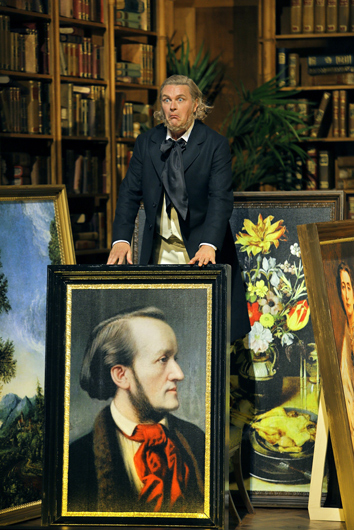
At home, Wagner-Zax discoves the wife of Kozim. Madame lies in chairs with migraine. Guests gather for tea, among them - the father of Kozima Franz Liszt and conductor German Levy. The best remedy for migraine is art. And Wagner hastily organizes one of his famous home performances. Give, of course, the "Nuremberg Maysterszgers." The roles are distributed, the suffering Kozima is Eve, one of the maids - Magdalen, Franz Liszt willingly try on the luxurious mantle of Feit Pogner, the golden affairs of the master. The dropper Levy Wagner literally forces, despite his desperate resistance, to accept the role of Bekmeser.
 © Bayreuther Festspiele / Enrico Nawrath
Since this staff is not enough, from the womb of the piano, on which the sheet and Wagner are improvised in four hands, it crawls out - so to speak, is born from the spirit of music - still heels of cloned Wagners aged to a child to a mature husband, all as one - in black velvet berets. The young embodiment of the composer turns out to be David (Daniel Bele), mature-heroic-Walter von Stolzing (Klaus Florian Fogt). The lush costumes of the Renaissance era get from the closet, and the performance is gaining move, rushing through all the events of the first act with a dashing tributary, without leaving the walls of Villa Vanfrid. The abbot leaf and the artistic-pure Wagner put the educated Levy in an awkward position, making it a participant in the family worship. He will not understand when you need to kneel when you get up.
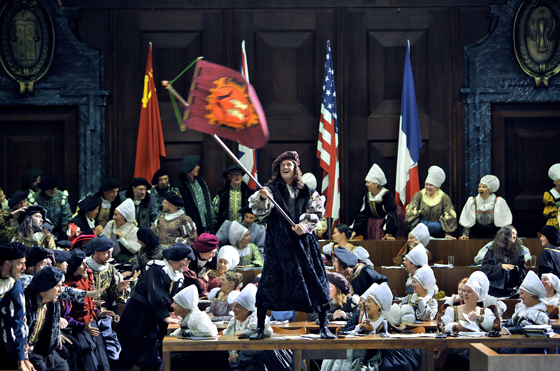
The exaggerated, opera character is perfectly fed to the music of the first action - it is no coincidence that Wagner when working on the Maysterszgers took into account the experience of Albert Lortzing, who wrote the popular Zingshpil “Gans ZakS” for the same plot. And only at the very end, the festival audience, who is having fun with the heart, is slightly silent when the salon with its funny characters leaves, like a doll house, in the depths of the stage, and the no less identified interior of the hall number 600 of the Nuremberg Palace of Justice, where processes over many former former Bayraitsky departments have been manifested in the right and right, manifests itself. festival.
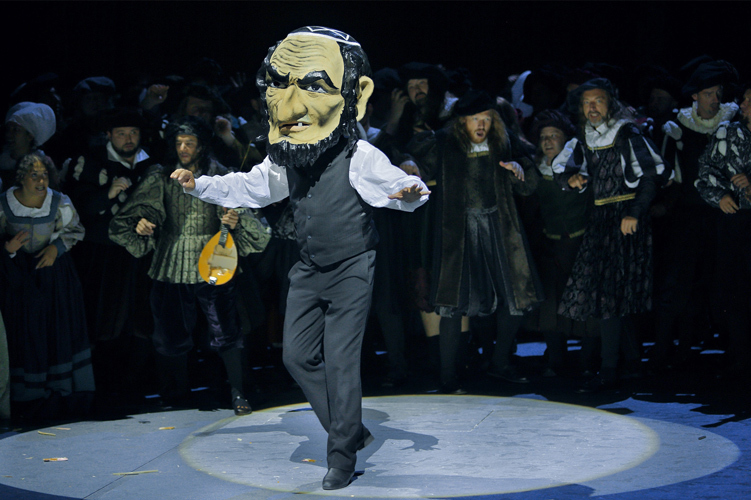
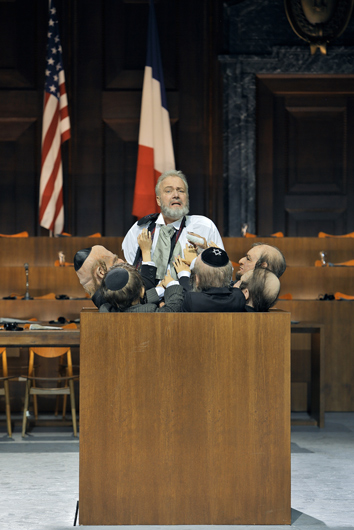
In the second action, the initial slapstick is overturning to the eerie absurd theater: the residents of Nuremberg in picturesque Durerov costumes (Klaus Brunes) beat Bekmeser under the portrait of Wagner and glue him with a hypertrophied head from papier-mash with an anti-Semitic caricature from the newspaper Schromovik. Bekmeser-Levy dancing the likeness of Freilehs under the major tulle of the Wagnerian orchestra, an eight-meter balloon with the same caricature swells over the court department. Hans ZakS, aka Wagner, looks at what is happening without interfering.
 © Bayreuther Festspiele / Enrico Nawrath
The third act is in fact, the trial of Wagner and its music. The accusation is charged with each of the opera scenes so complicated for modern, especially German, from the shoe monologue about the madness of the world to the march of brave German artisans and the notorious reasoning of Wagner-Zax about the essence of pure German art. In the finale itself, the choir and orchestra appear on stage in modern dark evening suits. Wagner-Zax conducts the final choir. Then everything disappears, and the master is on the forefront in complete solitude - in his legendary black beret. The music triumphantly proclaims an acquittal, directing is silent.
The easiest way would be to expose the very brilliant from the director’s, as the reading of Barry Koski as a result of unrequited love from the conjunctural point of view: the Koski does not tire of emphasizing that Wagner, the alchemist of his “first opera drug”, is disgusting to him as a character in European history. But there is no doubt something else: firstly, the colorful shabash of this production is, of course, a cleansing character and facilitates the dialogue with the “Maysterszgers” for the audience and future interpreters, and secondly, it also draws cosques with a touching portrait of Wagoman-Egoman, artist, genius.
What is the scene of delivery to the composer of silk, perfume and elegant shoes from Paris (all this is historical truth, Wagner spoke about all these pink peignoirs and puffs for van as “a way to cultivate his precious sensuality”) or a touching quote from Kosima’s diary, which had just escaped to Wagner from the legitimate husband, vonis Bulova: ““ Nothing in the world can be nicer than our room, because my lovely neighbor lives next to me, ”R. says. Then he comes closer to me and says: “Look: in bed lies a melody! And quite large. You are my melody!” ”(Now we know where the plagiarism of subsequent eras drew inspiration!). And Kozima really was a rather large “melody” - a cut above his beloved “r.” ...
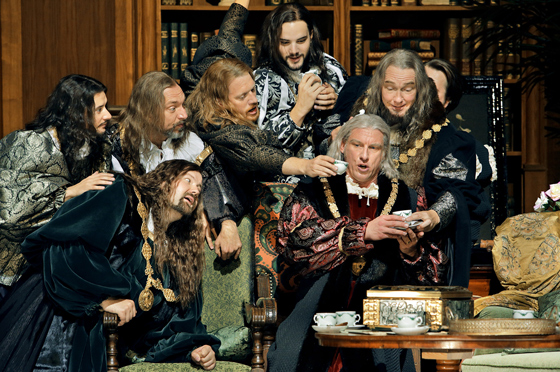 © Bayreuther Festspiele / Enrico Nawrath
The twenty -minute ovation at the end (with separate “boo” addressed to the unsuccessful Eve - Anna Shnevilms) became unnecessary proof: the work of Koski is exactly what the “doctor prescribed” to the modern Bayroit. These “Maysterszingers” are dramaticly fit into the general concept of a qualitatively new Wagner festival, where the Bayroit Symposium “Discourse“ Bayroit ”” is held in parallel with the priesthood on the green hill, in which the leading intellectuals of Germany discuss the fate of this mystical place in different, including complex, segments of history.
In parallel, there is a new consolidation of the scattered clan of the descendants of Wagner, in the hands of which the festival is still concentrated (at least symbolic). For the lack of its own windzers, Germany was accustomed for decades to savor the brawls between the two branches of this family - the descendants of the two grandchildren of the composer, Viland and Wolfgang Wagner. Viland Wagner, a victim of a painful schizophrenic role of the Crown Prince Hitler and the creator of New Bayroit after the war, died in 1966 at the age of only 49 years. After that, his family was, in fact, expelled from Bayroit to his native Uncle Wolfgang and has since unsuccessfully fights for participation in the family heritage.
Only this year there was a certain consensus: the opening of the festival was preceded by a solemn act dedicated to the centenary of the birth of Viland Wagner. In FestSpilhaus - an unheard of fact for Bayroit! -Sounded Verdi and Berg, and the son of Viland, the exile of Wolf-Zigfried, climbed the stage and, like that titurel, turned into the darkness of the hall: “Katarina, are you ready?” "Yes!" - Resolutely came back to him. That was his cousin Katarina Wagner, the great -granddaughter of the composer and the current leader of the festival in Bayroit. Her burden is heavy.