
Translated material
The case of Dmitry Bogatov

A graduate of the Mehmat Moscow State University, a teacher of mathematics, programmer Dmitry Bogatov is accused of calling for terrorist activities and riots. He spent more than three months in the Moscow pre -trial detention center, is now under house arrest. He faces up to 19 years in prison. This case shows both the work of the bureaucratic machine of the investigation and the court, and the characteristics of the attitude of universities to any activity that is contrary to the line of state power. About this - an article by Alexandra Zapolskaya , graduates of Moscow State University.
Signatures - the trustee
On July 18, 2017, the administration of the President of the Russian Federation was transferred to Vladimir Putin in defense of Dmitry Bogatov with signatures of one and a half thousand students, employees and graduates of Moscow State University. The appeal says that the graduate of Moscow State University Dmitry Bogatov is mistakenly pursued, and the exceptional weakness of the basis of the accusation is emphasized: the coincidence of Dmitry IP addresses and the unknown author of posts calling for illegal actions. The document is addressed to Vladimir Putin as the chairman of the Board of Trustees of Moscow State University and Viktor Sadovnich as the rector of Moscow State University (the last signature was taken the day earlier). A week after the transfer of Bogatov’s signatures, they unexpectedly released from the pre -trial detention center under house arrest. This can be considered as a concession made under the pressure of the public by the investigating authorities, but the charges themselves are valid. The very logic of this accusation may have serious consequences for Russian Internet users.
The case of Dmitry Bogatov
The reasons for the broad resonance of the case at Moscow State University and beyond the borders lies, in my opinion, in the phenomenal absurdity of this story. A graduate of Moscow State University, a teacher of mathematics and programming by MFUA D. Bogatov, is essentially accused of the fact that he is the author of posts with calls for violent actions that were published on the Sysadmins.ru forum under the pseudonym "Ayrat Bashirov" on March 29, 2017.
The investigation found that the posts were sent from hundreds of IP addresses. One of them is the IP address of Dmitry Bogatov [1]. On this (and only on this) it was detained on April 6. On April 10, the court decided to arrest the young man for two months, and twice the court extended the preventive measure. Why, out of a hundred IP addresses, the investigation became interested in the IP address of Bogatov, it does not explain. Mystery. I can only state that from the address of the address received by the Moscow investigator, only the address of Bogatov was also Moscow. Users from Japan or Podolsk for some reason are uninteresting.
How is it possible that a certain “Ayrat Bashirov” writes from hundreds of different addresses? This is possible if the user, wanting to remain anonymous, writes a message through the Tor browser. A chain of three randomly selected nodes is built between the user and the site, on which there are appropriate software (there are now about 7 thousand in the world [2]). The site “sees” the IP address of the latter in the server chain, the outlet node of the network. Keeping the network node is not a crime under Russian legislation. So, the programmer D. Bogatov held at home the output node of the Tor network, so his IP address was displayed as one of the IP addresses of Ayrat Bashirov. How long does the investigation take to figure out that Dmitry had such a software on the computer?
The Tor Project is a non -profit organization founded in Massachusetts. It is financially supported by a variety of organizations (including human rights, private and government). The nodes of the network (both the weekend and intermediate) are selflessly held by enthusiasts, who, as a rule, are supporters of the free Internet and consider it an important possibility of anonymous use of sites protected from surveillance (including organized by advertising agencies). In practice, this means that a certain software is placed on your computer or on a rented server. This does not carry any special domestic inconvenience, but there is an opinion that holding the output node at home is a risky business.
Time goes on, the charge is not removed. I was at two court sessions and became a witness to how the level of absurdity is growing. Alinibi Dmitry was already confirmed: at the time of sending his messages, he was not at home, he was in the gym and in the store, which can be seen on the records of surveillance cameras. The defense pointed out that the form and content of posts (written with errors, call for violence) contradict the version of the authorship of Dmitry. Bogatov writes without errors (as evidenced by a 40-page correspondence with his wife), does not accept violence (he, in particular, a vegetarian), appreciates mutual understanding and peaceful dialogue (he is an escarantor). But for three months he was not released even under house arrest.
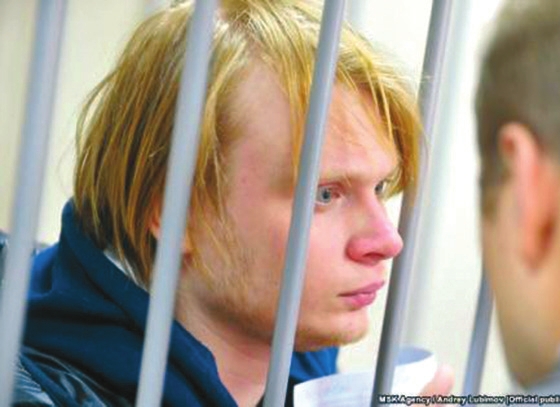 The argument for leaving in the pre -trial detention center was fears that Dmitry could affect investigative measures. The latter are in the examination of computers seized in the apartment. How exactly could Dmitry influence this? Another riddle.
As an explanation, why the examination is still not ready, the prosecution replied that Dmitry on the computer is “not the programs that we are used to.” As the assistant professor of Moscow State University, Andrei Stolyarov, noted in one of the issues of his video blog, commenting on Bogatov’s business: “Our organs, it seems, do not know how to grind their teeth. That is, if they clung to someone, then everything ” [4]. I can't disagree. When on July 21 it became known that the investigation came up with a petition for replacing the Bogatov preventive measure, surprise almost blocked joy. Since July 24, Dmitry has been under house arrest, which will last at least until August 31. The mitigation of a preventive measure can be considered as a reaction to a loud public campaign. It is important to understand that such a move is often done when the party has an intention to achieve conditional condemnation.
Reflection of the realities of university life in the case of Bogatov
The case of Dmitry Bogatov managed to almost impossible - to show us how the investigation and the court work and surprise us living in Russia in 2017. In addition, the history of the teacher sheds some light on what is happening in universities: MFUA, where the employer’s attitude to the accused manifested itself, and Moscow State University, where both solidarity with the graduate and her fear were manifested.
MFUA, where D. Bogatov taught since 2014, in response to a request from the investigation stated that the contract with him ended in February 2017. How this could happen, Dmitry himself does not understand-for three consecutive years with him they concluded a civil contract on the provision of educational services for a period of year (until August 31). At the moment, the situation for me looks like this: MFUA simply terminated the contract retroactively when clouds thickened over the employee.
It is impossible to understand violation of labor rights when the employee is in jail. However, the very fact that the teacher was not a labor, but a civil law contract, has a very specific interpretation. “Work on the maintenance of training sessions is certainly a labor function. Part 2 of Article 15 of the Labor Code of the Russian Federation directly prohibits the “conclusion of civil law contracts that actually regulate labor relations between the employee and the employer,” Pavel Kudyukin, co-chair of the university solidarity trade union, commented on the situation. That is, in the MFUA there is a doubtful practice in Russian universities in Russian universities.
At Moscow State University, several noticeable attempts were made to help a graduate of Mehmat. I would explain such solidarity primarily by the presence of associations at the University of Associations, ready for collective actions. In particular, the initiative group of students, graduate students and employees of Moscow State University from time to time initiates mobilization on socially significant issues or helps some initiatives at Moscow State University with its resources (information and human). The last role, in my opinion, was played by the fact that Bogatova’s wife, ready to publicly defend her husband, also a graduate of Moscow State University (Tatyana Fedorova graduated from the biological faculty).
Of course, the cohesion of the Faculty of Mechanics and Mathematics is also important. So, the Mehmat Student Council at his meeting in May voted to turn to the rector with a request to help in the Bogatov case. This appeal was assigned to the rector on May 23, but the answer to it has not yet been received. However, on the same day, the chairman of the Studs council Ilya Denisov ran into an unexpected reaction of vice -rector Vladimir Podolsky (student and co -author Viktor Sadovnichy). He gave a comment from which he followed that he considers the gust of the Studs council with stupidity, which would never allow himself student (and Komsomol) organizations of the mechanized mechanic's last decades. He also annoyed the inconsistency: the Studs council is engaged in a “political” matter, while recently he opposed politics at the university. (I believe that he had in mind the protest of the Mehmat Studs Council against the Vesna rally-concert at the MSU walls, which was held on March 18, 2017, on the “Crimean Reunification Day with Russia.” It is known that Podolsky contributed to this concert [3].)
Members of the Mehmat Studio Council proposed to the Studs council of Moscow State University and Studs Soviets of other faculties to support the appeal in the case of Bogatov. However, according to the stories of eyewitnesses who attended the meeting of the student self -government body, Vice -Rector Vladimir Marchenko “neutralized” the discussion with the words that the initiator of the proposal cannot be convinced of Bogatov’s innocence by 100%, and the requirement of a competent investigation is redundant. Those who collected signatures under the appeal to the garden and Putin at the bottom of the physicist (a festival traditionally passing on the site in front of the building of the Physics Faculty) also told about attempts to supplant solidarity with the Bogatovs from the university. Members of the organizing committee of the Day of Physics told collectors that the holiday was “outside the policy”, and asked them to go beyond the territory of the event. The organizers were afraid that the faculty and the holiday might have problems. This almost did not interfere with collecting signatures, the collection continued nearby. True, I still had the question of the nature of self -censorship and fears of members of an official student organization.
The next time the “boundaries of permitted solidarity” were tested on June 16: the Mehmat Student Council announced that on June 19, as part of the International Solidarity Day with Bogatov, he would collect signatures in the room of the Studs council from 10 a.m. to 20 pm. The collection of signatures there was episodically before that, but not all day and without a wide notification. This time, the initiative group of Moscow State University on its information resources called on everyone who is related to Moscow State University, to come and put signatures (including graduates who can go to the Moscow State University’s buildings upon presentation of a diploma and passport).
The next day, Igor Molodtsov, the chairman of the Mehmat Stad Council by phone, called the deputy dealer on educational work and demanded not to arrange a collection of signatures. Both hints of possible problems from the chairman himself and the threat to take away his room from the Studs Council of Mehmat. Having weighed all the pros and cons, the Studs council decided not to carry out the collection in his room, to publicize the situation and support the collection of signatures that students and graduates sympathizing with Bogatov decided to conduct in another place.
Participants in the initiative group proposed to hold a gathering on the ground floor of the main building, in a round lobby with shops and buffet tables, which was still nicknamed the “puck” in the zero. (In the 1990s, political discussions were conducted in this lobby, and the place was known as a “guide park.”) Having organized a change of duty officers, students and graduates collected signatures “on their feet” all day. (As a graduate, I also participated in this.)
The collectors decided that they would not approach themselves in the lobby and initiate a conversation, but they would only silently wait for those who, knowing about the assembly, are suitable for themselves. In the social network, they would throw a cry as much as possible to everyone in Moscow State University about the collection of signatures on the Workshop. With informing, everything turned out even too well: about noon, police officers approached the collectors and reported that they received a call “On the announcements hanging on the main building of the Moscow State University”. The police expressed the opinion that it was impossible to collect signatures at the university, and they suggested "going to the police department to go to the objections of collectors." (True, it would most likely have not had to go anywhere, since the police department is right in the main building of the Moscow State University.) The district police officer who came up later recognized some participants in the initiative group, was convinced that the order was not violated, and advised the police to leave.
The collection of signatures continued. Not only students, but also employees, teachers and professor approached the subscribing. Many graduates were not too lazy. A significant number of signatures appeared thanks to the efforts of enthusiasts who collected them in their hostel or in the training group before and after June 19. So 1544 “living” signatures were collected in a variety of ways, which were transferred to V. Sadovnich and V. Putin in July. Together with the transfer of signatures, single pickets were carried out.

Solidarity is relevant and needed
Supporting D. Bogatov, people from around the world publish photos with the hashtag #freebogatov. Edward Snowden and Julian Assange, Pirate Parties of Germany, Spain, Iceland, Norway, Brazil and Russia, the TEJO International Solidarity and Discourse, Left Bloc and Amnesty International, spoke out in defense of Dmitry.
The expression of solidarity with Dmitry Bogatov does not lose relevance. I am afraid that today growing public attention is almost the only real chance to save a person who has become a hostage to the errors of the investigation, career appetites growing on the affairs of “mass riots”, and the lack of an independent court. If the charges are not removed and the verdict is accusatory, then we will enter into reality, where the coincidence of IP addresses will serve as a sufficient argument for landing. This is precisely the bet in this struggle, so the public exposure of the absurdity of the accusation of Bogatov is still necessary.
Alexandra Zapolskaya
2. Https://metrics.torproject.org/networkSize.html
3. Http://infoviolence.org/en/vblog/v720View/infoviolence_008.mp4