
Translated material
District number 9
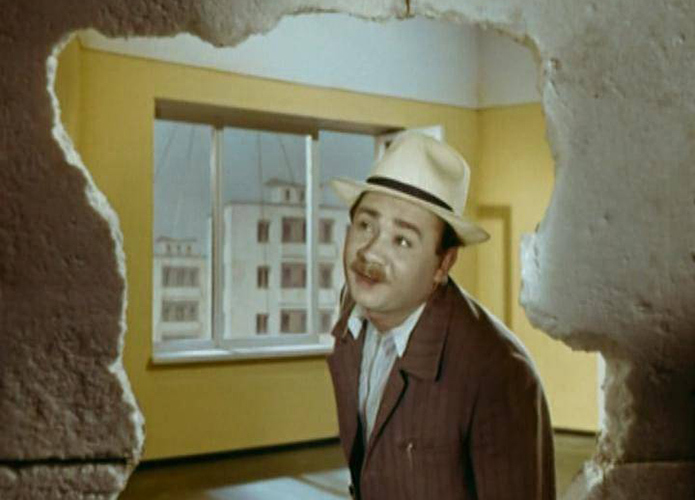
The third film screening of the program “Cinema through the eyes of an engineer”: the film version of the operetta Shostakovich “Moscow, Cherryshki”, set by Herbert Rappapart, will be shown on August 6 directly in the courtyard of the 9th experimental microdistrict of new cherries (with a 35-mm film!). Before the film is a tour of the reference area of typical development of the late 50s (just do not forget to register for the show and excursion ).
"Cherries" (1962)
Director Herbert Rappaport
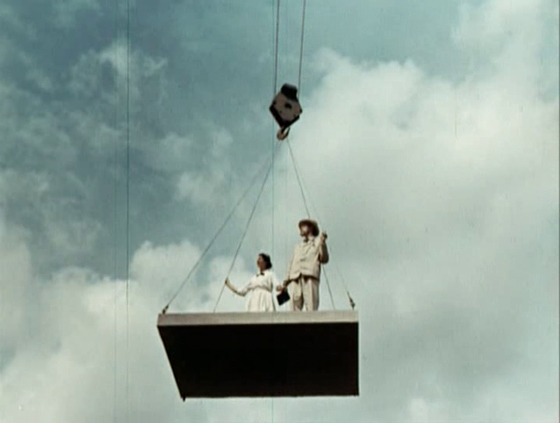
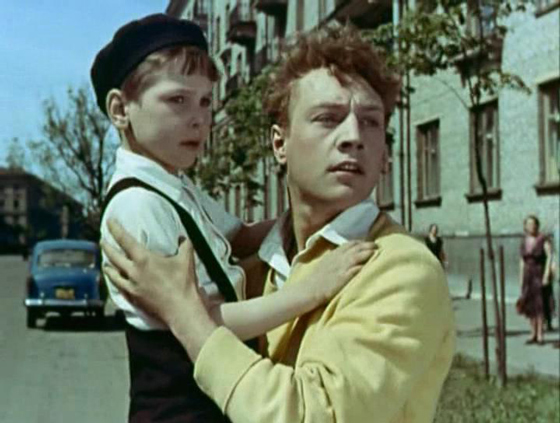
Museum employee Lidochka has long been ready to meet someone special, but so far she is not very lucky. The ironic shock Boris is also not averse to connecting himself with relations, but there is no one with. Sasha and Masha got married, but they can’t get fucked up - nowhere. The driver Sergei cannot confess the love of Lus to the crane, and all their joint walks end with pessimistic reasoning in the spirit that love is like a flower, and flowers are quite quickly wither. Comrade Dreednev, the head of the trust, married a young girl and is now trying to increase his living space by capturing someone else's apartment. All this happens against the background of the construction of a new area in Cheremushki, where residents of emergency houses in the center of Moscow should move.
Operetta Dmitry Shostakovich “Moscow, Cheremushki” was initially excellent comedy material, quite comparable to Ninochka Lyubich. The cold -handed Lidochka admitted: "I have not yet forgotten the name of rivers and mountains, where to put a comma, where not to put a comma, what is the current force ... But I live lonely." The entrepreneurial Boris declared himself a relic of capitalism and, through witty intrigues, entered into the struggle for Lidochkin an apartment, which, with the help of a thievesous administration, tried to assign himself a comrade Drandynev. In the music, quotes and curtains sounded: from the "fried chicken" to the "anti -formalistic Raik".
 © Lenfilm
Herbert Rappiport strengthened the strengths of the operetta, making the film on its basis completely beautiful and crazy. The rapport was generally the most successful candidate to transfer this comedic material to the screen. A native of Vienna, a fan of Malera and a assistant to Pabst, who managed to work in Berlin, Paris and Hollywood, he moved to the Soviet Union in the mid-30s to put anti-fascist cinema (however, with varying success: his famous “Professor Mamlock” was removed from the rental almost immediately after the exit-the USSR signed the Molotov-Ribbentrop Pact with Germany, and condemn From the screen of the atrocities of the Nazis, it became somehow inconvenient). Although it did not really work out with political paintings, the rapport actively put light comedies and music films, marked with some kind of elegant grace for the Soviet tradition (in addition, at the very beginning of the 30s, he managed to work with Chaliapin on the filming of the film “Don Quixote”).
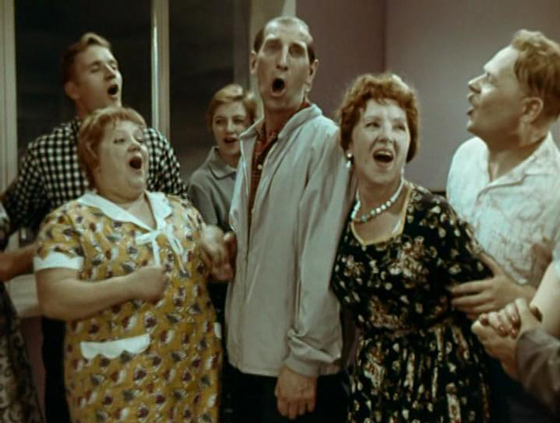
The “cherries” became one of the peaks of his work. There is everything in them: sudden explosions, flights of heroes in love, “birdhouses”, turning into block houses, and sharp, unexpected installation. This comedy of square meters does not seem to be some Soviet archaic with virtuous workers, joyful songs about the harvest and a duty to the party. On the contrary, the heroes of the film seemed to come from the classic Viennese operettes, and the problems facing the heroes are an encyclopedia of modern Moscow wisdom. In the "Cheryomushki" everything is extremely businesslike. Not wanting to get on the bus, cars are called here, they calculate how many apartments in the new housing complexes can be obtained for a three -year -old in the center, they dream of getting their own housing to call friends there and arrange discos. Young Muscovites from the Soviet past are too much like modern hipsters, and the new area itself, whose plan is put on public display in the museum, is more like a cluster of block houses, known to each resident of sleeping areas, but the Zaryadye Park is all strange, unusual and brilliant. The problems that the heroes face are a mugal with real estate, the seizure of apartments and a link to some acts and documents-also as if from today's news releases.
 © Lenfilm
At the very beginning of the film, a sunsid voice reports that cherries are not Moscow, cherries are a future. And the voice is right. Although now, 55 years after the release of the film, those, once new, areas will most likely sweep the renovation program, their inhabitants will also move to new houses, begin to get acquainted, fall in love, quarrel, and the plot of the “Cheremushki” will again be relevant. After all, it is not so much about a particular area in the film as a legend. Cheremushki is a myth. And myths live forever.
Experimental 9th quarter of new cherries
The point of reference of mass typical development in the USSR can be considered Khrushchev’s decree “On Eliminating Excesses in Design and Construction” - it was the compactness of forms and components that became the main feature of the Khrushchevs that caused the irony of contemporaries and the rage of current inhabitants of these close apartments.
It was necessary to solve the post -war problem of lack of housing on a large scale - only in Moscow it was necessary to build 65 million square meters in 20 years. The special architectural and design bureau under the leadership of Nathan Osterman was instructed to develop a project of typical housing development. The project required intensive development of technologies, since there was no industrial base for such construction in the USSR.
 © Lenfilm
The experiment of the Osterman team was that the entire quarter was designed as a single organism: residential buildings, schools, kindergartens, shops, cinemas, service enterprises and interdomema spaces with garages and molds; Residential complex in the modern sense. Even before the order “On the Development of Housing in the USSR” of 1957, a review of the best projects of residential complexes was held, where the project of the 9th experimental district of the new Cheryomushki received the first prize of the state building. Thus, the task of the district was to confirm the functional viability of the project. Therefore, in the 9th district, 14 typical models of buildings were tried, which mainly had four sections, but structurally different from each other in technology and materials-block, brick, panel, with different roofs, the division of facades and planning apartments.
The unifying principle was the savings - square meters, construction time and budget. Based on the experience of European colleagues, Soviet architects calculated the minimum necessary space for humans - 9 sq.m. One house was built on average in 12 days, and the entire quarter was built in 22 months. Almost immediately, the Crocodile magazine began to release caricatures ironic over the quality of new housing.
Nevertheless, the experiment in new bird cherries demonstrated that the mass development area can be not only functional, but also attractive: palisades, pools, a diverse decor of facades and courtyards. Architects and builders began to drive architects and builders to the exemplary area to teach how to build new housing. So the bird cherries bloomed first in Moscow, and then throughout the USSR.