
Translated material
"It's hard to forgive when you are all in chocolate"
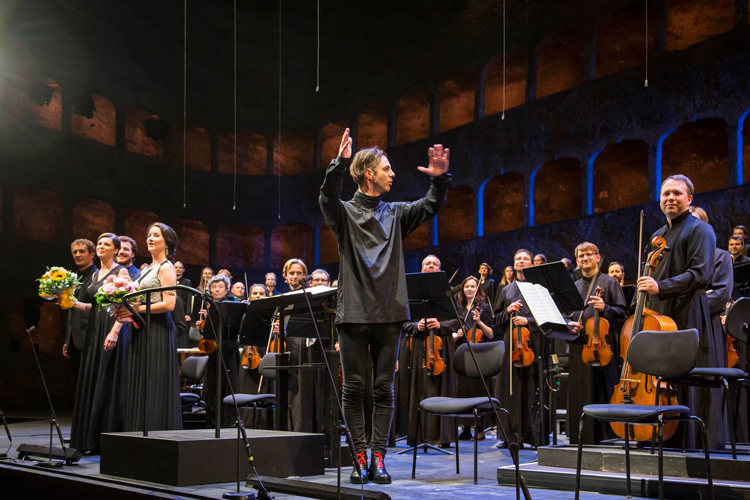
Theodore Krentzis with his orchestra and chorus Musicaeterna became the sensation of the current Salzburg festival. To say that the Permians conquered the stiff, bonton, still very conservative Salzburg public is to say nothing. Standing ovations - after the evening and night concerts, which actually opened on July 23 a concert program of Salzburg. Spontaneous, like a rolled wave, standing ovation - after the premiere of "Mercy Titus" in Felzenraitshul. The hall welcomed not only the conductor, but also the triumphantly returning to the festival of Peter Selhars, who is remembered here from the productions of the Francis of the Assisian Messian and the first opera of Kaya Sarariho at the distance.
It rarely happens that the debutants became the headliners in Salzburg, at the very status European festival. In this sense, Marcus Kh Integoizer, the current artistic director of the festival, risked great - but as a result, they won everything. The saturated audience received the ensemble unique in their timbre characteristics; The Kh Interchoiser once again proved that he is free from the pressure of the Salzburg-Vensky elite, that his musician taste is unmistakable, and the flair on talents is still acute and true.
Kurentzis himself tastes the first fruits of world glory. In his artistic, managers, director of orchestras and theaters are constantly crowded; According to him, tempting sentences fell on him like from a cornucopia.
- For the first time you performed in Salzburg about five years ago - it was in the winter at the Mozartwoche festival : then you gave your first concert in the FestSpilhaus, with Viennese philharmonicns. Probably now Salzburg seemed to you completely different? After all, you have been preparing here a premiere and concert programs for a month now?
- I am very good here; I love Salzburg. Especially in winter, when there are no tourists: in winter it is very quiet and calm here. When I performed here with the orchestra of the Camerat Salzburg, only a local audience was sitting in the hall. This city has a special atmosphere - and it acts on me very much.
I am pleased that from this year the festival is headed by Marcus Kh Integodser; He activated the spirit of progress here, and we all hope that with him the Salzburg festival will become much more interesting.
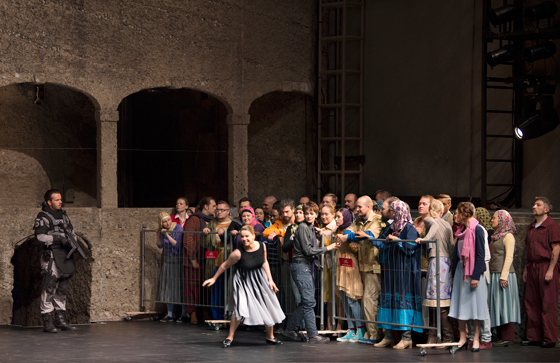 © Salzburger Festspiele / Ruth Walz Scene from the opera "Mercy Titus"
- For your evening concert, where Mozart was performed, you chose the Felzenraitshule hall. Why?
- This is a place charged with special energy. In essence, this is not a concert hall, but a cave; It smells there like in a cave or temple, but for me it is important. Therefore, we chose this site for the production of Titus - a huge scene without curtains, but with natural scenery: rough stone walls, galleries. For the play that Peter Selars invented, and the scenery is not needed. Therefore, the scene is almost empty: periodically, some columns of transparent or smoked concrete slabs with holes from shells grow from hatches. In general, Felsenraitshule is definitely magical: there are no windows, stone arches are crushing, you feel that you are inside the cliff.
- The audience listened very carefully: at first warily, but then more and more penetrating the intimate intonation of execution. It was probably scary to play in Salzburg Mozart? Here, after all, hundreds of interpretations of the details from outstanding conductors heard! Moreover, you proposed not quite conventional performance: on historical instruments, and even with inserts from Urtecst ...
-Firstly, I prepared a requiem as a slide show, designing every beat. My task was to identify the pure linearity of the letter, to trace where and how each vote is conducted, what is combined with. Requiem is polyphonic music; Mozart, composing it, was under the strong influence of Bakho Polyphony. And I needed to build such a balance in the choir and orchestra that each voice was heard absolutely distinctly and, moreover, carried a certain function - especially in the fugue. We carried out a complex, painstaking work so that the continuous line of each voice was heard perfectly.
Secondly, we tried to reconstruct an old Salzburg sound. Here, even before Mozart, there were orchestras at the court of the archbishop. The famous violinist and composer Heinrich Ignat von Bieber lived and worked here - it was he who wrote the grandiose Salzburg Mass for 53 votes, which Mozart could not know. So the traditions of church music in Salzburg were laid as Bieber. In the court orchestra, thrombones and poethorn were sounded - tools that, by the way, were very fond of Masons.
We searched for a special sacred sound in Requiem, so that it would resonate with the atmosphere of local churches and cathedrals. And it was important for us to reconstruct that already forgotten Salzburg sound. So that the Requiem is perceived as an intimate dialogue of man with God. After all, Requiem is a man of man to God and the answer of God to man. And in the structure of the mourning mass, various aspects of this dialogue are presented.
We included in the score of the first eight bars of Lacrimosa , which were written by the hand of Mozart himself: he already felt the approach of death when he wrote him. And we played these eight beats as they were written: without a bass, without harmony - only a melody. And then they began to play what Zyusmeier wrote.
After Lacrimosa, Mozart planned to put a fugue on a chant the words of Amen . In principle, the sketches of this fugue are preserved.
- Where did you get sketches?
- From the archive. And then, after fuggage fragments, we start offrtorium - domine Jesu , Hostias and further.
Imagine - night, rain is scrapping, and suddenly people in black appear in the square, walk along the street and sing Amen.
- In your opinion, is the difference between the parts written by Mozart and the parts that Zyusmeier wrote?
- If you take your own works of Zyusmeier, then they are quite mediocre in music. But what he wrote for the Requiem is quite worthy of the first, original parts. Maybe because Zyusmeier prescribed a requiem with the blessing of Mozart himself. Or maybe he was so shocked by the death of the teacher that this shock for a moment brought him closer to the genius of Mozart; Maybe he had an insight. In a strange way, the last parts of the Requiem are filled with a genuine Mozart spirit - even BeneDictus and Agnus Dei ; But these parts are completely, from beginning to end, composed by Zyusmeer. There is nothing from Mozart, not a single note. Moreover, the latest parts are well combined with the whole; The complete feeling is created that this is Mozart's music.
- At a night concert in the collegiums, you continued the theme of death, after the fifteenth quartet Shostakovich spoke “a concert for the choir to the poems of Grigor Narekatsi” by Schnitka.
-Yes, it seems to me that in these essays differently, but the internal struggle of a person, passing the line between this world-and topics, is captured. The moment when a person is transformed, the transition to other being. This is a heavy struggle, and it is felt very strongly with Shostakovich, and in Schnittka, and Mozart.
“Do you think this is a struggle?” I will hear something else in these works: fluctuations, doubts, the creative fear of a person in front of a fatal threshold - and an attempt to look behind this threshold in black. This is such a question about death: a person is trying to understand, estimate, somehow realize, look there ...
- When you move to the border and see that death is approaching, you experience a particularly strong tension. And the artists feel it very sharply, instinctively. This is a feeling of emptiness, almost minimalistic, which is in the fifteenth quartet of Shostakovich - and inside there the block is huge and crazy tension. A young man would never have written such music; And Shostakovich himself at the age of thirty could not have been able to write. Only a person who was already close to the last line could write this.
- And this quartet in Collegiankirche sounded especially appropriate - here is another mystical space. However, there are many such places. In this city, not everything is so simple ...
- Yes, this is Salzburg. By the way, I advise you to go to the house-museum of George Trukl, the great Austrian poet; He is very close, in one quarter from here. These people created the aura of Salzburg: Bieber, Mozart, Trud.
- The night concert in the collegialskirch ended unusually: the choir, continuing to sing Amen , went down the podium and, flowing out the hall from two sides, went to the exit, went to the square. The audience at first sat quietly, but when your voices began to silent in the distance, she stirred: people did not know whether to go home or wait a little more ... And then you started to return.
- Yes, we made such a procession around the church. But the most interesting was outside. Imagine - night, rain is scrapping, and suddenly people in black appear in the square, walk along the street and sing Amen . There everyone raised to the balconies, passers -by stopped. Probably thought that we were ghosts.
Yes, the final of the concert turned out to be spectacular. However, about the moving sound - Stokhausen has a lot of this. But he, in turn, borrowed this moving sound from the traditions of Byzantine church singing.
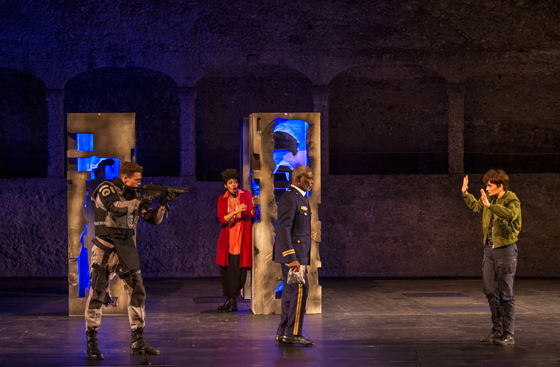 © Salzburger Festspiele / Ruth Walz Scene from the opera "Mercy Titus"
“But let's talk about“ Titus mercy ”. What can you say about the opera, about the production?
- This music was intended, let's say, for the inauguration of Donald Trump (laughs) . Mozart wrote it for coronation celebrations: in Prague, the coronation ceremony of the Austrian Emperor Leopold I was supposed to be held in Prague. And several Prague aesthetes, which very respected Mozart after the production of his “Don Juan”, found the Libretto Metastasio; It was a junk written fifty years ago. Mozart - a revolutionary, a free Mason - the topic of exalting and glorification of the supreme power was, of course, completely uninteresting. After all, the Masons were carriers of a free spirit, they sought to create a society in Europe, based on equality and fraternity, to abolish kings, absolutist power. Their ideas eventually led to revolutions in Europe.
In addition, Mozart was not interested in the shape of the opera-series: by that time he had already written a trilogy on the libretto and Ponte and worked with might and main on the composition of the first magical German opera-the “magic flute”. But he was paid two and a half times more than usual - and Mozart’s financial affairs were in a deplorable state at that time. And he agreed - the work was urgent, it was necessary to have time to write the opera almost in two weeks.
Nevertheless, even on such material, Mozart managed to find some radical solutions. For example, in the final of the first act, a crowd of rebels set fire to the emperor’s palace, but Titus is saved from the attempt. Mozart decided to make such a finale in which Titus is absent on the stage, and sent it at that moment to drink champagne. Metastasio did not have this. Then, already in the second act, Titus comes out and sings the aria “ Che Orror ! Che Tradimento ! ” - “What a horror! What a betrayal! " The emperor and empress, present at the premiere in Prague, were in shock. They leave the box, and Empress Sofia - she was an Italian - exclaims: “ Porceria Tedesca ! " ("German lead!").
Now I will tell you what we did with Sellars. If we imagine that Mozart is alive and with us, I think, he would not want a pompous production. And we made the performance very strict and minimalistic to emphasize Mozart’s personal statement.
Emperor Titus, when he was still a general, destroyed Jerusalem, destroyed the Jerusalem Temple and brutally suppressed the Jewish uprising. After that, Titus arranged a show in Rome - the triumphal procession, as was customary. And in the process of this procession, he showed how he arranged the largest genocide in Jews. Titus created the secret police in Rome, who watched everyone. That is, he was a man who committed a lot of crimes. But at the same time, he was madly in love with the Jewish princess Berenik. It is written in the Talmud (and this is still being read in yeshivas) that after Titus treated the Jews and destroyed the temple, Jehovah sent a worm, and this worm climbed into his head and ate his brain. And indeed: Titus died shortly after the accession.
So what happened to Titus? He, like the Apostle Paul, was first an enemy of Christianity, but then changed strikingly. He had a love disappointment. When there was a great eruption of Vesuvius and thousands of Romans suffered, he gave personal money to support the unfortunate. When the plague came to Rome, he allocated money for the construction of hospitals. That is, from the monster, he turned into a virtuous, compassionate person. This is Clemenza - mercy.
In our performance, all the Romans are blacks, and all refugees are white -skinned.
Peter Sellar and I staged a performance as a story of a man who waged a fighter war, ruined the country. Refugees from it appeared in Rome. Tit gives them a shelter, money for arrangement - at this moment, gold ingots are taken out onto the stage. He even finds Sextus and his sister Servilia in a crowd of refugees, finds Vitelly - the daughter of one of the previous emperors of Rome - and says: we will live together. That is, he creates a family with them.
Vitelly persuades Sesst to commit a terrorist attack - to kill the emperor. And here we include Adagio and Fugu in the opera score to transfer this moment to a certain higher spiritual dimension. And we also turn on pieces from the pre-Minor Mass. Because of this, the opera is somewhat lengthened.
Sextus is preparing for a terrorist attack - exactly according to the libretto. But Titus notices this - and he specially goes ahead of Sexst, as if giving him the opportunity to choose. Sex, who worships Titus as his benefactor, almost a father, hesitates. Nevertheless, he, like a weapon, is charged with Vitelly to kill - and he shoots at Titus. Titus is mortally wounded.
The second act begins with Kyrie Eleison - we see people with candles and flowers, they carry them to the place of attack. Tit dies in the hospital - but before his death he says goodbye to everyone and forgives everyone. In the finale, he sings in despair: "Turn off, oh eternal gods, cut off my days." And he himself breaks off all sorts of medical tubes, falls out of bed - and dies in torment. Because he cannot survive the betrayal of those whom he considered his relatives.
The opera with the sound of the Masons Mozart, the text of which we transferred to Hebrew ends. And the ghosts of all the Jews killed by him pass by the dead Titus and surround his body, enclosing in a living circle. So the performance ends.
- That is, the plot was redone?
- Not redone at all. Yes, Titus was wounded at the end of the first act, and then he dies the entire second act. Only this is the difference. Sellars just needed a stronger motivation to explain why Titus forgives everyone. It is difficult to forgive when you are all in chocolate, when you are well -being. And when a person understands that he is no longer a tenant, then there is a reassessment of values. This is a very subtle job. Peter Sellars and I, when we work, verify everything very carefully - all the motives of behavior, all movements are literally up to a centimeter.
- And the choir showed himself remarkably at the premiere ...
- There is no second such choir in the world; All this is said. Here no one can do this as our choir: to sing like that and play like that.
Yes, I also wanted to add: in our performance, all the Romans are blacks. Tita sings Russel Thomas. Publi - Willard White. And Annia is Zhanin de Bick. And all refugees are white -skinned. Such a detail.
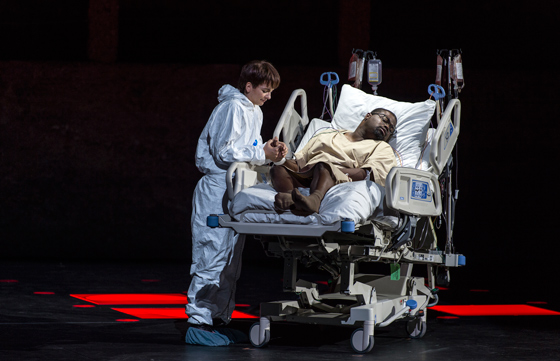 © Salzburger Festspiele / Ruth Walz Scene from the opera "Mercy Titus"
- You have a crowd of people in artistic after each performance. This, of course, is in the traditions of Salzburg, but you just have some endless stream of people. Who comes to you?
- Well, different people: artists, soloists. Just here Zordi Saval came in. Matthias Gerne was, Marcus Kh Interkhoizer ...
- This is understandable, of course. But I noticed a lot of serious people at your door in good costumes: in appearance - directors or large managers. Were they received interesting offers from them?
- Of course, a bunch of proposals.
“And you can ask which ones?”
-Well, many suggest leading opera theaters or some teams.
- But you just agreed to head the united Stuttgart orchestra ...
- Yes, I have a contract with them for three years.
- Honestly, I have not heard about this orchestra before, until I found out about him in connection with you.
- They connected two orchestras. One is the former Bouleza orchestra, he was considered the best orchestra of modern music in the world, constantly performed at the festival in Donaueshingen, played almost all the world's world premieres. In different years, they were led by Hans of Rosbaud, then Pierre Bulez, Ernest Bur, Michael Gilen, Hans Center performed with him.
And the other is a symphony orchestra of a more academic plan; Julini, Norrington worked with him. Now both orchestras have united, and a huge composition turned out: 160 people with completely different experience and repertoire. To make them a single team, you will have to work a lot. I was asked to conduct trainings with them, find the sound of an orchestra.