
Translated material
Alexander Aseev: The problem of Mongolia can be solved in the paradigm of cooperation, and not the "war of sovereignty" for water resources
In Ulan-Ude, the Baikal International Forum was held as a section of the world's natural heritage: 20 years later ", and within its framework-the scientific and practical conference of the same name. The forum participants stated: after the launch of the FC “Protection of Lake Baikal and the socio-economic development of the Baikal natural territory for 2012–2020”, much changed for the better. On the SB RAS website, commentary on the results of the forum gave the chairman of the Siberian department, academician of the Russian Academy of Sciences, Alexander Aseev.
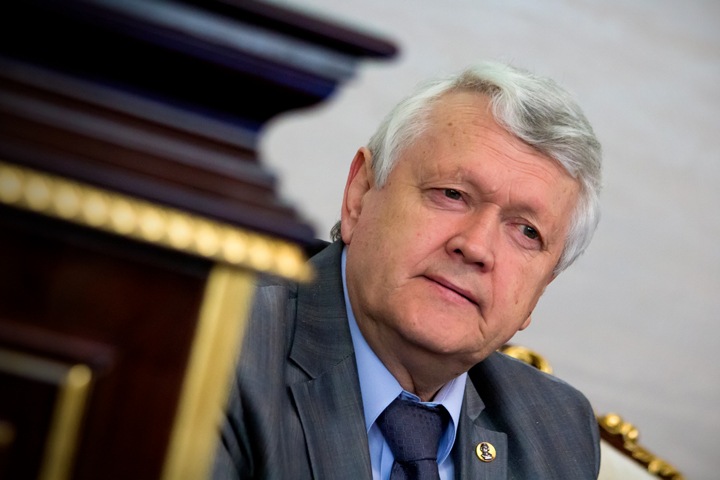
According to him, in the framework of the FCP, “treatment facilities were built, roads were laid, the shores visited by tourists have become more equipped and civilized. The main recreational zones received a new look - for example, the “Baikal Harbor” in the former village of Lesozemeuvikov Turk. ”
“But at the same time, the anthropogenic load on the lake that increases every year is an alarm. Thanks to the roads and universal motorization on the coastline are whole caravans of cars, with the numbers of regions from St. Petersburg to Vladivostok (there are fewer inaccessible sections of the Baikal coast). We will add to this the influx of foreign tourists - first of all, from China and Mongolia, ”the academician distinguishes the problem.
At the same time, in his opinion, “a problem area is an incredible number of large and small prohibitions arising from the FCP, laws and regulatory acts for the protection of Lake Baikal. In the coastal zone, it is not allowed to harvest firewood and drown them, make skins, bake bread - everything that can even in the slightest degree can negatively affect the environmental situation. But in our country, as you know, prohibitions give rise to violations and loopholes: poaching has spread on Lake Baikal, and the forest in order to get firewood, in many cases, at first they deliberately set fire to - the burners are permissible to chop on the furnace. ”
The protection of Baikal and the influx of tourism are not supported by the economic basis, environmentally friendly energy and infrastructure development, the scientist notes. “In Russia, there is no need to talk about the social responsibility of business, with rare exceptions, and the real sector of the Economics of the Baikal territories has not come out of a depressive state,” Aseev states.
He is sure that "the Baikal region, due to its international status, the public and the influx of tourists, has become the center of attraction - but has not yet been formed as a development center." And budgetary funds should be directed to scientific research in two global areas directly related to Baikal - planetary climatic changes and complex dynamic modeling of the lake biosystem.
“We will not get a holistic picture if we separately study the spread of the spirogira, the degradation of the colonies of the Baikal sponge, the fluctuations of the number of omul and the like,” says Alexander Aseev. “Accordingly, the conduct of large -scale interdisciplinary research requires additional resources for the development of the Buryat and Irkutsk Scientific Centers SB RAS - primarily for the purchase of modern equipment and the deployment of expedition work.”
Academician Aseev and “International Collisions” raised, generated by the intentions of Mongolia to build a cascade of hydroelectric power stations in the Selengi basin, which gives about 50% of the flow of water in the “Holy Sea”. Why the scientist in this case operates on the term “cascade”, although in the case of Mongolia it is a day of hydroelectric power stations on different rivers, it is not clear - but this mistake, in principle, can be forgiven.
“The level of [Baikal], in connection with global climatic changes, and so decreases to critical marks, the intersection of which can, accordingly, reduce the drain of the hangar and complicate the work of the powerful hydroelectric power stations located in Russia. Scientists <...> offer alternative solutions to the global level. Mongolia actually needs electricity, but Russian generation offers too high price per kilowatts much exceeding cost. The problem of an adjacent country can be solved at a cross -border level, based on the cooperation paradigm, and not the “war of sovereignty” for water resources. Moreover, the New President of the Academy of Sciences of Mongolia, Academician Duger Ragdal, who was present at the forum, is a classic-scientist aimed at cooperation with Russia and, specifically, with the Siberian Branch of the Russian Academy of Sciences, ”said Alexander Aseev.