
Translated material
The smell of a kid
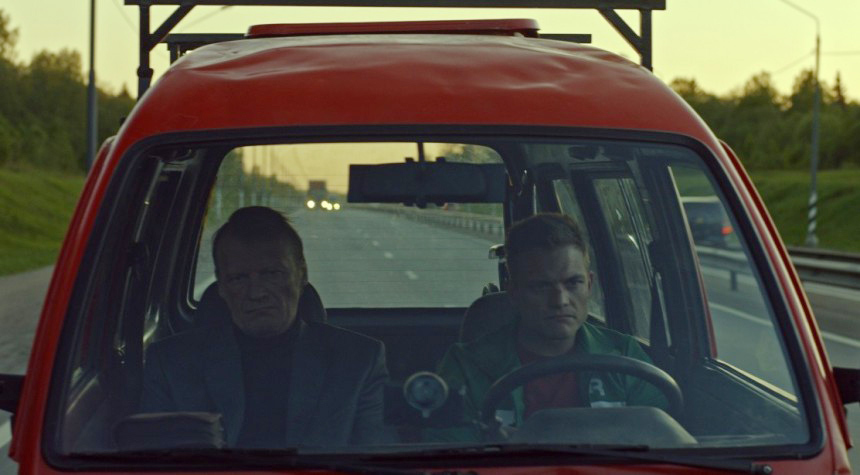
At the window “Window to Europe” was held by the Russian premiere of the amazing film by the graduate of the workshop of Karen Shakhnazarov, shot under the supervision of the director of VGIK Vladimir Malyshev (before that the picture was taken by the main prize of the program of the Karlovarian festival “East from the West”). Ivan Chuvilyaev - about why Vitka Garlic has nothing to do with other Russian cinema - both official and independent.
The debutant Alexander Hunt works with a completely canonical plot of Road Muy. Vitka Garlic (Evgeny Tkachuk), a kid from the province, finds out that he has a dad. Threatened by Urka, paralytic (Alexei Serebryakov). If you hand it to a boarding school, you can enter Papkin Hatu. So you need to take it. In general, all as many times before - two morons, the road, knowing the white light. But where the plot retelling usually ends, Hunt begins the most interesting. After all, Russian cinema is usually prone to playing with mythologems: father and son, road, troopian bird, state house. But Hunt has nothing of this! Dad remains a prisoner, the son of a gopnik, the road is a highway, a thieves' hut - a hut with Radio Chanson. No subject goes beyond the boundaries of its domestic measurement. This simplestness becomes the most winning feature of the "pin". The film breaks beyond the boundaries of the generally accepted metropolitan reflection on the rotten hinterland, dry and reproduced standard of Russian cinema. Hunt, a native of Siberia, is completely devoid of all kinds of metropolitan complexes. For him, a murdered hospital, a large road, a state house - only nature, and not the opportunity to cry about the dying homeland. Even from the Road Muy genre, in which the story of enlightenment and comprehension of simple joys of life is tightly sewn, Hunt diligently evaporates all the esoteric contents. Only the plot mesh remains: met, went, ran into adventures.
 © "VGIK-DeBET"
A lot of things in the film are clearly borrowed from those authors who like Hunt. Without afraid of accusations of eclecticism and bad taste, Hunt falls in a bunch of the obvious Balabanov and Fargo, Seven Psychopaths (they are quoted just directly) and “Boomer”. At the same time, he deliberately crosses out what he himself asks for as analogies: “a man of rain”, “careless riding”. True, the “pinener” “pin” does not turn into the “Sputnik of the Cinema”. This thing is too whole to look for separate quotes and allusions in it.
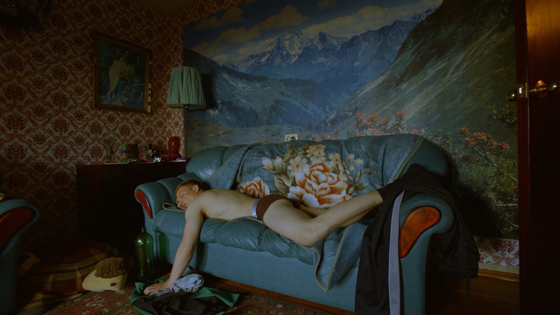
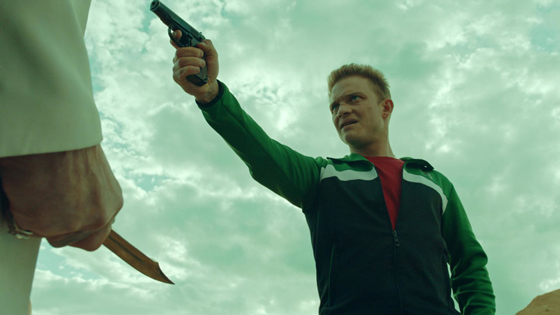
In the first education, Hunt is an operator. A student of the Balaban co -author of Sergei Astakhov and Lenfilm Patriarch Edward Rozovsky. He shoots the “pin”, first of all, as a picture, not history. It works with the wildest green color scheme. Builds a frame on strange oblique angles, on super -circular plans. It revels in texture, the devastation of the single -industry towns - rusty ferries, peeling walls, painted oil paint into evergreen. Rapak - here “mushrooms” and Antokha MC are filled with columns, and these tracks are not a continuation of the protagonist, a fool of garlic. It’s just that Khantu himself is clearly a buzz, this music, and if it were possible, he would not turn it off all the way.
There are subtleties: the “pin”, with all its simplicity, must be watched carefully. To understand, for example, the geography of the film and the place of action (hints are scattered there and so). Or to figure out why the character of Andrei Smirnov wants to deal with the pin (the explanation of their long-standing quarrels is given in general in one single assembly gluing). As in any charming debut, such laconic and spectacular moves with very schooling things get along quite easily here - such as gluing, in which the golden features of the pin and braces of the girl looking at him are mounted.
 © "VGIK-DeBET"
It is the texture and optics here that is a strong side. Weak - text, speech. Teachers - Shakhnazarov and Malyshev, perhaps they will even present Hunt to their opponents: here, they say, look, you can make a good movie without boobs and matyugov! But Hunt, it seems, generally spit deeply about what the heroes say (reasonable if you shoot a movie for showing at festivals with English subtitles). "Mushrooms" and the hum of neon lamps are drowned out. Again, the "pin" was made against the domestic rules of the cinema of textual, aphoristic.
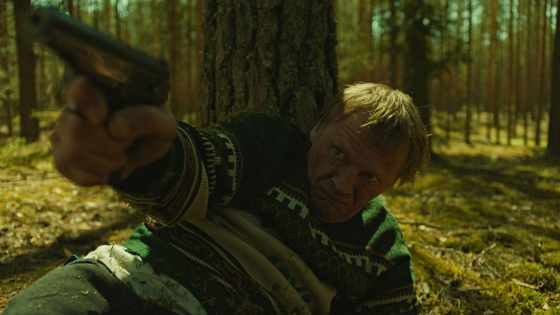
Exactly the same debutant impudence manifests itself here in working with actors. In principle, each of them should be grateful to the director. Serebryakov finally crawls out of the skirt of a large macho and returns to where he came from: in one of his early ribbons, “Serpa and Hammer”, he already played a paralyzed hero-metro-industrialist (in which the Soviet government turned the beauty-commercial). Evgeny Tkachuk finally plays what he had to play from the very beginning, without any of these metropolitan elaborations, Schubert behind the scenes and great Russian literature on the lining. Even Andrei Smirnov looks quite convincing in the form of a thief in law-with his Bunin background!
These simplicity and straightforwardness create a thing, really very unhealthy. "Bin" is a rare case for Russian cinema just a film. Not the Bible, not the guide and did not rules life. Just cool pictures that talk about something like that. This, damn it, captivates.
 © "VGIK-DeBET"
Although probably the same thing will happen further with Khanty as with Zakhar Prilepin. He was also praised at first for integrity and simplicity. For hearing the language of the Russian province and introduces it into literature. Then it turned out that all these “bowl”, “hall”, a carpet on the wall, three -page descriptions of birch and nipples are ordinary graphomania and nothing more. Hunt may well shoot further at least the series “House with Lilies” or clips for the Leningrad group (they are created stylistic for each other; take a closer look, Sergey Vladimirovich) - he has already done a big job. He shot the most living debut in Russian cinema.