
Translated material
Art and commerce
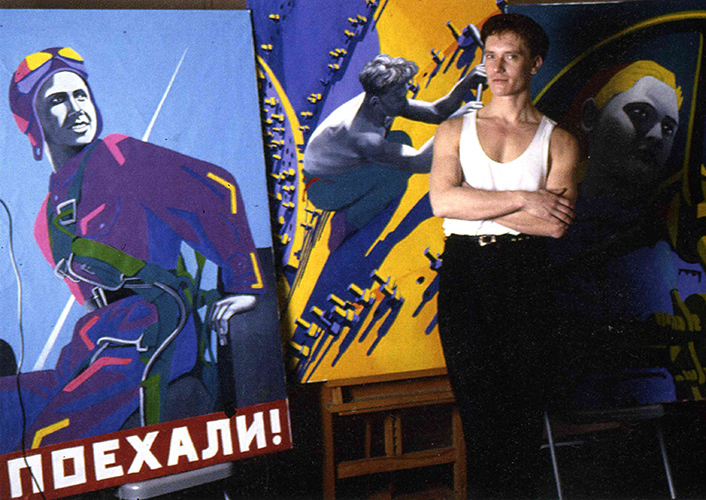
Timur Novikov (1958-2002) and Georgy Guryanov (1961–2013) are one of the most interesting and significant figures of the Russian art of the turn of the 20th - XXI centuries. This statement is also supported by the market of modern domestic art. So, for example, Georgy Guryanov in a commercial rating became the most expensive contemporary artist of Russia . But what is happening with the creative heritage of these authors causes serious concern. The conditions in which their art fell are diametrically opposite, although they are brought to one denominator - both from an art and a commercial point of view.
At first, a few words about the so -called copyrights for the works of recently deceased artists. As you know, copyrights are inherited by the closest relatives of the deceased author, as well as works of art, who were created and in his possession at the time of death.
The main, greater, part of the creative heritage of Timur Novikov is textiles. Namely - decorative panels sewn in accordance with the theoretical works of the artist, with images applied to them. Details his creative method is set out in the book “Horizons”, which was very highly appreciated by the Nobel laureate Joseph Brodsky, and in the theory of “Perekopromation”. In addition to textiles, Timur created a number of traditional picturesque works, photo collages and art photographs.
In the case of Timur Novikov copyright holders, persons who are indirectly related to fine art are became. Future heirs in the last years of his life helped Timur in the manufacture of textile works: they sewed fabrics according to his plan, processed the edges and, in some cases, embroidered frames for images, the images themselves were personally made by an artist, mainly with the help of stencils cut out by him and formed into a special box intended only for them. But after 1996, when Timur was blinded, the whole process was already without his physical participation. A similar way to create works of art made it possible to quickly do very spectacular work and, importantly, compactly store them in a small St. Petersburg apartment. Thus, by the time of his death, a significant number of works have accumulated, which have passed along with his copyright and vast archive heirs.
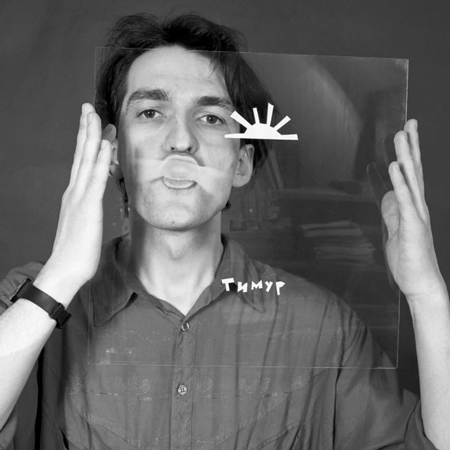 Timur Novikov “exhales” the cloud for his glass work. 1980s
After the death of Timur, as this usually happens when a significant artist leaves, a real “boom” on his art began. Prices began to grow rapidly, and here it is worth noting that during his lifetime he never crossed the line of 5,000 cu, but after his death, the cost of work rose several times. But then a very sensitive situation developed: the fact is that, being a prolific and bought artist, as well as a good friend for many and a lover of gifts, Timur provided a rather large number of people with his work, and it is quite natural that after his departure there were a lot of people who wanted to sell them both at auctions and a private way. Rather, try to sell.
For quite objective reasons, the copyright holders decided to keep the monopoly on Novikov. They founded the Committee of Timur Novikov , created the site of his own name and began to carefully monitor domestic and foreign auctions. As soon as the work of Timur appeared at the auction, set by them, the organizers of the auction written a letter that the copyright holders did not confirm the authenticity of the picture. Moreover, it did not matter, it is real or imaginary belonging to this work of Timur's hand.
In the case of Timur Novikov copyright holders, persons who are indirectly related to fine art are became.
In some cases, with a special arrangement of copyright holders to the owners of the works, it was possible to agree with them individually, but it is known for certain that these cases were isolated. It came even to the point that the work sold by Timur himself, for example, in the bank collection and having all the necessary papers, was still declared illegitimate. And after taking the photo from the auction, the work was published on the committee’s website in the “Unconfirmed Work” section, which was specially created for this, and this, of course, became for her a kind of “wolf ticket” - and forever. By the way, another section of this site is very curious - “Work on the study” , where for years the photos of the same Christmas trees or boat have been hanging for years as in a “good place” - a section on confirmed work .
It is worth dwelling at the moment of determining the authenticity of the work of recently deceased artists. The fact is that a full -fledged examination for this category of paintings is simply impossible for quite objective reasons. For example, a chemical analysis will not say anything in these cases, and there are almost no similar specialists who can take responsibility and own objective methods of analysis. And the documents, pro -wings and receipts, how to make sure over the past 15 years could not have any importance in this situation.
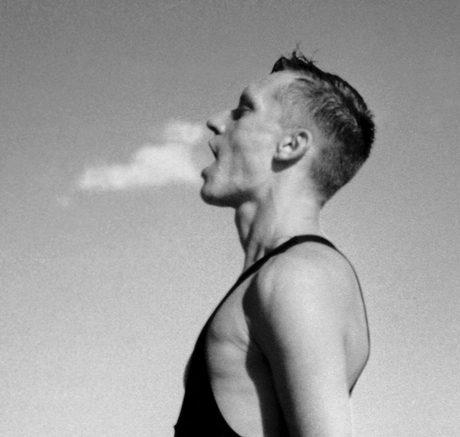 Georgy Guryanov “blows” the cloud. 1980s
In fairness, it is worth noting that after the death of Timur, directly based on his phrase “If the artist is not faked, then this is very bad!”, There were many falsifications - from very funny and naive to quite virtuiously made. Also, the case of determining authenticity is complicated by a large number of copyright versions made by Timur himself.
So, the struggle for the monopoly and the fight against fakes turned out to be a stick about the two edges. Prices began to fall rapidly, purchases of work took place less and less. It happened that nothing was bought or sold for two years in a row. This affected not only textiles, but also painting, which was always more expensive due to a small amount of his work performed in this genre. In general, everything happened in accordance with the statement of one very competent specialist, a leading employee of one of the Russian national museums: “Any diverse of doubt and other things in the public sphere clearly reduces the creative and“ market ”weight of the artist’s heritage.”
Unfortunately, the excessive commercialization of the creative heritage of Timur completely overshadowed the theoretical, very important and interesting, its component. But not every artist can boast of theoretical works, especially if they are such a level as Timur: after all, a similar one is very expensive. As a result, even his archive remained unsubstantiated and unexplored. And the description of the creative biography of Timur is very inaccurate and is replete with numerous “white spots”. True, there were his posthumous personal exhibitions, which pleases.
The heirs of George Guryanov immediately appeared “advisers and well -wishers”, well versed in art and, most importantly, in its commercial component.
But with art history, the situation is deplorable. An exception to this dull picture is his biography in the book “Do only the truth”, by the way, quite readable, but it turned out interesting only due to the fact that Timur came up with the idea, and his name was his colleague Oleg Kotelnikov. The compiler author simply interviewed the list and then deciphered them, although this is also a tremendous work!
The situation that has developed with the creative heritage of George Guryanov, as already mentioned, was diametrically opposite to Novikovskaya. In this case, close, blood relatives of the artist became the copyright holders. Unlike the Timurovsky, they had nothing to do with the visual arts, and, as some eyewitnesses said, they had a kind of shock when they learned about the price of the paintings of George, who reached (unlike Timur's paintings) a line of 100,000 cu Even during life (which, in fact, can be explained by the difference in the years of the death of artists).
Also, the number of works that remained at the time of the artist’s death in his possession, unlike Novikov, was minimal: only a few unfinished paintings and a small collection of works by George's friends. By the way, after the death of Novikov, his collection of paintings by other authors turned out to be very impressive.
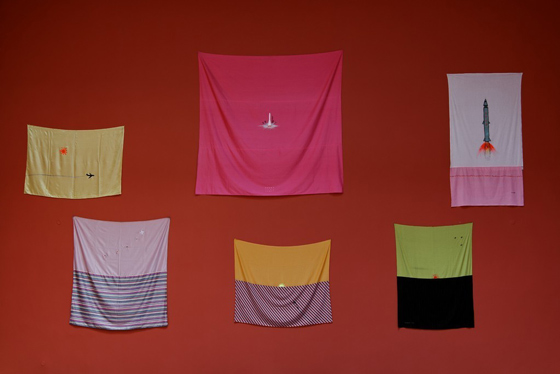 The works of Timur Novikov. 1980s
The heirs of George Guryanov immediately appeared “advisers and well -wishers”, well versed in art and, most importantly, in its commercial component. As a result, the possibility of the artist’s personal exhibition in the Hermitage interesting in the concept of the personal exhibition was missed. But the fund of his name began to be created, an electronic catalog of paintings, which was planned to publish with the texts of the famous art critic, gather in different countries. Rumors began to walk about festivals of fashionistas-indentes under the auspices of the fund. But here the “commercial approach” intervened in the situation again. True, if in the case of Timur the similar actions were at least somehow justified by the same stick about the two ends, then the monopoly was purely speculative here: after all, the copyright holders did not have paintings by the artist.
But, despite this, and by the sad example of the story with Novikov, which, of course, was known to them, the monitoring of auctions, scandals of social networks, numerous unproven accusations of falsification, television programs and articles in electronic and paper media began, even open letters were written, for example, by the phrase: “Dear Sotbis”! Georgy Guryanov could not draw this picture ... ”It was about the famous“ rowers ”of his brush, of course, nepheals, as evidenced by the lifetime posters and numerous publications of its reproductions. True, there was a significant difference from the situation with Timur: not a single work with the trading was removed.
The result of these actions turned out to be, as they say, there are copyright holders on the advice of their “well -wishers” abandoned the author’s interest, which are laid in the sales of their paintings that did not belong to them. After all, you can’t take money for the fake, however, this is definitely not proved, but still. The main thing is that it was put on bidding bypassing the Council of "experts"!
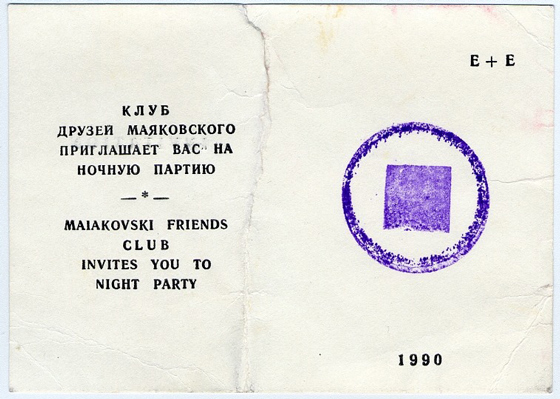 A ticket for the first "night party" in Russia with the seal of the club of friends Mayakovsky. 1990
Prices began to fall, rumors crawled that, having paid a certain amount, it was possible to get confirmation of authenticity, “experts and specialists” began to multiply, there were discords and quarrels between them - right in the episode of the “golden calf” Ilf and Petrov, where “children of Lieutenant Schmidt” are described.
The copyright holders themselves were very difficult to access or completely inaccessible without intermediaries. If there were no paintings in the electronic catalog, it was declared a fake-but this directory was made up by people who, at different periods of the creative path, were a little by little, who superficially knew the artist and his work, who heard something about the movements of his paintings, which, however, did not prevent them from writing the disclosure of Sotybis and other places about which they repeatedly sat on sofa. Moreover, those who really versed in the periods of his work were simply not allowed “to the body”.
But the most important thing-there was not a single personal exhibition of this interesting author, the catalog book turned into a small article in a paid electronic edition with the strange name “The Drummer of the Kino Group became the most expensive artist” (the quote is not literal, but the fact that everything was exactly the opposite can be affirmed with confidence-this artist was a drummer of the “Kino” group). And as a result, the biography of George Guryanov was made by an enthusiast and fan of his work, which, in the course of the case, “experts” in the life of Guryanov subjected obstruction and criticism; True, they did not even read the book itself, as expected by our tradition.
 "Rodchenko's Jump" by George Guryanov. 1980s
Well, can nothing be done in such circumstances? With confidence, we can say that such a situation, of course, is subject to change. To begin with, for example, it would be worth not to tear out the work of recently deceased artists from the context of their environment: after all, they were participants in not one joint (both for them and for other persons) creative association. Participants of such communities are still alive, which are quite competent, as with the fullness of information - from historical to technological, could also carry out full -fledged expert actions.
The most authoritative of these communities is the Mayakovsky friends club. This club included musicians and artists, art historians and fashion designers, photographers and poets, the names of some of them are well known to many. This is Andy Warhol, Pierre and Gille, Georgy Guryanov and Konstantin Goncharov, Oleg Grigoryev and Viktor Tsoi, Sergey Kurekhin and Andrei Krisanov, as well as many other artists. The Mayakovsky friends club appeared in Leningrad in the mid-1980s, its founder was one of the heroes of our history, namely, Timur Petrovich Novikov, a culturalist, art theorist and a wonderful artist.
By the way, the club’s activities were not limited only to the area of fine art. For example, there is one fact that is little-known to the general public-the first Russian fashionable party of 1990, as well as the first two conceptual raves, Gagarin-Pati and Mobile, were directly related to the club. The organizers of the raves Ivan Salmaksov and Evgeny Birman were his members, and the club chairman Timur Novikov and activists (Georgy Guryanov, Andrei Medvedev and Denis Egelsky) created posters, accessories and visually designed this event.
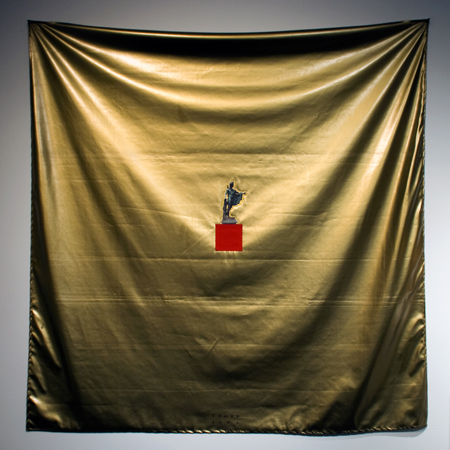 Apollo on the Red Square (printing club of friends Mayakovsky). 1990
Also in the bowels of the club there was a course of fine art, which can now be safely called "new romantics" - in honor of the popular direction in music at that time. By the way, the creative unions “New Artists”, “New Composers” and “New Academy” are undoubtedly owed their “novelty” in the name of the same popular musical style.
The pioneers of this direction in the painting of the Leningrad underground of the second half of the 1980s were George Guryanov and Denis Egelsky. Actually, they continued the tradition of Alexander Samokhvalov and Alexander Deineki, who actively used quotes from works of classical art in their work. Subsequently, in the 21st century, Dmitry Mishenin and the Doping-Pong art group, working both in digital graphics and traditional techniques, joined the club of friends of Mayakovsky. I would like to note that the members of this art group are pioneers of the Russian digital Art Spaces. Thus, in the late 2010s, the Mayakovsky friends club was revived by the remaining participants, moreover, it was replenished with new members.
In connection with the situation and to protect the creative heritage of their deceased participants from commercial arbitrariness of various amateurs, the Mayakovsky friends club resumes its artistic, scientific and expert activities. It is planned to carry out a number of thematic exhibition events dedicated to their memory, at which works of art and artifacts that are little -known to the general public will be exhibited. The publication dedicated to the history of the club’s activities, and the cycle of lectures about its most outstanding participants are also being prepared.