
Translated material
Wind generator who lives on the roof
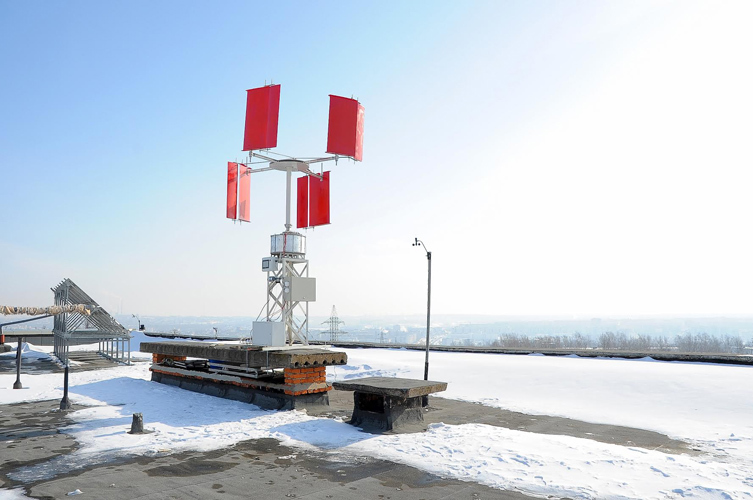
The text continues the project on the Ecology "Variable" .
Europe has long been accustomed to landscapes and marinas, deceived by the wind farms, and for us so far photographs of the windmills in the Ulyanovsk wind park under construction look somewhat alien. According to experts of HSE, the technical potential of the wind energy of Russia is from 6516.6 to 17100.9 billion kWh - this is quite a lot. So far, the existing wind farms produce tenths of the percentage of all electricity in the country, and the total installed capacities are still a penny of 13 MW - for comparison: in China, the total installed capacity in 2015 exceeded 105 GW, 60 GW in the United States.
But if you just make wind generators all the free areas in the country, there will be little use. A huge market for small capacities is opened in Russia - remote areas where it is inappropriate to pull power lines, places where it is necessary to have backup sources, rural areas, various kinds of temporary and seasonal objects. In February of this year, Deputy Prime Minister Arkady Dvorkovich gave an instruction on “stimulating the development of microgeneration based on renewable energy sources”, and in July he also approved a plan to stimulate it . What can domestic developers offer this promising market?
Wind generators are of different types. The most common - with a horizontal axis of round rotation, or impeller - the same that are similar to a large fan. But there are others - less noticeable, but more effective.
In order to evaluate the effectiveness of wind generators, they look at the main parameter - the coefficient of using wind energy, or KIEV, which shows what part of the energy from this raising flow can be effectively used. It can be called an analogue of the useful action coefficient - this is our old acquaintance from the school course of the efficiency of the efficiency, about which we remember that it cannot be more than one.
“At one time, Nikolai Zhukovsky and independently of him Albert Betz theoretically showed that the maximum kiev, which can be obtained for wind generators, is 0.59. Until now, this is considered an unsurpassed limit that developers are trying to approach. The most efficiency is the windows of the classic impeller, whose KIIV at the wind speed of 10-11 m/s can reach 0.47, ”says Andrei Terentyev, general director of Energoinnovation and the author of the wind generator of Albatros.
The developers of Albatross took as a basis a less effective rotor Daria. This is a device whose blades resemble the wings of the aircraft moving around the vertical axis. It works due to the lifting force, and its main drawback - it starts only at high wind speeds. But in its effectiveness, it approaches classical horizontal models.
In Russia, the installed wind generation capacities make up 13 megawatts - for comparison: in China, the total installed capacity in 2015 exceeded 105 gigavatts.
In order for the rotor to start at low wind speeds, the engineers came up with an adaptive wing control system, adding clicks to the wings, which are also controlled by this system. “In the process of the rotor, the wings and flaps move relative to each other like a fish with a tail. As a result of these improvements, it turned out that under a certain regime, we not only overcame the limit of Zhukovsky - Betz, but also received KIEV more than one, ”says Terentyev.
How did it happen? Albatros does not really violate the laws of physics. When the wing interacts with the closing, the suction streams of the vortex occur. If it were not for the wing and closing control system, then, as in the case of classic models, part of the wind flow would simply deviate in front of the screw itself and would pass by. In the case of Albatross, it turned out the other way around: with this design, the effective iconic surface, from which the flow energy is removed, increases virtually. Moreover, to achieve this effect, there is enough wind speed of only 2-2.5 m/s. Albatross starts at a speed of 0.5 meters per second.
Andrei Terentyev and his colleagues have already created a prototype of wind generator ready for industrial production. With all the pluses, its price becomes a large disadvantage: the device will clearly be expensive, and the reason for this is the generator in which neodymium magnets are used. A neodymium monopolist of China is not shy about raising prices, which, alas, affects the cost of such devices.
Can such a wind generator develop enough energy? The first attempt to reduce the data of meteorologists with the characteristics of specific models of the windmills was made by a second -year student of the Department of Climatology and Environmental of St. Petersburg State University Julia Kazachkova under the guidance of the associate professor of Alla Yurova. In her course work, Kazachkova calculated at what height and at what wind speed in the Leningrad Region the experimental wind generator of the Albatross vertical type will work most efficiently. It turned out that at an altitude of 10 meters (this is the standard height above the ground, on which the speeds of speed and direction of wind at the weather stations are carried out), the wind generator will produce 72 kWh of energy per month, and at an altitude of 30 meters - already 165 kWh. Based on the standards of electricity consumption in St. Petersburg, for each of the three people living in a two-room apartment and using gas stoves, 48 kWh energy per month is needed. That is, for three, one wind generator will be enough.
It is worth noting that in fact, the Leningrad region, despite the fact that the wind here, as Nikolai Vasilievich Gogol, according to Petersburg custom, blows from all four sides, is not true, is not among the regions with the highest wind-potential. The average wind speed in autumn and winter is only 4 m/s, and the average annual wind speed is 3.3 m/s. Due to large reservoirs (Gulf of Finland, Onega and Ladoga Lakes) and the variety of landscapes local weather is unstable, and this, in turn, greatly complicates the forecasting. The favorable zones of the development of wind energy include, in addition to the north-west of the country, the northern territories of the Urals, Kurgan region, Kalmykia, Krasnodar Territory, the Far East.
Based on the analysis of data in the past, you can compose at least an approximate picture of how much energy can be obtained from local winds. For this, Julia Kazachkova took data on the speed and direction of the wind for 10 years (from 2005 to 2015) at the weather stations located in Pulkovo (south of the city) and Vyborg (north of the Leningrad region, not far from the border with Finland). These data are available on the website of the American National Administration of Oceanic and Atmospheric Research (Noaa) . Another important characteristic of the wind is its repeatability, which shows what part of the time from the selected period of the wind of the blow at one or another speed. By comparing these data with the characteristics of a particular wind generator model (the same KIEV), the student using the Matlab program calculated the wind flow power for each specific wind speed in this region at an altitude of 10 and 30 meters.
And still, this is a rather rough estimate, since another important characteristic is not taken into account - the landscape affecting the formation of air flows. In the future, a student can develop a program or application, thanks to which each user can calculate which way of obtaining energy from the wind is best suited for his needs.
Of course, in cities such small energy sources will be difficult to compete with electric networks. But in places where everything is bad with electric networks, such systems may well justify yourself - for this now it is necessary to automate the calculations necessary to understand whether it is worth putting a windmill next to your country house.