
Translated material
"We gave Mozart a second chance"
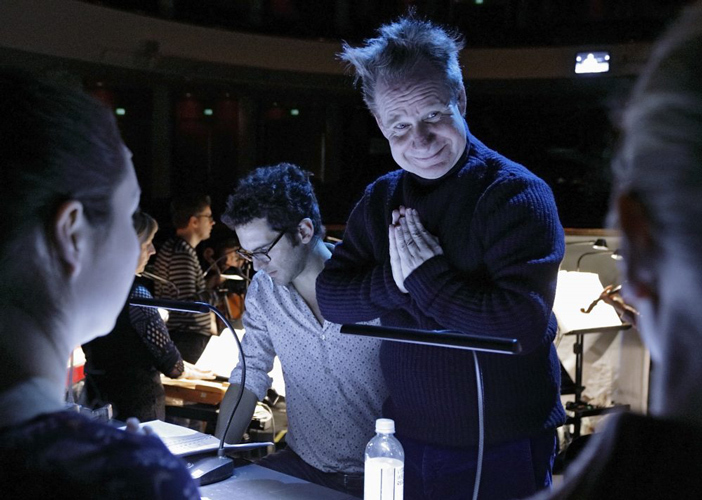
In Salzburg there are the last shows of “Mercy Titus” - a performance that opened the 2017 opera program. For the Salzburg audience, the opening was the Perm Phenomenon - the first -class orchestra and the Musicaeterna choir, which debuted at the festival, led by their chef Theodore Cuentsis . But not only this was noteworthy the prime minister of Titus; Together with him, Peter Sellars, an American director, who became famous in Russia with the production of the “Queen of the Indians,” reappeared here after almost a 17-year pause. The triumphal return to Salzburg - in a roundabout way, through Perm - happened. And the master seemed extremely satisfied with this circumstance.
- I saw your performances in Paris, Helsinki, Salzburg and Perm. Your last work is the production in the Finnish opera of the new composition of Kaya Saariaho " Only The Sound Remains ” -“ There is only a sound. ” In this performance, you are again trying to explore the nature of the human soul. Literally - what does it consist of, of what the finest matters. As far as I understand, the central theme of many of your performances is the study of some mystical spaces where the soul wanders. You are definitely occupied by this mysterious transition, invisible threads, connecting the local creature world with the world unhealthy. Why do you return to this topic over and over again - in almost every your performance?
- It seems to me that music always speaks with us about this: it recalls the spiritual component of our local life. I think the most important topic of art is to explore different aspects of being. This is something that we cannot understand through the TV-well, you understand what I mean ...
We live in excessively materialistic time. But it is so interesting to try to look behind the line that lies outside our sensory experience. Ask questions that appeal to the supersensible. Open other spaces and measurements of our lives. And there are such treasures that we may not even suspect. And we can suddenly discover completely new mental and neurological capabilities.
The fact is that there are other types of worlds. And this is so surprising - to open them; If you, of course, admit that there are ways to this other life (laughs) .
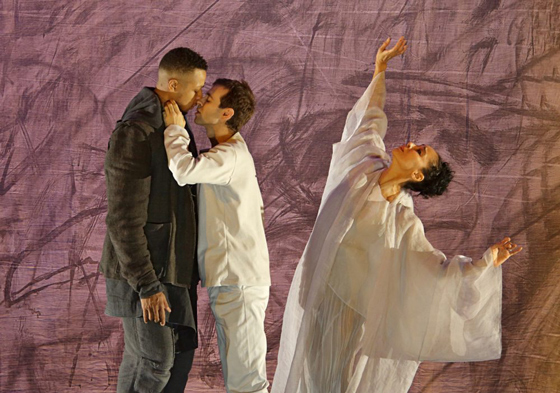 © The Finnish National Opera and Ballet Scene from the play “Sound only Sound” in the Finnish opera
- In this case, what is the main theme of your performance “Mercy of Titus”? How did you interpret the opera of Mozart, what you found in the Mozart score?
- At the end of his life, Mozart constantly turned to the old masters. It is known that he admired the oratorios of Handel and the polyphonic forms of Bach. He understood the greatness of these colosses-composers of the XVII century. And he understood that these old masters wrote the music of the future, that any avant -garde always relies on past forms, on the entire previous musical experience. And therefore, the Opera-Seria, which he forced to turn to at the end of his life, was not a completely obsolete form for Mozart. Surprisingly, she discovered for him a new direction in his work.
Traditionally, the libretto in a man of seria (including the text of Pietro Metastasio “Mercy of Titus”, which by that time had already written several operas by different composers) suggested that all the heroes were singing solo; The unit of the form in a man of seria is an aria. The hero always says one. But Mozart writes for “mercy of Titus” and duets, and terraces, and sextiles with a choir. That is, he departs from the principle “one hero - one aria”, “the second hero is the second Aria” and so on.
Mozart understood that the old masters wrote the music of the future.
Mozart is the heroes in groups: a man is connected with a woman, parents with children, a servant with the master. All actors of the opera are connected by the threads of family and social relations. Thus, Mozart overcomes individualism in the representation of heroes, surrounds them with a cloud of various connections and affection. Groups create new anti-anterior surgeons in music, which is written much more complicated than the traditional opera-series.
And this Mozart change of traditional musical structures precisely indicates that the old principles of absolutism, the sole power of the supreme ruler with the pyramidal structure of social ties that go from top to bottom are replaced by horizontal connections, where people interact with each other. And the truth of one should be divided with others - which happens in duets.
In this custom -made project, Mozart reanimates the old forms, actually breathing a new life into them and thereby taking them from the past to the future.
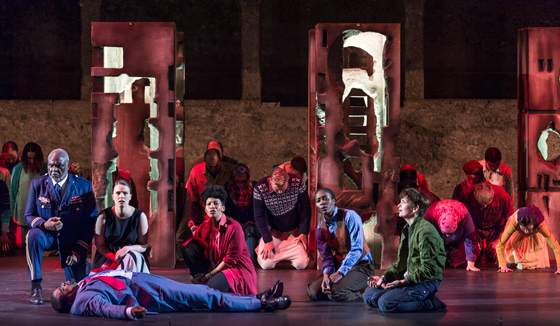 © Salzburger Festspiele / Ruth Walz Scene from the opera "Mercy of Titus" in Salzburg
- You included fragments of other works of Mozart in the opera score. Why did you need this?
- We chose and used fragments of opus in which Mozart directly enters into dialogue with Bach and Handel. Adagio and Fugu C - Moll, he wrote after he discovered Bakho fugues. He must have exclaimed to himself: "Oh my God, I have to try to do the same." And when we listen to Adagio and Fugu, we understand that he really is competing with Bach in this composition, and this struggle is severely given. In my opinion, this is one of the most unusual and amazing works by Mozart.
And when Mozart discovered H - Moll 'New Mass Bach and Handel’s oratorio, he wrote “Masonic mourning music”. With us, it sounds at the very end of the performance in a transformation for the choir. This music is performed by incredible emotional power. And again, he uses the baroque forms and techniques of the orchestration: string and winds are divided, very similar to the Gendelev mourning march, designed at a slow pace and rhythm of Sarabanda.
In all the opus chosen ones, Mozart’s connections with great predecessors can be heard. This is always a mix, a mixture of borrowed and their own, two streams merge, different musical worlds come into resonance. From this, many fragments of music to the "mercy of Titus" arose. This is what, in essence, was occupied by Mozart’s mind when he composed this opera.
Mozart wrote her in such a terrible hurry that he had no chance to check something, correct, change. I am sure that if he had time, he would have written something differently, added or removed something. And now we gave him this second chance.
- Many consider the “mercy of Titus” an unsuccessful opera, preferring “Idomena” or “mitridate”.
- As for me, I love Idomena. I think this is one of the most visionary operas ever written.
“Mercy of Titus” was less fortunate. This opera was not loved or put for many years. It was re -opened at the end of the twentieth century; And before that, the audience chose, of course, “Don Juan”, “This is what everyone does”, “Magic flute”. It is all the more important to return Titus again to opera use.
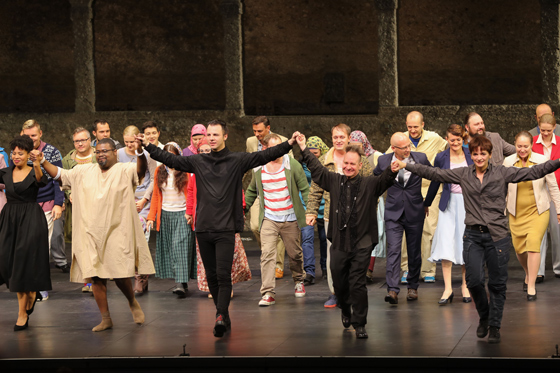 © Salzburger Festspiele / Franz Neumayr "Mercy of Titus" in Salzburg
- During the time of Gerara Mortier, you staged performances at the Salzburg festival several times. Your last one - before a long pause - it seems, the opera has become the opera of Kayi Sarariaho "Love from afar" in 2000?
- For the first time I staged a performance for the Salzburg festival in 1992: it was the Francis of Assisian Messiana. Then he was resumed in 1998. Then, in 1994, I put here the “king of Oedipus” and the “symphony of the psalms” of Stravinsky. In 1997- " Le Grande Macabre » Liegeti. And, finally, the first opera of Kaya Saariaho “Love from afar”. Yes, the 90s in Salzburg was a special time.
- It seems to me that these times are returning - with the advent of the Marcus Humanizer festival. It seems that you have found a common language with him and coincide with him in aesthetic preferences?
- You are absolutely right, we speak the same language with Marcus. He is my great friend and outstanding artist, and I am very happy to meet him again in Salzburg.
This is something that we cannot understand through the TV-well, you understand what I mean ...
- You, apparently, have developed quite harmonious relations with Theodore; Mortier introduced you, right?
- Gerard Mortier was those who invited me to the festival for the first time, and then to Paris and Madrid - wherever he worked. It was a very strong figure in our world, it is very missing . And he knew how to find like -minded people and make them in teams. A rare gift.
- Mordier also gave you the opportunity to put modern operas - and you continue to do it. Please tell us about your work with modern authors.
- Next week, I return to California and immediately start setting up the new opera of John Adams "Girl from the Golden West." We begin work with a two -week rehearsal cycle. The premiere is scheduled for November this year.
- Is it analogy with the Opera Puccini “Girl from the West”?
- Yes, partly like Puccini - and not like Puccini's. Adams turned out a ridiculous, lively and strong essay with a very tense action about gold fever in California. In general, the story of California is wonderful interesting and it is worth the opera to be written on it.
Of course, I would also like to mention the recent production of the new opera of Kaya Sarariho in Helsinki. Kaya wrote excellent music; It has so much movement, so much subtlety. Then this performance will be shown in Paris. Perhaps the next year it will be recorded on DVD . It is very important for me to periodically put new operas.
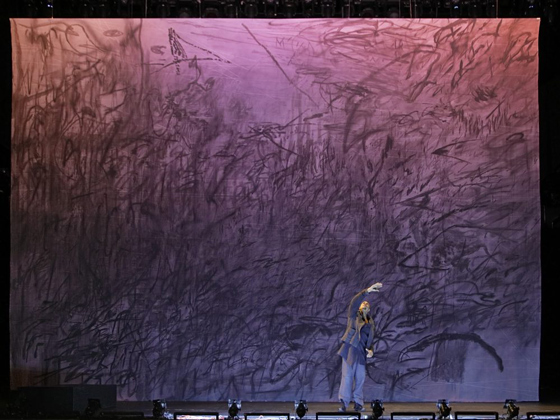 © The Finnish National Opera and Ballet Scene from the play “Sound only Sound” in the Finnish opera
- The first opera of Saariaho “Love from afar” and her new opera “only sound” remains - in my opinion, the most beautiful in music. I liked Adrian Mater. I was in Paris at its world premiere; Remember, then the strike broke out and the first performance was simply canceled?
- Yes, of course, it was a very difficult time: both for us and for Mortier. The performance was produced with great difficulties, it was a painful process. But, you know, the second version of the production, in Santa Fa, was much more successful. After Paris, we needed a second look at this essay. George (Tsypin. - G.S. ) continued to work, but proposed a different scenographic solution. There is an Internet version of what he came up with. You can see and make sure that “Adrian Mater” is much more successful there.
- It was a sensation - when you came to Perm to put the "Queen of the Indians." How did your cooperation with Theodor Custezis flow, with the choir?
- I arrived and found in Perm a unique team - the choir and orchestra Musicaeterna , which theodore formed. I was shocked; It turned out to be such an inspiring team! I have never met such devotion, such an obligation, such artistic self -awareness. No routine, all extremely focused on a creative task; The implausible severity of the emotional living of music. I can confidently say that today there is no other such team in the world. They all very clearly imagine the final destination: where they come from and where they should come. And in the Perm Theater there is a special atmosphere. They have something that no one has. It is so wonderful to imagine Perm musicians to the whole world. Right now, these days, the audience in Salzburg is increasingly imbued with the thought that I had met something special. Right now. And it's great.