
Translated material
He's not a couple for you
The US Senate Special Committee approved the initiative that limits the possibilities of President Donald Trump to cooperate with Russia in the field of cybersecurity, Reuters reports . The proposal is included in the bill on intelligence allocations for 2018.
The document prohibits cooperation with Russia on cybersecurity without the approval of the congress. The Director of National Intelligence will be obliged at least 30 days before the planned conclusion of an agreement with Russia or the formation of a joint group to provide a special report to the relevant committees of the Congress. It should include convincing grounds for such actions, a list of intelligence, which will be transferred to the Russian side as part of a joint work, and an assessment of the benefits of such joint activities for the US national security.
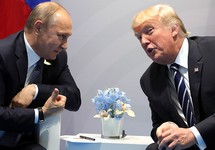
On July 8, Putin at a press conference, following the results of the G20 summit, said that at his first personal meeting with Trump, an agreement was reached on the creation of a joint Russian-American security group in cyberspace. “We agreed with the President of the United States that we will create a working group and work together on how to jointly control security in the field of cyberspace, how to ensure unconditional compliance with international legal norms in this area, how to prevent interference in the internal affairs of foreign states, first of all, in this case, we are talking about Russia and the United States,” the Russian president said.
However, the very next day, Trump expressed doubt that such a Russian-American group will be formed. “The fact that President Putin and I discussed (creation. - Ed.) The cybersecurity group does not mean, I think this will happen,” the president wrote on his Twitter.
At the same time, Trump assured that the truce in the south-west of Syria, agreed at a meeting with Putin, would be fulfilled. “This (cybersecurity groups. - Ed.) Cannot be, but the ceasefire - maybe it has already been achieved,” the American president added.
On August 2, Trump signed the law on additional sanctions against Russia, Iran and DPRK, adopted by the absolute majority of both chambers of Congress. In particular, the document provides for the consolidation of the previous orders of the US administration at the legislative level and obliges the country's president to coordinate any mitigation of sanctions with Congress.