
Translated material
“During the 1996 election, the source told me that there would be a bomb in the subway, and Yeltsin will get sick”
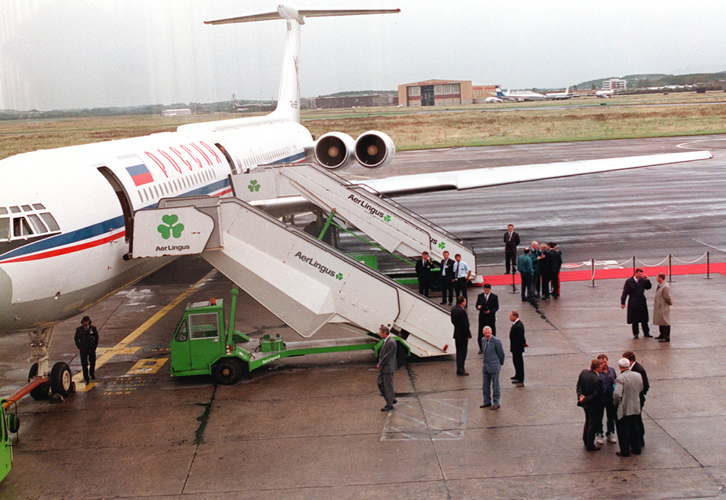
In July, the representative office of the European Union in Russia and the European Federation of Journalists in the framework of the project “Public Diplomacy. EU and Russia ”(we remind you that the section on the Colt “ Bridges ” - its media mirror) held the first summer school of journalism in Dublin. Correspondents and editors of ten Russian and ten European media spent a week in the capital of Ireland, where they met its history, political system, economy and journalism. The school participants visited the parliament, the Ministry of Foreign Affairs and the editorial offices of the Irish media.
One of the speakers of the school was a famous Irish journalist, former international news editor of the newspaper Thus Times Shaimas Martin. His name is known not only in European, but also in many other countries, including in Russia. The head of the Corcontal in Moscow, Shaimas Martin, transferred reports to the world about the collapse of the Soviet Union, talked about the work of the Parliament of the 90s and was friendly with the journalist-investigator of Novaya Gazeta Yuri Shchekochikhin. He managed to interview Vladimir Putin to his presidency, and Nelson Mandela was one of the first after his release from prison. He wrote about two Chechen wars, explosions of residential buildings in 1999 in Moscow, presidential elections and many other events. He wrote several books and participated in the creation of documentaries about Russia. Now Shemas Martin is retired. One of the participants in the school, the editor -in -chief of the Belgorod publication GO31, talked with him. ru Maria Litvinova.
- What brought you to this profession?
- I was always interested in journalism, even in childhood, and my ambition was to become a foreign correspondent.
“And you fulfilled your dream.” Do you consider your journalistic fate happy?
- In general, yes, although my journalistic career often took away all my time. I happened to illuminate the two most important events of the second half of the 20th century: the end of the communist system in the Soviet Union and the end of the apartheid system in South Africa. But in general, I worked in almost 50 countries on all continents, except for South America.
- Including a sports commentator ...
- Yes, I was engaged in sports journalism, and at one time it was pleasant. But day after day it became more boring. Every day the same thing: you tell people how someone kicked the ball into the net.
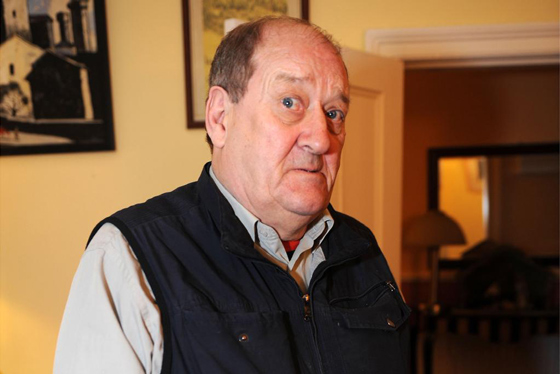 Sheimas Martin
- Tell us about your first and last visits to Russia.
- The first time I got to Russia as a sports journalist in 1974, and my last visit happened in 2014 as a consultant to a television documentary crew. One of these visits was shortly before the coup in August 1991. It was a very intense time, in those days Reuters published a daily ballot called World News Highlights , which listed 20 of the most important news of the day. In several cases, all 20 stories were dedicated to Moscow. So it was continuous work every day for a very long time. I remember that I lost about9 kilograms of weight in 6 months.
- Is it difficult to live here then?
- Well, they paid me in US dollars, so my life was not so complicated. Soon after I arrived, the Irish supermarket and pub were opened on the New Arbat, and I could buy food and drink there or buy in Birch stores. But for most Russians it was a very difficult time, the old women sold their personal belongings on the streets and in the crossings.
- And what do you remember about the putty itself?
- Like most foreign correspondents, I was on vacation. On the morning of August 19, I managed to fly out of the Irish Shannon airport to Moscow. It was an Aeroflot plane, which was originally flying from Washington, but all American passengers canceled their flights when they heard about the revolution. Thus, there were only six passengers in the plane - two Irish and four Russians, and we were all transferred to first grade. In Sheremetyevo, I expected that the airport would be surrounded by tanks, but everything was in order, and I quickly passed passport control, because there were practically no other passengers. I took a taxi to my apartment on Taganskaya Square. On the garden ring, soldiers stopped us and said that no one was allowed into the center of Moscow. Along the way, I met a group of little boys who played and looked into the tank next to the press center of the Foreign Ministry on Zubovsky Boulevard. But the subway worked fine, so I was able to easily get to the very center of the city. Tanks also stood in Manezhnaya Square and in front of the Kremlin. I remember how the commander of one of them told me that he had no ammunition. On the second day, my Russian friend, whose father worked in the Kremlin, said that the GKChP had lost control and the coup d'etat ended. He was right.
- And these days I had to work especially a lot?
- Certainly. There were no mobile phones then, so in case of exceptional urgency, journalists had to leave the scene and return to the offices to send their texts to the editor. In my case, I first printed my report on a primitive computer, then printed and loaded it into a tex machine. It was a complex and uncomfortable activity.
- You were in a pool of foreign journalists and could tell a lot about Yeltsin.
- The recent actions of Trump in connection with the hiring and dismissal of the White House employees reminded me of those days. Yeltsin used to appoint and dismissed prime ministers almost every week. By the way, I am also caused by the irony of the current hysteria in the United States regarding Russia's intervention in their presidential elections, because there is no doubt that the Americans intervened in the 1996 presidential election. An article even appeared in the influential magazine Time , explaining how the United States helped Yeltsin win.
As for me, these elections are associated with one of the strangest events in my long journalistic career. Together with the Australian colleague, I spoke with a Russian source, who said that during the election campaign we should expect two events. Firstly, in the Moscow metro there will be a bomb, and secondly, President Yeltsin will seriously get sick shortly before the second round of voting. That same evening, a bomb exploded in the tunnel near the Nagatinskaya metro station, and shortly before the vote, Yeltsin suffered a serious heart attack.
- Who, do you think, these events could be planned and why?
- In the Yeltsin camp there were people who wanted the elections to be canceled, to lose. Many in Russia can guess the names of those who can talk about here.
-The story of Yeltsin is known, which did not leave the plane in Dublin in 1994, where the Prime Minister of Ireland met him at the airport. What did the Irish press write about this?
- This happened at the Shannon airport in the west of Ireland. At that time I was in Abkhazia, wrote about the consequences of the conflict there. The infrastructure was destroyed, there was no electricity, running water, and so on. Every morning we had to wash in the Black Sea. We stopped in a house, the owners of which managed to turn on their TV with a car battery, and late in the evening in the news of Russian television showed an interview with Yeltsin at Seattle Airport. His performance was not very articulated, and I, knowing that he was supposed to arrive at Shannon the next day, suspected that his speech could be even more incoherent and my newspaper The newspaper Irish Times will require me in this case. But there were no phones in Abkhazia, so we had to hastily travel across the border to Sochi, where I was able to contact the Irish Times .
I learned that the president’s plane was late because he circled for two hours over the airport without explanation. Then Oleg Soskovets came out of the plane and said that the president would not appear. Our Prime Minister Albert Reynolds waited below at the ramp, having arrived specifically from New Zealand, where he was on a state visit. He very diplomatically informed the media representatives that he understands how Mr. Yeltsin is exhausted after his journey, and expressed the hope that he would be recovered soon.
The media were not just as diplomatic. This was the main news in the front of all newspapers and in all news releases of radio and television. The most sarcastic comment was a caricature in The Irish Times , depicting a message from Yeltsin, addressed to the international media, which was placed in a bottle of vodka.
- Who, from the point of view of an experienced European journalist, Vladimir Putin: the successor of the “family” or the successor who betrayed her interests?
- Putin, of course, is not the successor of the Yeltsin family. Friends of Berezovsky then sent to pack their suitcases. But I would not call it a betrayal. Russia was extremely unstable in the era of Yeltsin. Putin in the first years of his reign brought stability and some prosperity. Of course, he was helped by an increase in oil prices. Currently, many Western media talk about him as a devil in the flesh. He, of course, is not an angel, but I do not think that he is as black as he is portrayed.
I must recall that Ireland is one of the six Western European countries that are not NATO members. And Ireland with great skepticism refers to the role of NATO, which is a military alliance. If NATO does not have an enemy, then there is no reason to exist. Therefore, NATO worked hard to create the image of the enemy and now has found it.
- You say that the Western media represent Putin in an overly negative light. But does unlimited and long power not lead to disaster?
- No one can be so black as Putin is drawn in the West. Once again, I repeat that he is not an angel, and in English there is aphorism - "power corrupts, absolute power corrupts absolutely." This is a definite dangerous situation, but I do not foresee the disaster emanating from Russia. North Korea is perhaps China.
- What do you ask Putin about if you are interviewing him?
-In fact, I interviewed Putin during the visit of the Prime Minister of Ireland during explosions in Moscow in 1999, when he himself was the chairman of the government. Naturally, I asked him about the tears. He was excited and angry, told me that the Chechens would answer that they would be caught and forced to pay for their actions.
- You talked with many interesting Russian people. For example, they interviewed the daughters of Marshal Zhukov.
- Yes, they were very interesting and polite interlocutors. I forever remembered their story about the day when Zhukov came home excited, in a raised mood, and said to them: "Today I arrested Beria."
- When you worked in South Africa, you illuminated the collapse of another regime. Follow what is happening in this country?
- Yes, after the end of the apartheid, great hopes were imposed on New South Africa, but in some cases, black politicians turned out to be as corrupt as their white predecessors. The African National Congress remains in power for all these 27 years, but still during this time he had four different presidents. The country is still a democratic lighthouse for many neighbors, which is controlled by not only the same party, but also the same person for the same period of time. Although I believe that we should be careful and try not to impose Western political traditions to Africa, as well as Western views - Russia.
- What impression did Nelson Mandela make on you?
- In fact, I was lucky to become one of the first journalists to get the opportunity to take a detailed interview with Mandela after his release from prison. I was very impressed with him. The lack of bitterness in this person after 27 years of prison was especially amazing for me.
- You have repeatedly covered armed conflicts; Remember when it was the worst of all?
- I was in several difficult situations, including once I ended up in the middle of the demonstration of Zulu in South Africa. The demonstrators waved a machete, long knives, and sang a song. I asked one person what the song meant, and he replied: "In the song it is sung that there is no place for a white person."
But the most difficult episode in my career came on March 13 and 14, 1997 in Albania. People throughout the country plundered weapons from state arsenals and began to fight with each other, since in Albania, in general, family ramps often occurred. Then they began to shoot at aircraft flying and landing at the airport tyrants. All flights were canceled, and I needed to get to Helsinki to discuss the meeting at the highest level between Clinton and Yeltsin. I managed to get into a group that the Italian armed forces were supposed to be taken out of the country, from the port city of Durresa, which was under fire. Three people near me were killed. In the end, the landing took us to the Italian naval ship and delivered to the port of Brindizi, from there I already went to Finland.
-Your brother is the Roman Catholic Archbishop of Dublin. Conflicts in Northern Ireland in the late 90s somehow touched your family?
- During the conflict in Northern Ireland, my brother was a Vatican diplomat in Rome and a permanent representative at the UN and the International Monetary Fund in Geneva. So, when he returned to the country by the archbishop, the conflict was already resolved.
- And what do you think, what fate awaits Northern Ireland, that is, part of the UK? Is it possible in connection with Brexit its accession to Ireland?
-It’s very early to predict something, since negotiations between Great Britain and the EU have just begun. But, however, it seems that after the UK exit from the EU, some border measures will be repeated. However, it is impossible to establish complete control, since the border in some cases runs in the middle of villages, fields, and in some areas - through individual houses, where one room is located in the UK, and the other in Ireland.
- How much is the genre of journalistic investigations in the Irish media now? And how do the authorities react to them?
- Investigative journalism exists in Ireland, but this is an expensive occupation. Irish newspapers, as in other Western countries, are now in difficult financial circumstances. There is more money at the disposal of public television in Ireland, and they are worthy of all sorts of praise for conducting many important investigations that led to changes in the policy of the government and state organizations. But I think that the fall of journalistic standards occurred everywhere. This is largely due to the financial crisis in the media industry, in particular, newspapers are under strong pressure due to social networks. The circulation of The Irish Times today is half the way he was during the years of my work.
Newspapers have no money to hire as many people as before to check facts or send correspondents to work abroad. In cities such as Moscow and Johannesburg, where I worked, there are no more Irish Times . In English journalism, it was always said that “facts are sacred”, facts and comments on them were strictly divided. And now more and more opinions are presented as news, since it is believed that they are more important than news.
- Do you follow the situation with the Russian media?
- The Western media claim that in Russia there is no free press at all, that everything is under state control. Experts in Russia, who make such comments on TV, cannot even correctly pronounce Putin's surname. They call him "Pyutin." But independent publications in Russia can be small, but they still exist: “Echo of Moscow”, and “Rain”, and “New Gazeta”, and many regional media. So this is not true, and it is deeply offensive to independent journalists in Russia.
- You were well acquainted with the founder of Russian investigative journalism by Yuri Shchekochikhin. Tell us about the circumstances of your acquaintance.
-Yes, I regularly visited Shchokochikhina in his office in the State Duma in the 1990s, when he was a deputy from Yabloko. It was after the October events of 1993, when the Duma moved to the old building of the State Planning Commission in the center of Moscow. In those days, foreign journalists were admitted to the Duma building. It was a very unusual building - in addition to the parliament itself, there was a gastron, in which prices were lower than in other Moscow stores, so we could prepare reports on the work of the parliament and still buy ourselves cheaper products.
It was an unusual parliament. There was no special press zone in the meeting room. Journalists sat in a separate room and watched materials on internal television. You did not see the whole picture of what was happening in the hall, but only a small space around the speaker on the rostrum.
- You were friends with Shchekochikhin or were your relationships only workers?
- I would answer that I met Yuri Petrovich on a professional basis, but these visits were very friendly.
- And how did you use the information from Shchekochikhin in your publications?
- In my work, I used only the information that I received from it personally. Mostly it concerned what was happening in the Duma and the difficulties that the New Gazeta faced. Обычно после парламентских сессий я вместе с коллегой-корреспондентом заходил в кабинет Щекочихина, и он объяснял, что происходит за кулисами. Как правило, наш разговор начинался с того, что Юрий открывал бутылку армянского коньяка. В один из моих недавних визитов в Москву я поехал в Переделкино на его могилу и оставил там рюмку армянского коньяка. Одним из тех, кто сопровождал меня в тот день, был Андрей Миронов , который позже вместе с итальянским журналистом был убит во время конфликта на Восточной Украине.
— На ваш взгляд, что общего у ирландцев с русскими? И что их различает?
— В свое время я обнаружил удивительное сходство между русским и ирландским народами. Русские больше похожи на нас, чем любые другие знакомые мне нации. Сначала они могут быть с тобой слегка грубоватыми, но после того, как узнаешь их поближе, они оказываются очень теплыми, дружелюбными и гостеприимными людьми. И, конечно, обе национальности склонны к употреблению некоторых напитков, возможно, более, чем другие. Но главным отличием, по мнению моих русских друзей, было то, что, живя за границей, ирландцы поддерживали своих соотечественников больше, чем это обычно делали русские.