
Translated material
We are not protected incorrectly

Instead of teaching people of contraception, the state fights abortion. But people cope themselves - the contraceptive revolution continues
Contraception against abortion
Throughout the world until the 1960s, the main means of controlling the birth rate were interrupted sexual intercourse and criminal abortion (abortion could only be done in the USSR). In the 1960-1970s, with the advent of hormonal contraception and intrauterine contraception of the new generation on the market, Western countries survived a real “contraceptive revolution”.
New technologies made it possible to significantly improve birth control, supplant abortion and, in general, increased human freedom. It became easier to decide when to marry when to have children. Women stopped dependent on men, since the connection between sex and conception was torn. The number of random pregnancies decreased sharply, and the forced “marriages in addition” began to disappear, despite the fact that the age of the beginning of sexual life, on the contrary, was reduced.
Of course, such an increase in intra -family control was reflected at the birth rate - it was reduced due to unwanted pregnancies, but is it bad? There are studies proving that children born as a result of unwanted pregnancy, compared with the desired children, studied on average at school, were more conflicting, much more often applied for psychiatric help and sentenced to prison terms.
For a long time, Russia, along with all of the USSR, remained aloof from this movement. For decades, the country's leadership adhered to dogma that increasing the standard of living in the Soviet state would contribute to the return of mass large families, and, therefore, there is no need to plan the family. At a time when hormonal contraceptives quickly gained popularity in the West, the Soviet Ministry of Health sent letters about the dangers of hormonal contraception.
The position of healthcare managers could not but cause an almost hostile attitude of the population to “hormones”, which has not yet been overcome. In the mid-1980s, young Muscovites called the most effective contraceptive the method of interrupted sexual intercourse. Due to the lack of a family planning service and a shortage of contraceptive funds, the level of abortion in Russia was extremely high. In 1967, the 100 births accounted for almost 300 abortions.
Significant changes began in the late 1980s. Post-Soviet Russia began to quickly catch up, and now it can be asserted with certainty that from about the mid-1990s a contraceptive revolution has been in our country. Perhaps the most striking certificate of this is a rapidly reducing number of abortions.
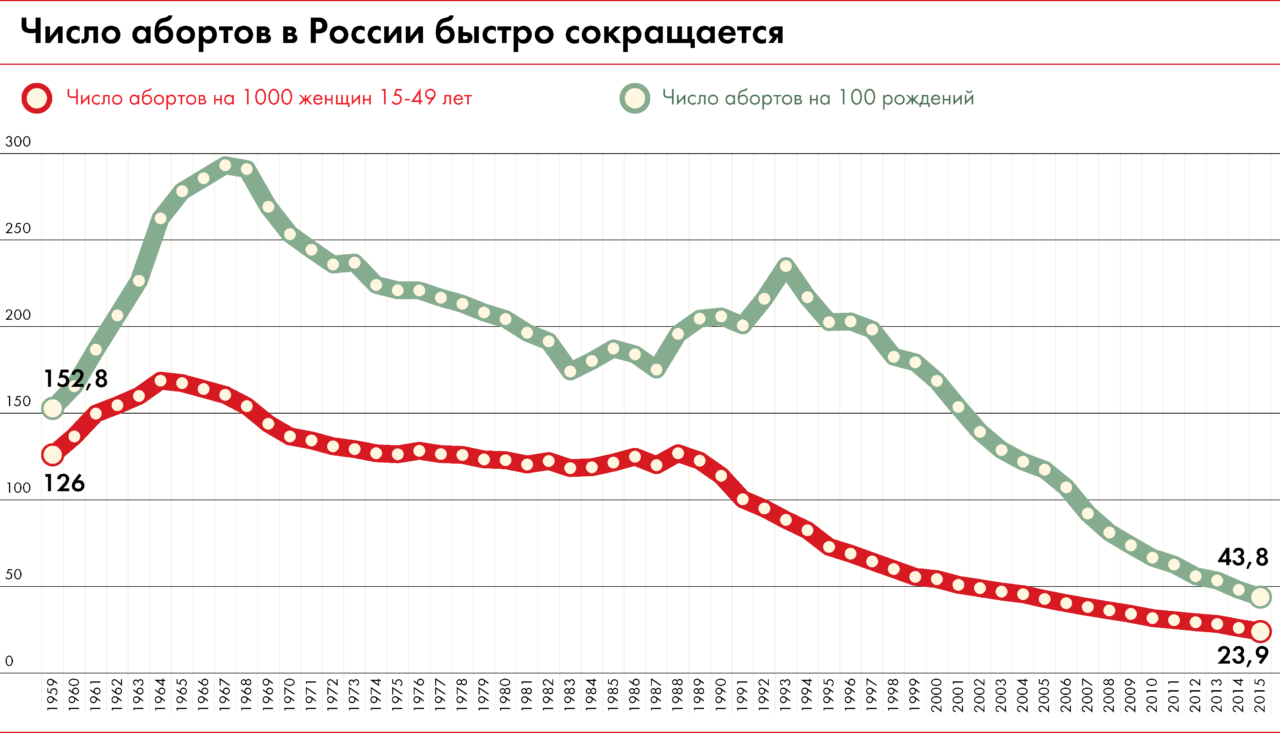 Source: Rosstat
A condom against sterilization
In Russia, there is very little data about the so -called contraceptive behavior. The state almost did not finance the relevant research. In 2011, for the first time in our history, a special “selective examination of the reproductive health of Russian women (Wors) was carried out .” We will use its results.
The prevalence of contraception in Russia is high. According to Wors, 72.3% of women aged 15 to 44 years, marriage or partnership, used contraception methods within 30 days before the survey. Never married, but sexually active women use contraceptive methods even more often. So the still relatively large number of abortions in our country does not say that couples do not know about contraception, but that malfunctions often occur (“contraceptive failures”).
The UN assesses the prevalence of contraception in Russia below - in 68% of women of reproductive age in marriage or partnership. This is at the level of developed European countries - Germany, Denmark, Greece.
But in terms of popularity of different contraceptives, Russia differs from developed countries.
The most popular contraceptive method in Russia is a condom; According to the Words, it is used by almost 27% of couples and 65% of women who did not marry (and a total of 37% of contraception users). Why do Russians love a condom so much? One version is unwillingness to once again communicate with state medicine, the desire to avoid "medical supervision" in the private sphere. A condom can be freely bought in a supermarket. The obvious plus of the condom is protection against AIDS and sexually transmitted diseases.
The second most common method is the intrauterine spiral, the third is hormonal contraception. Many years of discrediting hormonal contraception in the USSR had its fruit. You can still hear from women that hormonal tablets are harmful to health, they get fat, grow, etc.
Meanwhile, in the world, the situation looks completely different. The condom there takes only fourth place, and the most popular contraceptive methods today are female sterilization and intrauterine spiral: in 2015, the third pairs using contraception chose sterilization. Behind her are a spiral and hormonal pills.
If we compare the situation in Russia, Germany and the Netherlands, then with the same prevalence of contraception, the differences in the methods will be even more. In Germany and the Netherlands, about 60% of women resorting to contraception take hormonal tablets, another 14-16% choose sterilization. In Russia - only 13.2% and 1.5%, respectively.
Moreover, it is sterilization and hormonal drugs - especially implants placed under the skin for several years and are daily releasing minor doses of hormones - are the most reliable. But to residents of Russia, the latest generation contraceptives are poorly familiar.
The male condom and hormonal tablets relate to methods of average efficiency, their use involves a fairly high level of self -discipline (though I repeat, the condom protects from AIDS, its use should be promoted among the groups of the population subject to such risks).
The most unreliable means are spermicides (vaginal creams, pastes, jelly), interrupted sexual intercourse and calendar methods; When using them during the year, 25-29 pairs out of 100 occurs an unplanned pregnancy.
Meanwhile, about 15% of couples in Russia rely on interrupted sexual intercourse and calendar. In Western Europe, such methods use no more than 5% pairs. There is a reserve for a further reduction in the number of abortion in Russia.
Poverty and ignorance
A study conducted in a number of Eastern European and Central Asian countries revealed several reasons why women do not use modern contraception. Firstly, this ignorance is a lack of reliable information about contraception methods and disbelief in the safety of contraception for health. Secondly, the lack of education is a full-fledged youth counseling about sex and family planning. Thirdly, poverty is a relatively high cost of contraceptives, as well as the lack of their choice in the market.
Often, gynecologists give women recommendations on contraceptives, about which they themselves know little. That is, training in modern family planning should be started with doctors.
In addition, in Eastern Europe, and even more so in Central Asia, conservative moods are strong, it is very difficult or impossible to talk about anything related to sex and sexuality, and society dictates strict samples of sexual and reproductive behavior. Many of these factors are also relevant for Russia.
The contraceptive revolution in Russia is due to sharply expanding information and market capabilities, but almost without the participation of the state. It does nothing to promote modern family planning methods, despite the fact that there is practically no family that in one form or another would not have practiced such planning. According to the Levada Center survey, friends and acquaintances, not experts, are the main source of information about the methods of protecting from unwanted pregnancy of Russians. In official documents, including documents of the Ministry of Health, the word “contraception” is not found. Contraceptive means are not included in the compulsory medical insurance system. There is no sexual education in Russia.
The Russian Ministry of Health proposed to share the concepts of “prevention of unwanted pregnancy” and “prevention of abortion”. In fact, this, of course, is one and the same, but officials, introducing this artificial distinction, are the first to propose to understand the use of contraception, and under the second - measures of influence on a woman aimed at preserving an unwanted pregnancy, if she happened. All the activity of the Ministry of Health and public organizations specializing in anti -abortic rhetoric today concentrates around this “abortion prevention”.
In general, the state of contraception does not help, but does not interfere. Bye.
Author - senior researcher at the Institute of Demography of the Higher School
Other articles of the heading "Such Russia"
Abortion contraception Russia