
Translated material
The predecessor of the euro
In 1803, introducing a new cash unit - the Golden Frank, Napoleon I established not only the content of gold in it (0.290322 g), but also the ratio of the price of gold and silver (1: 15.5). After sixty, and a little of years, this ratio was adopted in the Latin Mint (LMS) created by France, Belgium, Italy and Switzerland. The agreement on the creation of the Union was signed on December 23, 1865 and entered into force on August 1, 1866.

The countries agreed to mint the standard gold and silver coins in weight and sample in order to ensure their interchangeability. The minting of silver coins of low denominations that created problems in previous years was also limited. The fact is that the influx of gold from California and Australia in the 1840s increased the relative cost of silver, after which the exchange silver coins of European countries, the price of the metal in which began to exceed the face value, began to disappear from circulation. The governments reacted with the minting of coins of lower weight and quality, but this unbalanced the monetary systems relative to each other: coins of better quality bought and melted. In particular, Italian neighbors suffered from low -grade (83.5%) coins, introduced into circulation in 1863 and practically never different from the high -industry (90%) coins of 1861–1862, and in France since 1864, the circulation of Swiss coins, minted from silver of an even lower sample (80%) were prohibited. In the end, France also reduced the sample of silver coins half, one and two francs to 83.5%, preserving the test of five -franc coins (90%); Moreover, these coins were very similar in appearance.
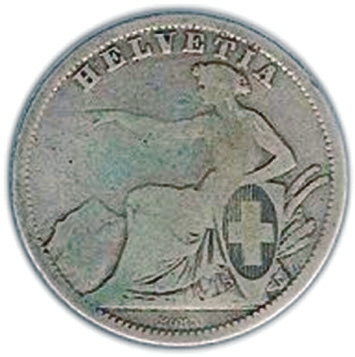
2. Switzerland. 1 franc model of 1860-1863 (5 g, 80% silver)
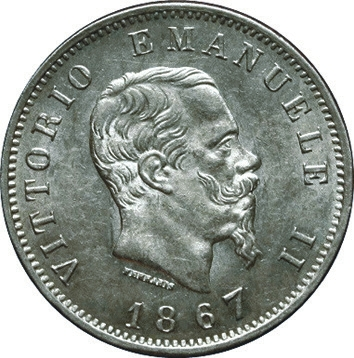
3. Italy, Victor Emmanuel II. 1 Lyra of a sample of 1863-1867 (5 g, 83.5% silver)
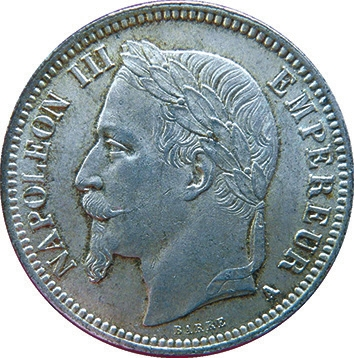
4. France, Napoleon III. 1 franc sample of 1862-1870 (5 g, 83.5% silver)
The agreement on the creation of the Latin Mint has legalized the current practice. Having taken as a basis the French franc with the current ratio of gold and silver (0.290322 g of gold, 4.5 g of silver), the contract provided for the minting of a silver coin according to the French norm. Greece, a number of countries (Spain, Romania, then Colombia, Venezuela, Serbia, Bulgaria, etc.) were joined the contract. Austria-Hungary, which did not recognize bimetallism, minted part of its gold coins according to the standard of Frank under a separate agreement with France. In Wikipedia, you can see galleries of coins minted in the LMS system; They are all similar: a portrait of the ruler on one side and the coat of arms - to the other; In the republics, instead of the ruler, freedom (in Switzerland) and Simon Bolivar (in Venezuela) were depicted.
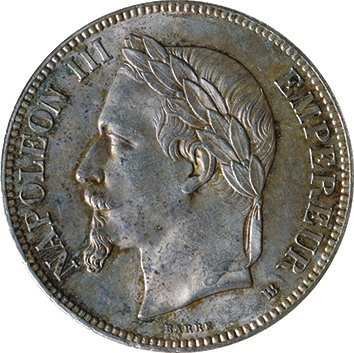
5. France, Napoleon III. 5 francs of a sample of 1861-1870 (25 g, 90% silver)
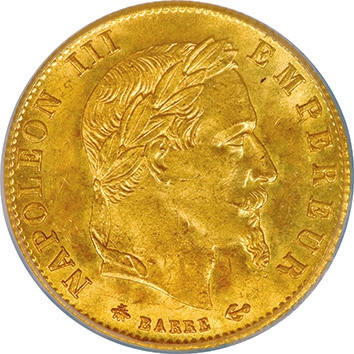
6. France, Napoleon III. 5 francs of the sample of 1862-1869 (1.6129 g, 90% of gold)
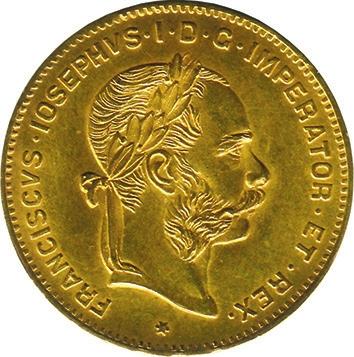
7. Austria, Franz Joseph I. 4 Florin / 10 Francs of the Sample 1870-1892 (3.2258 g, 90% of gold)
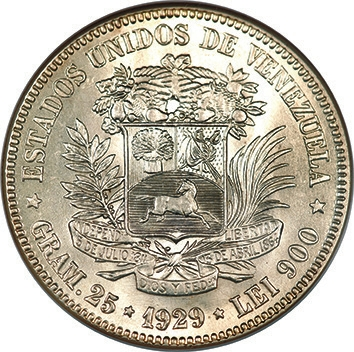
8. Venezul. 5 Bolivars of the sample of 1879-1936 (25 g, 90% silver)

The UK and the USA also considered joining LMS. In the United States, trial coins were even released in a dignity of 1 stella ($ 4), but their weight and sample were different from the LMS standard. Congress rejected this initiative, but several hundred minted coins were sold to Congress members at a metal price. Soon, when such coins were discovered in the necklaces of the inhabitants of the fashionable Washington’s public houses, a piquant scandal erupted.
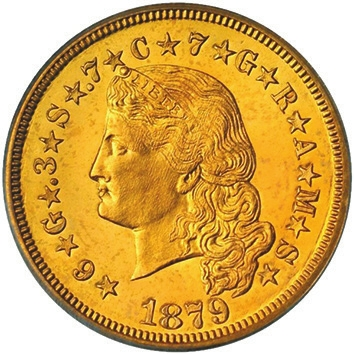
10. USA. 1 Stella / 4 dollars 1879 (7 g, 85.7% of gold, 4.3% of silver)
The Great Duchy of Finland, which has been part of the Russian Empire, minted gold (but not silver) coins according to the LMS standard since 1878. In Russia, the LMS standard was actually introduced with the reform of Count Witte 1885-1887. As a result, in 1897 a series of coins was minted at 5, 7½, 10, 15 rubles, equivalent in weight and sample 13⅓, 20, 26⅔, 40 francs.
In 1902, a coin of an unusual face value was released 37½ rubles. / 100 francs. Apparently, it was used for gifts; In any case, neither in circulation, nor in free sale, it was not; Now its cost at auctions is from 3 million rubles. In 1990, at the Leningrad Mint, the original stamps released a series of remodels from gilded copper-nickel alloy. Their circulation amounted to 50 thousand; They differ not only in weight, but also with an additional letter “P” (replica), made by another font.
By the way, Stopran weight and sample had a coin of 2½ imperial / 25 rubles regularly minted at that time, the ruble face value of which, if proceeding from the content of gold, was an overall about the entire series of 1897. Thus, contrary to the inscription on the coin, the imperial was no longer equal to ten (as at the start of the reform, in 1895-1897), but to 15 rubles.
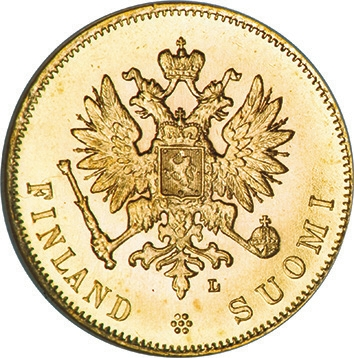
11. Finland. 10 marks of the sample of 1878-1913 (3.2258 g, 90% gold)
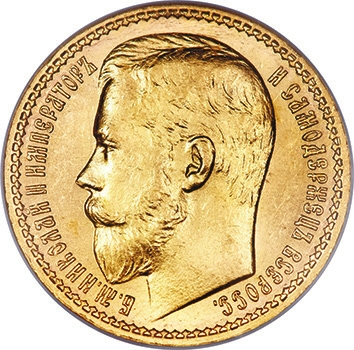
12. Russia, Nicholas II. 15 rubles. 1897 (12.9 g, 90% of gold)
The bimetallic system was unstable. By 1873, the price of silver dropped sharply. There was a temptation to earn money at the coinage of silver coins. In order to counteract this, LMS members limited the minting of full -fledged silver coins, and then completely abandoned it, actually switching from 1878 to the gold standard. The economic contradictions between the member states also grew. Large countries, first of all, France and Italy, abused the issue of banknotes, actually financing their current operations at the expense of small states; The contract was unprofitable for South European agrarian countries (Greece, Italy); The papal region was cheating on the sample of small silver coins (they were banned in France in 1870), Greece on gold (it was excluded from the LMS in 1908, but was accepted back in 1910).
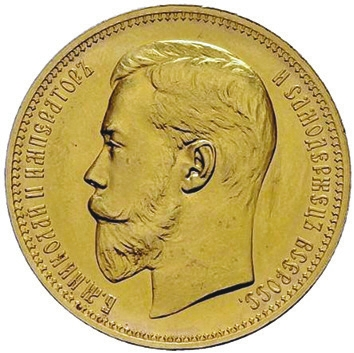
13. Russia, Nicholas II. 37 rub. 50 kopecks. / 100 francs of 1902 (32.26 g, 90% of gold)
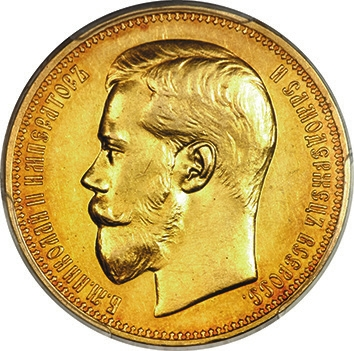
14. Russia, Nicholas II. 2½ imperial / 25 rubles. sample of 1896-1908 (32.26 g, 90% of gold)
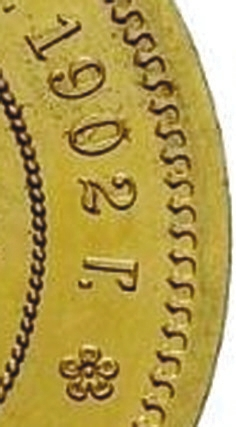
15. Fragments of the original coin 37½ rubles. / 100 francs and new 1990
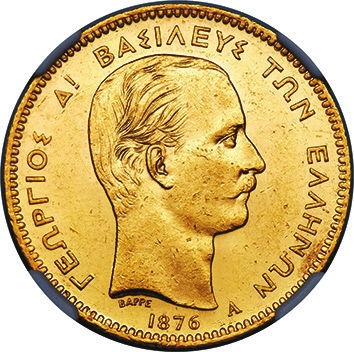
16. Greece, Georg I. 50 Drachm 1876 (16,12903 g, 90% gold, 10% copper)
Formally, LMS was dissolved only in 1927. Ironically, the last coins minted according to the norms of the LMS are just Swiss silver coins with a face value of half the franc to two francs: they were minted until 1967. However, Austria still mints investment gold coins in 4 and 8 guilders according to the LMS standard. And the silver is completely cheaper: the modern price of metal in the silver Pyatranovik LMS - € 1.93, in gold - € 50.90.

M. G.
1. Bae K.-H., Bailey W. The Latin Monetary Union: Some Evidence on Europe's Failed Common Currency // Review of Development Finance (2011), Vol. 1, RP. 131-149. www.sciencedirect.com/science/journal/18799337
2. Smirnov M.I. Production of new veins at the St. Petersburg Mint // Numismatika (2011), No. 1 (28), SS. 37–39.
3. Numista (photos of coins).
4. "Wikipedia" (drawings).