
Translated material
Patriotism for "dummies"
What is the essence of the historical policy of the Russian state
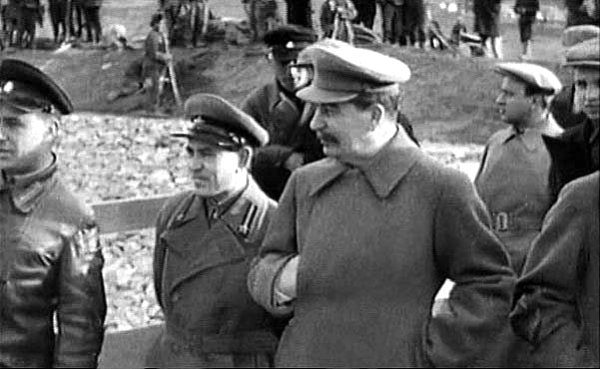
Joseph Stalin. 1932-1937 Photo: Commons.wikimedia.org
The Moscow Center of Carnegie submitted a report by the head of the Russian Internal Policy and Political Institutes program, the permanent author of NT Andrei Kolesnikov “Historical Policy in Russia: why it disrupts and not unites”. The discussion of the report was attended by historian and TV presenter Nikolai Svanidze, as well as the head of the International Council of the Association of Researchers of Russian Society, Gennady Bordyurov.
Battle of two fronts
Kolesnikov began a performance with a gloomy joke: he told how, after one of the performances, the young man approached him and asked for a long time - was it for sure that in Stalin's times could he be imprisoned just like that, without any guilt? The expert noted the growth of positive assessments of Stalin’s activity, told how in modern school textbooks for high school, it is described, for example, the beginning of World War II: “In September 1939, the West attacked Poland, for its part of the beginning of active actions and the Red Army.” This is not quite a lie-Germany is definitely the West for us, and the Red Army in September 1939 also acted actively, but due to the subtle arrangement of accents, the student receives completely perverted concepts about one of the key points of history of the twentieth century.
Turning to the main theses of the report, Kolesnikov noted that history is the main tool for the self -identification of Russians and the subject of national pride. But for the state, historical policy is also a management tool, a way to consolidate a nation around the official version of the history of Russia. The private memory of the events relatively recent past nevertheless still breaks through through any efforts of the state to create the “only correct version of history”: an immortal regiment can serve as an example here. However, the state of such initiatives fears and tries to control: the same immortal regiment has actually already turned into an element of the propaganda ritual.
Official memory is a weapon to fight two fronts, an instrument of internal policy, which is necessary for the consolidation of society and cut off the critics of the regime, but also - an instrument of domestic policy, a way of legitimizing the current position and claims of Russia in the international arena
Kolesnikov speaks of two types of memory: the state is trying to contrast the official memory of the official memory. Official memory is a weapon for the fight for two fronts, an instrument of internal policy, which is necessary for the consolidation of society and cut off critics of the regime, but also - an instrument of domestic policy, a way of legitimizing the current position and claims of Russia in the international arena (an example is a confrontation with Poland around the events of the Second World War).
The official version of history today is a story about endless victories, a course towards a militarization of consciousness and the heroization of the relevant historical characters - Stalin, including. But such a version of history does not consolidate, but split society. Kolesnikov believes that the main “fault lines” are just the attitude to the Stalin era, firstly, and to the nineties of the 20th century, and secondly. Those for whom the nineties were, although contradictory and difficult, but the time of freedom, will not find a common language with supporters of the official concept of “dashing nineties”.
The course for simplification
Nikolai Svanidze, in turn, tried, agreeing with the speaker, to highlight the key features of the state cultural policy. The main of these features, in his opinion, is simplification, primitivization of ideas about history. He considers this method Stalin. “Stalin had three heroes of the Civil War - Stalin himself, Voroshilov and Budyonny,” says Svanidze. Everything else is an unnecessary complication.
Why does the state need a simplified version of its own history? Svanidze has an answer. Firstly, such a simplified version is easier to absorb. And secondly, and this, of course, is the main thing-this approach to history destroys the ability to reflection in society, because an attempt to comprehend your own story with all its difficulties and tragedies is the best field for the development of reflection. The state does not need a reflective citizen, is sure Svanidze. It is more important to execute orders and assimilate propaganda cliches.
In Soviet times, Svanidze reminded, all world history was considered a kind of preface to the 1917 October coup. Today, the whole Russian history is interpreted as a series of endless victories, as a desire for the top, which is the modern Russian regime.
By the way, all the participants in the discussion agreed that there would be no particularly noticeable events in connection with the centenary of the “Great October” - the state is too difficult to enter the revolution into a new concept of history. Because if the Great Empire through the Great Union went to the great Russia Putin, then why did the revolution happen? It’s easier not to notice him than to try to explain.
Try of synthesis
Gennady Bordyugov proposed several conciliatory theses. He also said that it would be more useful for Russia to concentrate on the present, and not to conduct constant battles around the interpretations of history. He suggested that ideally, historical policy should be the result of a dialogue between the professional community, state and society. But this is ideal.
Andrei Kolesnikov completed the discussion with one important thought: the Russian people are not a Stalinist. The growth of the popularity of totalitarian leaders is on the one hand, the result of the pressure of the mainstream, official propaganda, the cult of endless victories. But on the other, it has protest potential. “For many, Stalin is the image of a tough but fair leader who was able to crush the thief. For some reason, they think that Stalin fought with thieves, ”Kolesnikov said.