
Translated material
Russian tango with right
The topic of Russia's influence on Western socio-political life is fashionable and multifaceted. If we subtract the most fashionable subthem - about hackers and the impact on the elections, there will also be clear mutual sympathies of the Kremlin with some governments, many years of campaign for the promotion of “traditional values”, etc. This has already written quite thoughtful research - for example, about the relations of the Russian Orthodox Church with Western (including American) conservative religious circles. But I, as a person who has been more than the same for many years, has been the most interesting, the newly published book by Anton Shekhovtsov “Russia and the Western extreme right. Black Tango ” (“ Russia and the Western Far Right. Tango Noir ”) .
The book was published by the Routledge academic publishing house, and the author is a really serious researcher, undoubtedly the best in this topic. It is impossible to retell the book-just because of the huge number of important details contained in it-but you can formulate the main conclusions that I can draw by reading it and correlating it with everything that I know myself.
First of all, who are these extremely right, with which relations from Russia are established? These are two not quite clearly distinguishable many political groups and parties - radical ultra -right, not neo -Nazi, and those who are usually called right -wing populists.
Recently, I have more than once had to answer questions regarding precisely Neonazi-whether because of their dominance in our VKontakte, be it because of their combat friendship with Russian like-minded people. Relations at this level are a long -standing tradition. More often, interest was from the Russian side - in search of additional legitimation, and it was not always successful: de Benois was quickly disappointed in Dugin, the German branch of Blood & Honour did not recognize the Aryans in the Russian namesakes. Sometimes the western extreme right were sincerely interested in expanding scale, like Jean Tiriar, but not so often. Even the book of Shekhovtsov could not accommodate all lines of such ties; They were and remain-not in vain, for example, it was Norway who fled from the psychiatric hospital the famous St. Petersburg Nazi Tarzan, and with the beginning of the Russian-Ukrainian war in 2014, in many ways, it was these connections that led European fighters to both sides of the front.
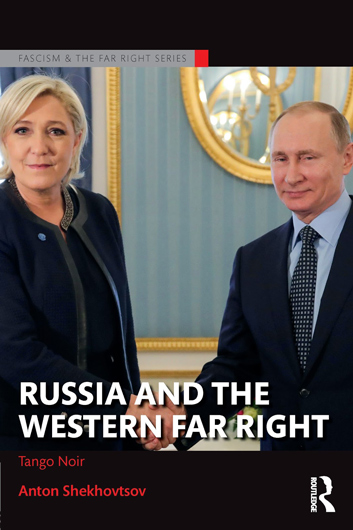 © Rutledge
Were all these ties effective? Rather, no. Participation in the war - how significant is this? After all, a war without Western fighters would have gone exactly the same. Of our marginals, communication with the West helped only some. If Dugin eventually broke through the political mainstream, then, say, the editors of Athenaea magazine (Pavel Tulaev and others), who did a lot to establish ties with Western colleagues, remained on the sidelines. The Party of Zhirinovsky over the years was increasingly connected with European neo -Nazi, and became less influential.
The second (and more promising) many Western partners are right -wing populists, that is, movements that, according to the formula of the researcher of Madd's extremism, combine technical populism in propaganda, authoritarian trends and a certain Nativism, that is, the idea that the country should be inhabited by the “indigenous” people, and other people are no less important, ideas are destructive for its development. Here, kinship can be seen, rather, not with Russian ultra -right or not only with them, but with much larger social trends, which are at the forefront of the discussion about the “indigenous peoples”, “traditional values” and at the same time about “traditional religions”. In the 90s, European right-wing populists were relatively weak, and Russian officialdom was not at all interested in them. Now, it gradually came to the official friendship of “United Russia” with the Austrian Freedom Party, the French “National Front” and others.
It is only important to understand that United Russia reaping the fruits of the long work of different circles of Russian nationalists, both remaining on an inconspicuous roadside (like the same “Athenae”) and continuing to flourish. People close to Prokhanov established many connections at one time, albeit often with the characters a little anecdotal, as the American Lyndon Larush promoted by Glazyev. Of course, Larusha could be sold as an important economist except perhaps the audience of the newspaper “Tomorrow”, how difficult it was to give a gloss brought by Baburin Jean-Mari Le Pen, but, if there weren’t those visits, maybe everything would not work out with his daughter.
Notable practical successes in the European-Russian extreme right integration began to appear as the Kremlin began to include in it after the “Orange Revolution”. Then arose-as a typical symmetrical response in the spirit of the reverse cargo-pult-the movement of pro-Moscow observers in any extra-Russian elections and the public condemnation of fascist tendencies (real or far-fetched) in Eastern Europe. It is curious that our ultra -right, including former RNE figures or the “Russian image”, actively participated in all this. Shekhovtsov describes in detail some of such bright wrestlers for democracy, in particular, the former Russian ultra -right Alexei Kochetkov and the former Polish ultra -right (now just right -wing populist) Mateusus Pisskorsky. Later, the western guests, mainly the extreme right figures, actively worked as observers in the Crimean referendum, elections in the DPR and LPR, etc. It is curious that in this specific observation activity, domestic activists are not just not far -right, but made a career on anti -fascism - like Alexander Brod (“civil control”). Here we could also speculate about the instrumentalization of anti -fascism for foreign policy purposes, but this is another topic.
The mentioned integration began to accelerate at the turn of the decade. In addition to the smooth change in the Kremlin course, it is no less important that many European extreme right -winged ones began to abandon the anti -Russian sentiments traditional for them (although there is a whole chapter in the Book of Shekhovtsov about episodes of ties and mutual sympathy back in Soviet times). At first, Putin’s “anti -oligarchic” policy (which fits perfectly into any extreme right rhetoric) at first, later - orientation to conservative values (no matter what it means is easy to ignore specifics), which they began to emphasize, as you know, since 2012. Rhetoric exercises on the topic of Eurasianism were also suitable for rapprochement.
Constantly pronounced in Moscow about the pluralism of civilizations (here from high -standing people, the first should be called the Metropolitan - then Cyril) are also pretty the western extreme right: they try not to represent themselves as a rather archaic opposition, but as a civilizational alternative. They even directly nod to modern Russia as a positive example. Of course, such a self -presentation does not coincide with the Russian rhetoric, still appealing to the vulgarized Khantington geographical distribution of “civilizations”. But a direct coincidence and a full -fledged coherent presentation of ideas is not needed, since it is not about building an ideological “international”, as it was during the time of the Comintern, but only about the pragmatic combination of propaganda approaches and narratives (however, we can say the same about ideology and propaganda and within Russia).
An incomplete coincidence of interests and propaganda techniques may prevent you from creating some kind of formal coalition (with this, European ultra-right ones are not so simple and within the EU). Some turned out to be at all on the way with official Moscow, as, say, open to Gaa Herth Vilders. A rather ambivalent position is occupied by the Hungarian Yobbik. But many other extreme right ones become more and more open and consistent in their pro -Russian position.
The presentation of new allies from the Russian side, respectively, is also becoming more and more definitely friendly. One has only to compare the intonations with which the official media wrote and spoke in different years about the same “National Front”. With obvious neo -Unaci is more difficult, of course, but here there are different ways. For example, the famous leader of the American white racists Richard Spencer Russia Today represented as an expert in Libya. By the way, the participation of the western extreme right in Russian propaganda is so noticeable that the whole chapter is devoted to this in the book of Shekhovtsov. The fact that now our ruling party signs official cooperation agreements with European extreme right -wing parties with obviously neo -Nazi roots is rather not shocking not by the fact of cooperation, but by the frankness of it.
Well, and, accordingly, a scale. Therefore, it is impossible to provide connections only by the forces of the old, since the 90s, personnel (although the role of Dugin in this sense is still significant), all new ones are connected. Activists of the "Motherland", as you know, held in 2015 in St. Petersburg the largest conference with the extreme right, if we counted by the number and political weight of Western participants. Alexei Komov, a very versatile figure associated with the patriarchy and protruding for family values and censorship on the Internet (along with a safe Internet league, behind which the figure of Malofeev is visible), played a noticeable role in rapprochement with the Italian League of the North. With the Austrian Party of Freedom, contacts were established with the active participation of Maxim Shevchenko, although it is difficult to call him extreme right, he is close in views to Islamist Heydar Jemal (however, the figures of this Austrian party were even met with Ramzan Kadyrov). Note that we are dealing with a competitive environment, so some initiatives simply die quietly: for example, that scandalous St. Petersburg conference with the Golden Dawn and other eminent neo -Nazi received.
Shekhovtsov in his book shows that on the Russian side there is no clear division into official and marginal agents of establishing ties with Western extreme right. There is, rather, a complex web of contacts, and it carefully monitors it. If we evaluate the dynamics of this process, then a gradual increase in level is obvious. Very roughly speaking - from Tulaev to Baburin or Prokhanov, then to almost the official “Dialogue of civilizations”, sponsored by Yakunin, and then to the activities of Sergei Naryshkin, who since the beginning of the Donbass epic, spent various events in Moscow with the participation of figures of the same Freedom Party, the “National Front”, the League of the North, but also the Bulgarian “attack”, etc.
What are the fruits of this policy of “taming” Western extreme right -wing different colors? Not very good. Sometimes “taming” breaks up due to the fundamental of potential partners: for example, antimissionary amendments in the “Yarova Package” greatly spoiled the planned friendship with the conservative wing of American Protestants on the basis of “traditional values”. Sometimes the frontal attack is counterproductive: the support of Marin Le Pen clearly played against her in the elections (or maybe against Fiion) and rather strengthened the Antimoskovsky course of Macron. Maybe someone sincerely hoped to cultivate in this way a new group of European leaders, friendly to the Kremlin, which were Schroeder and Berlusconi, but this attempt failed. What really happened is a close -knit pro -Russian group of extreme right -wing deputies of the European Parliament. A low percentage barrier when voting into this organ helps small parties, and this vote itself is easier to perceive as a protest, so in the European Parliament the extreme right are more noticeable than on average in national parliaments, but they are a small minority.
So why is the topic of Kremlin’s influence on Western socio-political life important then? Shekhovtsov in the conclusion of his book considers different options for further development, even the threat of a power scenario: now Russian ultra-right or former security forces train the Western ultra-right in several countries, and something similar was in Ukraine long before the Maidan. Whatever script - power, political, mixed, focused on one or another country, more or less believable - neither consider, one thing remains common: the threat does not seem realized.
But the very presence of a threat is already a political factor for a democratic society, the threat affects the course of all large parties and political leaders, albeit not always as you can expect. It is also important that the extreme right movements that have gone along the path of “taming” become more dependent on their eastern partner, and therefore more controlled, but not at the level of everyday steps, of course. In this sense, cooperation really becomes like tango, when the leading partner determines the main line, and the led - artistic and attractive details.
When they say that the Kremlin with the support of neo -Nazi and right -wing populists intimidates the West or can put it in its entirety or units under control, it is an exaggeration, but it will not be an exaggeration to say that, through this long -term campaign, it was possible to create a more or less controlled mechanism for influencing the policy of many Western countries.
Anton Shekhovtsov. Russia and the Western Far Right. Tango noir. - London: r o uteledge, 2017