
Translated material
One -way contract
The Ministry of Defense of the Russian Federation underestimates the scale of Russian participation in the battle for Deir ez-Zor
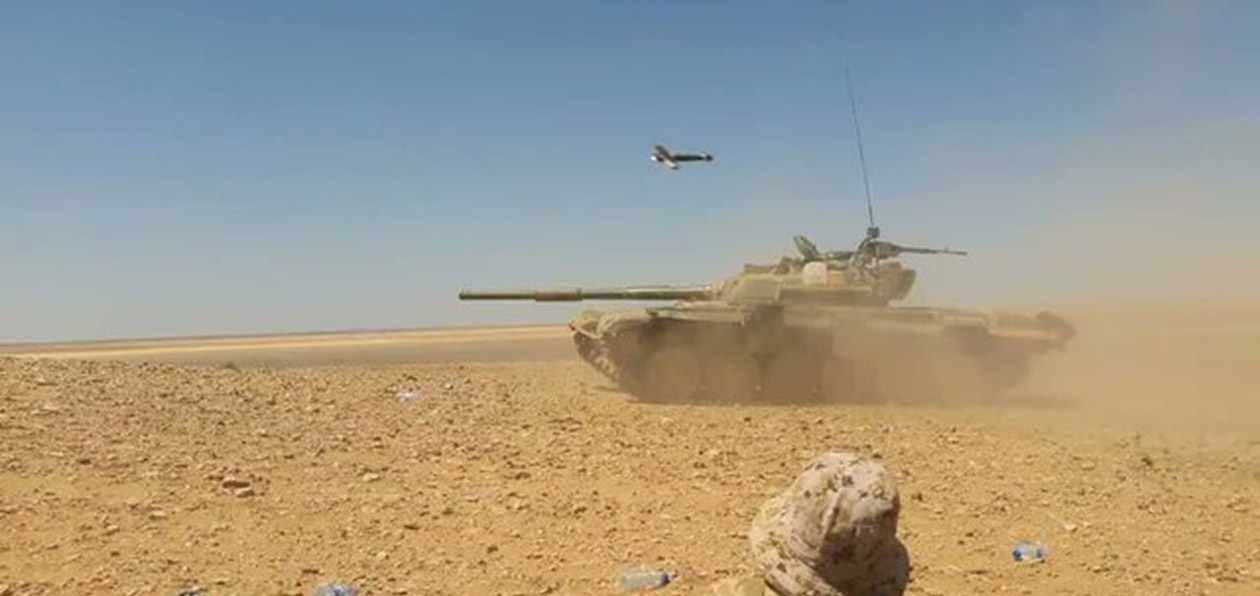
Photo: so-l.ru
For several days now, the Russian military department, without stopping, reports on the strategic success of the Syrian army. With the support of Russian aviation, she managed to release the city of Deir-Ez-Zor in the east of Syria, on the right bank of the Euphrates, which was surrounded by IG* detachments for almost three years. Judging by the relations, it was a carefully conceived and wonderful operation. And she walked in several stages.
Offensive with "caliber"
In early August, government troops, with the support of the allied forces, surrounded the city of Es-Sukhne in the province of Homs, which was an important supporting point of the IG*fighters. On August 12, for the first time since the beginning of the fighting against IG* in Syria, the Assad’s troops landed a tactical landing in the rear of the militants, after which they were defeated in the El-Ker area-this is how the Islamist detachments near Dair-Ez-Zor were cut off from their reserves. Then, in the area of the city of Ganami-Ali, government troops destroyed one of the most combat-ready and well-armed groups of IG* in the Euphrates Valley and became advanced along the eastern bank of the river. And on September 5, the blockade of Dair-Ez-Zora was broken. As usual, many enemies were destroyed and rich trophies were captured. The victory was doubly more pleasant for Assad and his allies due to the fact that Dair-Ez-Zor was blocked by detachments in which immigrants from Russia and the CIS countries were in large numbers.
Defense Minister Sergei Shoigu immediately reported on success to the Supreme Commander -in -Chief. And Vladimir Putin, in turn, sent a congratulatory telegram to Bashar Assad. At the same time, everyone significantly emphasized the decisive role of Russian VKS. The attacks of Caliber cruise missiles launched on September 5 from the Admiral Essen frigate, actually cleared the road to the advanced troops, the aircraft and helicopters of the Russian aircraft groups made up to 80 departures per day, supporting the offensive.
However, there is reason to believe that Russian participation in the operation was much wider than just aviation support.
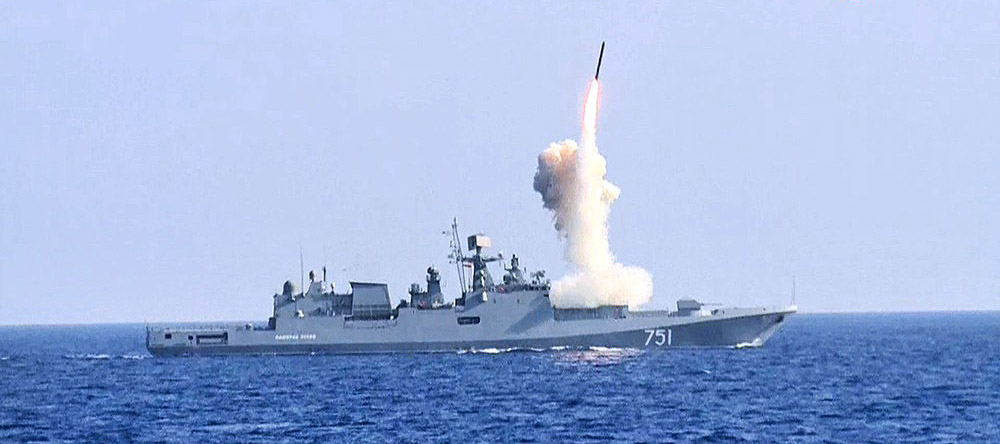
Photo: TV Center
Private hybrid war
Until recently, analysts converged that Assad’s troops were exhausted and conciliated by six years of civil war. And the release of Deir ez-Zor demanded not only careful planning (in the Russian Ministry of Defense, they practically do not hide the fact that it is our military advisers who are developing operations of the Syrian army), but also the direct participation of the “on earth” of fresh and combat regions. It is very significant that right now reports of the death of Russians were just in the area of Deir-Ez-Zor. And if the Ministry of Defense informs about the death of two military servicemen, then data on the dead “civilians” pop up in the media and social networks. In particular, two natives of Orenburg - Valeria Dziuba, a former employee of the assembly, and a certain Vladimir Kabunin is 38 years old. We add to this the fact that the previous victorious operation of the Syrian army-the capture of Palmyra in the spring of 2016-occurred with the direct participation of Russian mercenaries from the Wagner Group.
It is very significant that right now reports of the death of Russians were just in the area of Deir-Ez-Zor. And if the Ministry of Defense informs about the death of two contractors, then data on the dead “civilian” pops up in the media and social networks
This forces us to turn to the sensational investigation of the St. Petersburg publication "Fontanka.ru" . It was at his disposal that part of the archives of this so -called “private military company”, including questionnaires filled with those who died in Syria during hostilities. So it turned out that a combat unit was formed and prepared in Russian territory, numbering 2.5-3 thousand fighters, equipped according to the standards of the Russian army.
The Fontanka.ru investigation is remarkable primarily in that it shows how the mechanism of the so-called “hybrid war” functioned-a military conflict, during which the aggressor state claims that it has nothing to do with military operations.
The idea of using “volunteers” mercenaries occurred to Russian strategists in March 2014, when it became clear that it was impossible to repeat the Crimean scenario: it would be necessary to create a border where it had never been, and place a giant number of troops to cover this border.
The idea of using “volunteers” mercenaries came up with Russian strategists in March 2014, when it became clear that it was impossible to repeat the Crimean scenario: it would be necessary to create a border where it had never been, and place a giant number of troops to cover this border
It can be assumed that some Russian power "structures" allocated "reliable people" money for hiring those whom Vladimir Putin will later call simple "combinearies and miners", and paying for their "patriotic impulse." So there was a "private military corporation (PMC) of Wagner." It can only conditionally be called “private” - both in the Donbass and in Syria, she acted on the money of the Russian state. However, Russian leaders did not particularly hide this. They not only awarded the fighters with the highest Russian orders, but took pictures with their commanders. It follows from the Fontanka.ru investigation that the Wagner Group is connected with the General Staff of the General Intelligence Directorate. The point is not only that the preparation of fighters takes place on the basis of the 10th Brigade of the GRU special forces in the village of Molkino of the Krasnodar Territory. The organizational structure of the Wagner Group (staff and rear units, 4 intelligence and gear detachments, tank company and artillery division) is very similar to the structure of a separate special forces battalion, which can be easily detected on the Internet. The battalion is reinforced by the artillery division (D-30 howitzers and a volley fire system), which was part of the standard schedule of the special forces brigade. Most likely, special forces officers, who were entrusted with the formation of an “unofficial” military unit, did not bother and chose the organized organized structure.
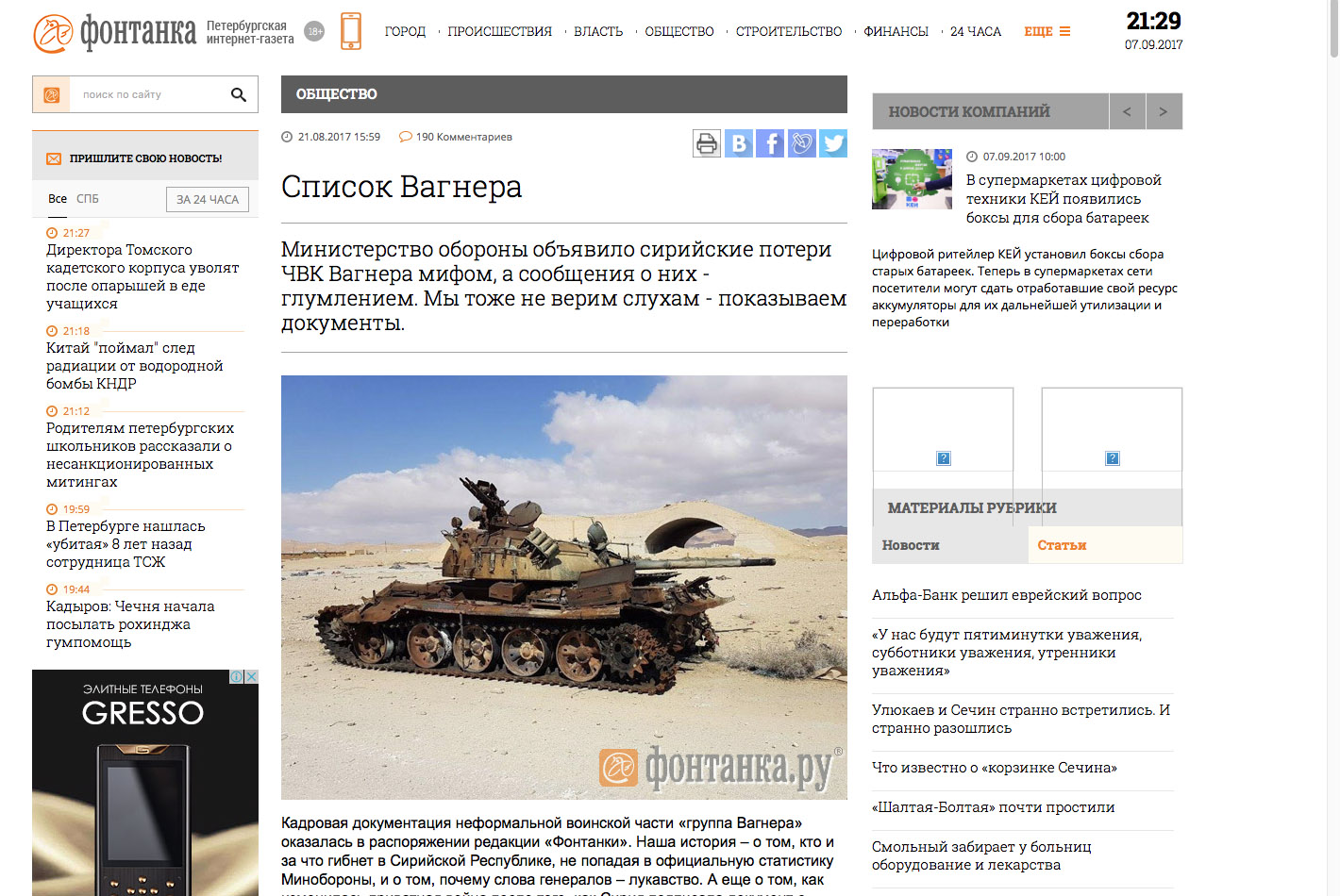
Photo: screenshot from the site fontanka.ru
The most curious in the investigation is the profiles and brief characteristics of the participants of the Wagner Group. These data dispel legends about mysterious super -elite soldiers. Only the command staff of the group are military professionals, retired officers of the army special forces and riot police, as a rule, with Chechnya's experience. In this case, the presence of appropriate training and combat experience were determining moments during hiring. So the former Major of special forces Kuznetsov served five years for robbery and abduction of man. Immediately after the release, he was taken to the post of company commander to Wagner in two years to get the star of the Hero of Russia for taking Palmyra and photographed next to Putin.
However, the ordinary composition of the connection is ordinary young men aged 25–35 years (although there are also “old people” 45 years and older), mainly from the Russian hinterland, where salaries, if any, are very modest. The Russian “soldiers of good luck” very frankly indicate in the questionnaires that they were forced to go to war by the desire to earn extra money and the need to return loans (salary of 240 thousand rubles. It seems a reasonable fee for risk). As for military experience, only the fact of an urgent army service, passed ten years ago, is enough for hiring. Even declassified elements are found. Such, for example, Igor Binder, who died in Syria with an 8-class education, which by the age of 40 has not acquired either a specialty or constant work.
The Russian chiefs suddenly created the feeling that, having hired “civilian” people to conduct hostilities, it would be possible to keep a state of participation in this war (in the Syrian case - participation in the ground operation) and not to bear any responsibility. However, it turned out that this was not so
In general, those who created the Wagner Group were guided by Soviet mobilization concepts. Their essence: it is enough to have a backbone of professional officers, who for a month or two are able to make serviceable soldiers from reservists who can be used as cannon fodder. Which, in fact, occurred at the beginning of 2016, when the "Wagnerians" threw Palmyra to storm.
Mercenaries in status
It also looks natural that after the victorious fanfare and awards, the Kremlin cooled to Wagner, who now has to conquer oil fields in Syria.
The interest of the Russian authorities in the PMC arose, as usual, as a result of an incorrectly understood Western experience. The Kremlin was inspired by the fact that the Pentagon and the State Department are widely used by private military corporations in operations abroad. But I did not understand that the reasons are, first of all, economic. The life of an American soldier is very expensive - for each deceased soldier the US military department pays more than $ 1 million. Much cheaper than PMCs, which themselves pay for insurance for the dead and wounded.
Moscow had the goals, first of all, political. The Russian chiefs suddenly created the feeling that, having hired “civilian” people to conduct hostilities, it would be possible to keep a secret in this war in this war (in the Syrian case - participation in a ground operation) and not to bear any responsibility. However, it turned out that this is not so. The participation of Russian mercenaries in hostilities in the Donbass and in Syria instantly became the secret of the police. And at the end of 2016, the Duma adopted a law on short-term contracts for service in the Armed Forces. The state received the right to hire those who want to fight abroad for several months. In addition, there was saving funds: whatever it may be, the actions of the mercenaries cost at least a billion rubles a month. Wagner became an unnecessary mediator, and the mercenaries received state status. It is possible that these “short-term contractors” are now fighting under deiz-Az-Zoros. Moreover, they are fighting against the Russian Islamists ...
* IG, ISIS, the Islamic State - an organization banned in Russia as terrorist.
See also: "Jihad in Cyrillic"