
Translated material
Pushkin and Bender in Belgrade
Alternative history of the Russian comic book
In the 1930s, emigrants from Russia composed and published comics in Yugoslavia. They invented their original plots and adapted the books of other authors - both Russian classics and Soviet writers. Yugoslavia of the 1930s is the backyard of Europe. The agrarian country and one of the centers of Russian emigration, including the Cossack. While the local Cossacks dreamed of creating free Cossacks as part of Yugoslavia, and the rest of the emigrants simply suffered from malnutrition, the owner of photocincography and emigrant Alexander Ivkovich decided to get rich in the new business. This business has become a comic book. So in 1936 Mika-Mish magazine appeared, which, in the plot, had an extremely distant resemblance to the creation of Disney. Following him, another 8 of his counterparts appeared. For a country in which the city competent population was repeatedly inferior to the rural, Ivkovich's magazines were popular and almost unthinkable circulations -
total 300 thousand copies. And this is only a week.
The very name of Irina Antanasievich’s book “The Russian Comic of the Kingdom of Yugoslavia” is perplexed. I would like to ask - was it? As it was. By the way, the life of Antanasievich itself looks like a comic. When in 1986 Antanasievich moved from the USSR to Yugoslavia, she was unlikely to think that in the unfolding Yugoslav war she would become a refugee. It is unlikely that in 1986 she expected that the candidate dissertation “Landscape in the Russian and Serbian Epica” would be defended during the bombing of NATO Yugoslavia in 1999. And you can give a hand to the cut-off, she did not think that she would engage in the Russian comic book of the 1930s, trying to answer a hidden question that still does not find an answer.
But back to Alexander Ivkovich. His concept was simple: he wanted to publish original Serbian comics. According to Antanasievich, in Yugoslavia they tried not to call their drawn stories not to call comics. Almost immediately, they began to call them “stripes” - in honor of George Strip (Yuri Lobachev), a man whom Antanasievich calls the “father of the new genre” in Yugoslavia, who blew up the market “Bloody inheritance”. At first, Ivkovich positioned himself as a publisher of a children's comic book, then expanded the audience at the expense of the phantom, Flash Gordon and Tarzan (the latter, by the way, had to change the floor and become Tarzanette). In the end, Ivkovich began to publish comics based on Serbian legends (from “The Marriage of Tsar Dushan” to comics about St. Savva, who immediately got into history textbooks), Russian history (“Peter the Great”, “Stenka Razin”) and Russian classics.
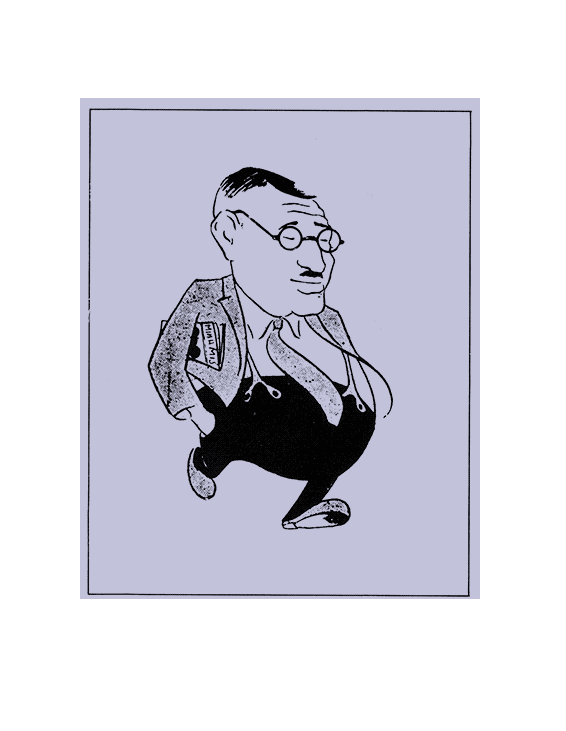
Sharz: Alexander Ivkovich in the image "Mika Misha"
Photo: rastko.rs
And how could it be otherwise if 6 of 9 artists who formed the Belgrade circle were Russian emigrants - Yuri Lobachev, Nikolai Navoev, Sergey Soloviev, Konstantin Kuznetsov, Alexey Rankhner, Ivan Shenshin. Scripts were written by Vadim Kurgan and Pavel Polyakov. These names, as well as the names that were not part of the Belgrade circle of Vladimir Zhhedrinsky, Nikolai Tishchenko and Vsevolod Gulevich, do not tell the modern reader of comics in Russia.
Nothing so far.
Almost all of them are children of the same generation. All of them were born at the turn of the XIX and XX centuries. The children of the aristocrats and even the grandchildren of the governors - all of them went the way of white emigrants, and some with weapons in their hands. Wrangel, Crimea, Constantinople, Belgrade. Their youth and youth passed in wanderings and poverty, most of them they had to live not in Russia. Few of them had an art education, and, surprisingly, many of them began to draw comics very late, when some were already over forty.
The comic was not only earnings for them, but also the reason to create a new language. Even now, the Belgrade circle is striking in its visual experiments. And, of course, it is amazing not so much by the omnivorousness of the authors who are ready to transfer to the comic and “children of Captain Grant”, the “wizard of the country of Oz”, and the “courageous soldier Schweik”, but by the rupture of all kinds of templates.
One of them, by the way, is associated with a superhero. People who read the comics have little, all the art of Sequential Art is somehow associated with the superheroic. Let this be not so, it is still nice to admit that for some time the Russian comic book conceptually ahead of American stories about guys in cloaks, masks and tight-fitting cries. Turned out for decades of detectives, horror and other boulevard literature, Zigomar (distant relative of the main character of the silent French film “Zigomar”) is the first serial superhero in Yugoslavia, created by Navoev and artist Branko Vidich. Zigomar lasted only until 1941 and perished during Belgrade's bombing.
And yet, as Irina Antanasievich shows, the stories about the Avengers in Masks and the Belgrade Frankenstein (comic book "Hurricane"), probably not the most interesting in the voluminous heritage of the Russian Commixists of the 1930s.
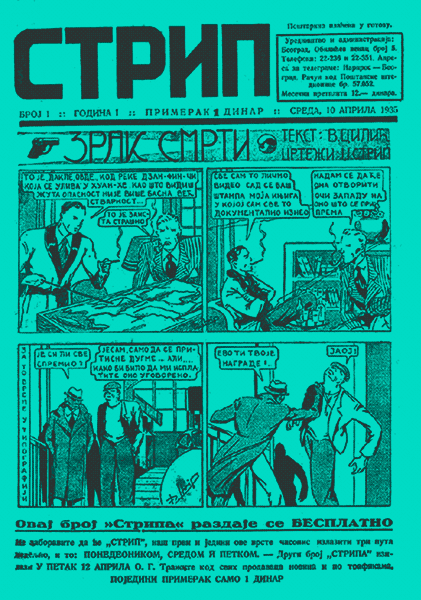 2/2
2/2 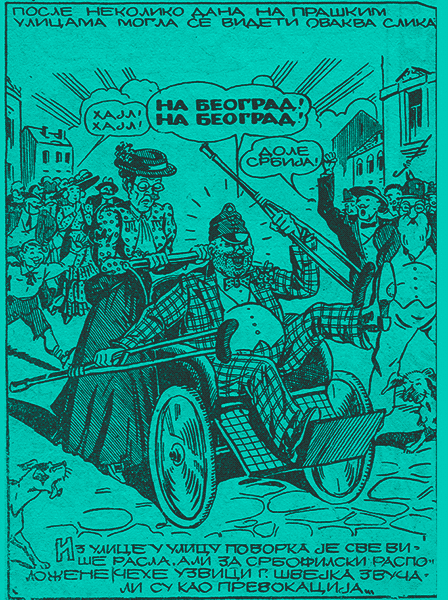
Russian classics in pictures
"Queen of Spades" as a Russian thriller. "Captain's daughter" and a merciless Russian rebellion. Two Tarasa Bulba and three Sundays. The separatist Haji-Murat, Anna Karenina and the sensitive “auditor”. For the authors of the Belgrade circle, especially such as Konstantin Kuznetsov and Alexei Ranchner, the classic as the basis of the plot was more likely to be an exception. For their comics, "Adaptation" is a wrong word. In his books, Irina Antanasievich shows this more than convincing. Translating the Russian classics at once into two languages - the Serbian language and the language of the comic book - the comixists of the Belgrade circle did anything, but did not simplify the original or slavishly followed its letter. They broke it, built it for themselves and highlighted the meanings that no one had paid attention to before.
Nothing prevented them from making Anna Karenin's “tragedy of motherhood”. Resurrect Haji Murat and add several chapters for Tolstoy. What can we say about the “daughter of the postmaster” (“station caretaker”), this communal apartment in which whole scenes from the novels “What to do?”, “Anna Karenina” and “Idiot” found shelter. For the authors of these comics, the Russian classic was not a dogma, but clay. And therefore, between them and the ultra-postmodern Masop “Anna Karenina by Leo Tolstoy” (2000) Katya Metelitsa with Vronsky-Travart and a killer train in the form of a stranger is not such a cultural abyss. Well, maximum from a five -year -old child to Leo Tolstoy.
They just behaved like nostalgic heretics. Their heresy is clear. But where their nostalgia is more important. “Not quite their own in a foreign country,” Lobachev and his comrades understood that the Russian classic was one of the few ways to remain himself. The imaginary Russia of the Dubrovsky, the kings of Saltanov, Ruslanov and Lyudmil were already good that there was no hint of the revolution that the February and October Revolutions, and then the Civil War in Russia, introduced into their life. Probably one thing. Do not experience Lobachev, Kuznetsov, Rankhner, Navoev, Poles and other authors of such an acute nostalgia for the abandoned homeland, the Russian classic would not become such a popular material for the Serbian comic book. This conclusion inevitably suggests itself after reading the “Russian classics in pictures” by Irina Antanasievich.
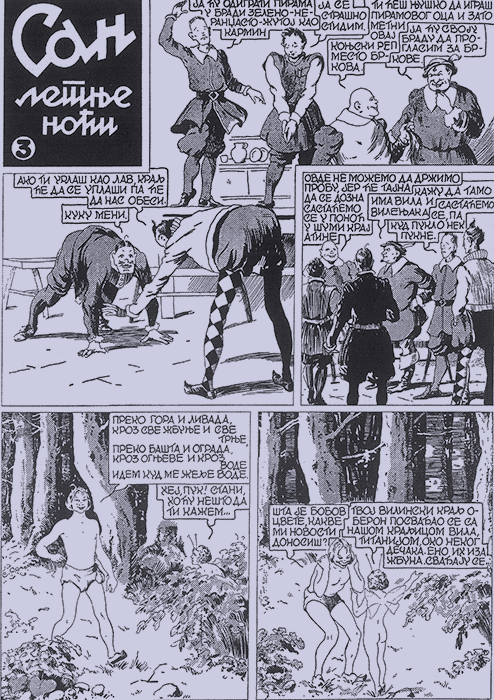 2/3
2/3 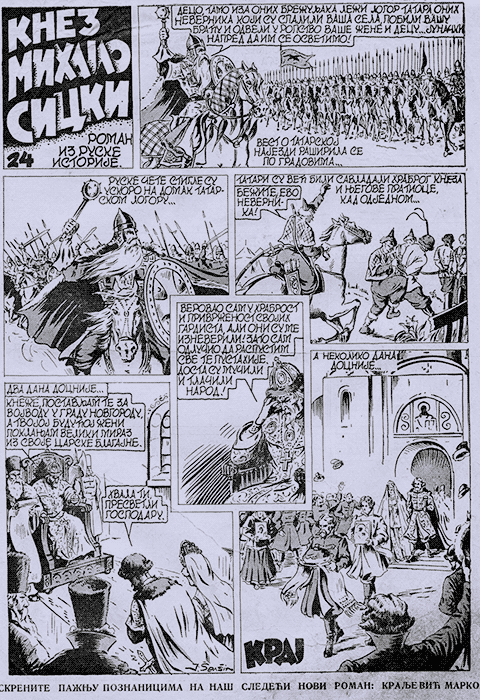 3/3
3/3 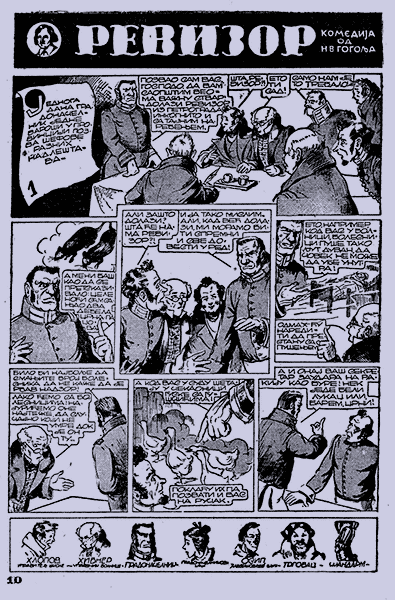
Adventures of white emigrants in the country of advice
The relationship between Russian emigration and Soviet literature of the 1930s is easier not to be called a dialogue, but by a game of ping pong with a brick wall. The naive Soviet citizens who were unlikely to read the “Berlin” novels of Sirin or “Essays on the Russian Troubles” by Denikin, would be amazed at how carefully Russian emigrant commitixers read Sholokhov, Ilf/Petrov and even Lazarus Lagin.
Looking at the heroes of the monographs Antanasievich, it is easy to guess that people who have passed the ice campaign, evacuation from Crimea, Constantinople and sitting in Gallipoli could not have a sympathy for the Soviet view of recent history. Therefore, their comics, adapting Soviet works (without taking into account the original comics of Navoev and Visich about Chelyuskins and their heroic icebreaker), even more than the adaptation of Russian classics, played on a change in the plot and various inversions - in the range from the ideological appropriation of the discourse to ordinary jokes.
Among such curioses are Navoev’s comic book “The Great Combinator Bender” (1935), the first comic book by Ilf and Petrov, who appeared four years after his original, “Golden Calf”, which, naturally, illegally reprinted the Parisian Satyricon. After a few issues, Navoev lost the Office of the “Antelope of the GNU” and mercilessly diluted his crew, throwing it into the abyss. On this “Yugoslav” adventures Ostap Bender ended. Unlike, for example, the adventures of Grigory Melekhov.
The graphic novel “Cossacks” by Sergei Solovyov is an example of less ingenuous work with Sholokhov's text. The first three volumes of the “Quiet Don” were published in 1935, and already in 1938 Soloviev made their comic version. Having preserved the time of action, characters and partly Sholokhov style, Soloviev in his own way showed the First World War, and then the Civil War from the point of view of the White Cossack. The Reds in this comic are even visually perceived as nonhumans. But the worst thing is the military personnel of the Cossack comic book, describing an offensive and a gas attack, instructing the horror that Sergei Gerasimov will not soon achieve in his film adaptation.
Russian emigrants in Yugoslavia managed to draw even the "Wizard Hottabych." The comic strip of Ivan Shenshin was published in 1940, that is, a year after the original (the fairy tale did not go out on the Serbian). As in the case of Solovyov’s “Cossacks”, there were not without direct inversions - so, Shenshin suffered the action of the story of the Lagin from the Soviet one in pre -revolutionary times. Schensshin’s boy muttered from the pioneer of Lenin to Scout, and instead of flights over industrial Moscow with monuments, the main characters, a blessed pioneer and sparkling of the domes of Orthodox churches were opened.
The authors of the Belgrade circle created not only the alternative history of the Russian comic book. They began an alternative history of Soviet literature. This inversion is now forcing him to ask unambiguous questions. At least from the series - “How would Sholokhov write“ Quiet Don ”if the whites won?” And "Who would the gymnasiumist of the wax of the kostalkov grow into, live he at the cursed tsarism?" The comics of the Belgrade circle is the eternal "if." The very one that does not moan about the "Russia that we have lost", but just complains about "Russia that we have not acquired."
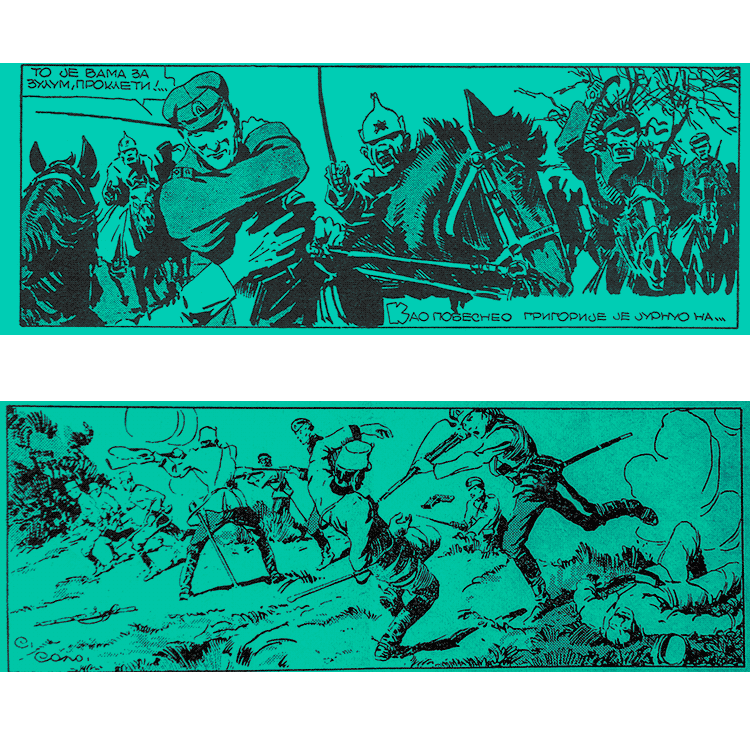
Fragments of the graphic novel "Cossacks" by Sergey Solovyov
Photo: provided by Irina Antanasievich
Further fate
Tuberculomic agent Navoev simply did not live until April 1941, when German aviation erased half of Belgrade from the face of the earth. Almost nothing left of Ivkovich’s enterprise. Except for people. And those-each in their own way-went to survive.
Kuznetsov and Ranhner began to cooperate with the invaders in the propaganda department "S". Lobachev went into resistance. Rankhner was then found dead in the ravine, and the Serbian patriots were shot by the Schenshin for illustrations for the fairy tales of Hans Christian Andersen. True, those were drawn for the German publishing house Sudost.
After the war, almost all survivors were forced to emigrate - and life scattered them in the range from Munich to Brazil. The comic stayed in their life behind. Kuznetsov became an icon painter in San Francisco, Zhedrinsky-the famous theater decorator in France. Polyakov ended up in Bavaria and finally retrained in the poet and storyteller.
In 1949, in the wake of the aggravated Soviet-Yugoslav relations, Lobachev left for Romania, and after the death of Stalin-to Leningrad. There, by virtue of the Soviet comic foby, his new comics were almost not published: they never appeared in Murzilka, and the “bonfire” was not published for long, his comic book “Hurricane goes to the rescue”. For the rest of his life, Lobachev painted comics in the USSR, but they still went out, in Yugoslavia, including the most famous-“Gaiduk Velko”. Lobachev died in 2002 in St. Petersburg. He was 94 years old.
According to Antanasievich, after the war Ivkovich tried to attract the audience with comics about fighters with fascism, but the new government sharply rejected this. And in vain: although Ivkovich was no longer engaged in a comic book, later socialist Yugoslavia came to taste and mastered the genre of “partisan” comic book, and then completely began to reprint the graphic novels of the “Golden Age”. In other words, although none of the Russian authors of the Belgrade circle, except Lobachev, was engaged in a comic book in the post -war Yugoslavia, in five pre -war years Ivkovich and his team prepared a new art and the tradition and audience. In the Soviet Union, where the first comic studios appeared only at the end of perestroika, there were no such five years.
Take off interest in Russia
In 1990, when 81-year-old Lobachev came to the presentation of the comic studio “Com”, acquaintance with him caused Moscow artists. The authors, who are now called the “pioneers” and “veterans” of the Russian comic book, suddenly found out that they were not the first: the iron curtain fell, and it became clear: the Russian comic 50 years before the studios “Com”, “Fly”, “Veles” and “Theme” took place as the golden age of the Yugoslavsky comic book.
The reprints of the authors of the Belgrade circle began to appear in Yugoslavia in the 1990s and are still going out there-including in such publishers as comico. Interest in these authors in Russia came gradually. Although the Russian Comics collection, published in 2010 with a new literary review, did not say a word about such a phenomenon as the Belgrade Circle, already in 2011, director Pavel Fetisov shot the documentary “Yuri Lobachev. The father of the Russian comic book. " Nevertheless, it will probably be possible to hold the Russian comics of the 1930s in their hands only now-eighty years after the appearance of Mika-Mish magazine.
This fall, the Black Hundred Publishing House, specializing in the publication of emigrant literature, promises to publish the anthology of the Russian Comics of the Kingdom of Yugoslavia, containing 17 comics and 426 pages. But Irina Antanasievich had a conflict with this publishing house.
“The story of the Black Hundred is rather unpleasant than the tragic,” she says. - Yes, I sent my books to people from the publisher, yes, I sent them some materials. The problem began when they started the publication of the album, and I refused to send them full versions of the comics, because I believe that the copyrights of both Serbian publishers and the Serbian side are violated in this way, which has been collecting, exploring and keeping these comics for years. The album is coming out now. If, upon its exit, all copyrights are taken into account, then I will only welcome it. ”
According to Irina Antanasievich, Russian artists left such a great legacy that even ten albums will not cover the abundance of those that they affected in their comics.
By the way, the Black Hundred already has competitors. The Bumpniga Publishing House, which has published an author’s comic book in Russia for many years, together with the Serbian Publishing House, plans to release a series of albums of the Belgrade circle. The publisher of Bumpnigs Dmitry Yakovlev shared that "the first to release is an album dedicated to comics in Russian classics." According to Irina Antanasievich, students of Belgrade University, as well as students from Tyumen, Belgorod and Voronezh, made translations. The purpose of this project is not only to publish the legacy of the Russian comicians of Serbia, really unfamiliar to modern Russia, but also to “connect our countries, make cooperation alive, and not dead officialdom”.
Irina Antanasievich does not consider himself the discoverer of the Russian comic book of the Belgrade circle. “This part of the history of the Yugoslav comic book is described in detail in the works of Zdorovavka Zupan and Slavko Draginich,” she says. - They wrote Slobodan Ivkov and Zoran Stefanovich about them. Their work was investigated by Zhik Bogdanovich and Alexander Rakezich. ” In addition to the systematization of all Yugoslav comics with Russian themes, Irina Antanasievich considers the popularization of the work of his heroes among the Russian audience. But, we must be honest, without books and speeches Antanasievich, we would not soon learn about the fate of the Russian comic book, which was not in Russia.