
Translated material
Vinus Williams defeated Shegren's syndrome and returned to the five strongest
The story of a great athlete who can do everything
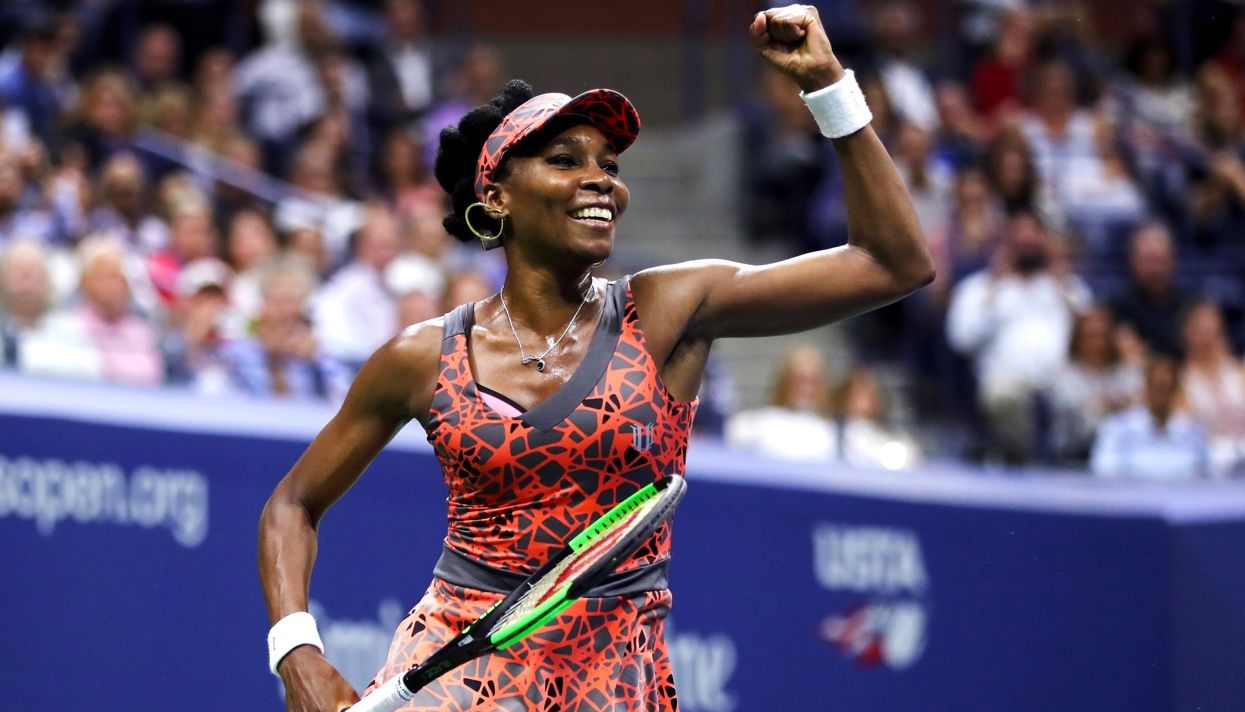
On September 10, the 137th US Open ends in New York, and Vinus Williams was one of the main events. From the famous tennis player no longer expected big victories, but this year she suddenly survived the Renaissance. The older sister of Williams reached the finals of the Australian Open and Wimbledon, and on US Open could become the first racket of the world-and, although she lost, eventually returns to the top 5 of the strongest tennis players of our time. At the request of Medusa, the editor of the Sports.ru tennis section Valeria Lee talks about what the athlete had to endure.
Disease incompatible with sports
In August 2011, 31-year-old Vinus Williams arrived in New York at her 13th opening championship. She won him twice-in 2000 and 2001. Williams's first victory in this US Open tournament was in the middle of her win -win series, which stretched for 35 matches, six tournaments and three continents. Soon after the second New York triumph, the 21-year-old tennis player became the first African American at the top of the world ranking. Until the end of the decade, she won five more Wimbledons, three Olympic gold, played a key role in the prize equation for men and women in the largest tournaments, and also received a designer diploma. Despite the fact that, according to purely sporting indicators, her younger sister Serena quickly circumvented her, the status of Williams Sr. as an icon of world tennis became obvious even then.
The season-2011, however, did not ask Vinus from the very beginning: at the first tournament, she was injured and missed six months, and in the summer, having barely recovered, she picked up a mysterious viral infection, returning after which she put off several times, which for players of this level is not characterly. It was US Open who became the first Williams tournament after the illness, and she even went through the Round, before impressing the tennis world to news: she has diagnosed Shegren syndrome - mainly female autoimmune disease that is practically incompatible with professional sports. Shegren syndrome is characterized by damage to the connective tissue, muscle and articular pain, the loss of strength and, in fact, is not treated. Williams starred with US Open to “focus on treatment”, and shocked reporters, trying to comprehend the drama of what had happened, reported that she left the tournament “Smiling, but with her head lowered”.
Later it became known that the manifestations of the disease: fatigue, numbness, swelling, inflammation, - Wilms brued from the second half of the zero, but their fragmentation made it difficult to make a diagnosis, and the struggle of tennis players for health was reduced to the unsystematic and exhausting suppression of symptoms. When the reason was finally established, the athlete met her stoically: she was glad of certainty and a few weeks later she stated that she would certainly return to the court. It even turned out that Williams recognized the diagnosis before the start of US Open, but decided to speak there just because she had done this for years already as a patient. “You almost get used to all these problems,” she told the New York Times . - You tell yourself not to pay attention and just continue. I had to pretend that I was in order when I felt terribly. ”
The next six months, Williams learned to live with the disease and control its course with the help of medicines, a vegan diet and dosed physical exertion. “At first there were days when I could not get out of bed,” she said CNN . “But it didn’t get better to me, so I chose a job.” I am convinced that no work goes away in vain, and if today you can do a little bit, even if it will be so, because in the end such days will also affect the general result. ”
Doctors promised that the tennis player would become easier for three to six months and were not mistaken: a little more than six months later, Williams returned to the court at a large home tournament in Miami and immediately reached the quarterfinals, defeating the Wimbledon champion Peter Kvitov. Further, Winus continued to play in her usual dense graphics and until the end of the season rose to a hundred and more than a hundred positions in the ranking, even winning one small title (44th in her career), as well as the fourth Olympic gold duet with Serena.
Visioner, revolutionary and trendsetter
Meanwhile, the victory of Vinus over the disease looked final only from the outside. The athlete herself only tried to come to terms with this new reality for herself, noticeably changing the position that she occupied on a global tennis stage.
Vinus Williams with all its titles and achievements is not just a tennis legend. Vinus Williams and her sister Serena is not only an amazing story about how two great tennis players grew up in one family without tennis traditions. Even Vinus Williams with her career, stretching for three decades, is not just an example of a fantastic sports longevity. Vinus Williams is a kind of tennis Steve Jobs: a visionary, a revolutionary and a trendsetter who changed his profession, if not alone, then at least strongly enough to take a special place in her history forever.
The Williams sisters showed that you do not need to be a child from a rich white family to make a pathos “Wimbledon” with their family competition. You do not need to be rushed through junior tournaments to become a successful professional. They showed that female tennis can be power, and not combinative, if it helps to win. Thanks to Williams sisters, no one needs to apologize for not answering someone's ideas about what should be (fragile/white/flirty/conventionally feminine). “Strength is beautiful,” the new slogan of the Women's Tennis Association (WTA) proclaimed in 2011, and you can only guess if Vinus and Serena would have appeared without victories.
For all the inextricable connection - both kinship and ideological - Williams sisters, the eldest vinus more or less took all the key professional steps first: played in the final of the "helmet", became the first racket of the world, won the Olympics. At the early stage of her career, she - consciously or not - acted as the face of the family and so firmly got used to this role of Ambassador that she later very organically transferred it to the scale of the entire profession. A public vyuz is traditionally calm and holds on an article that in the tennis community only the blind did not call the Royal (even in a lace dress inspired by the “muleu rouge”, in which she once played “Roland Garros”). She does not explain her failures with external factors like injuries, a difficult schedule or weather conditions, and after victories she does not boast of his own hard work and determination.

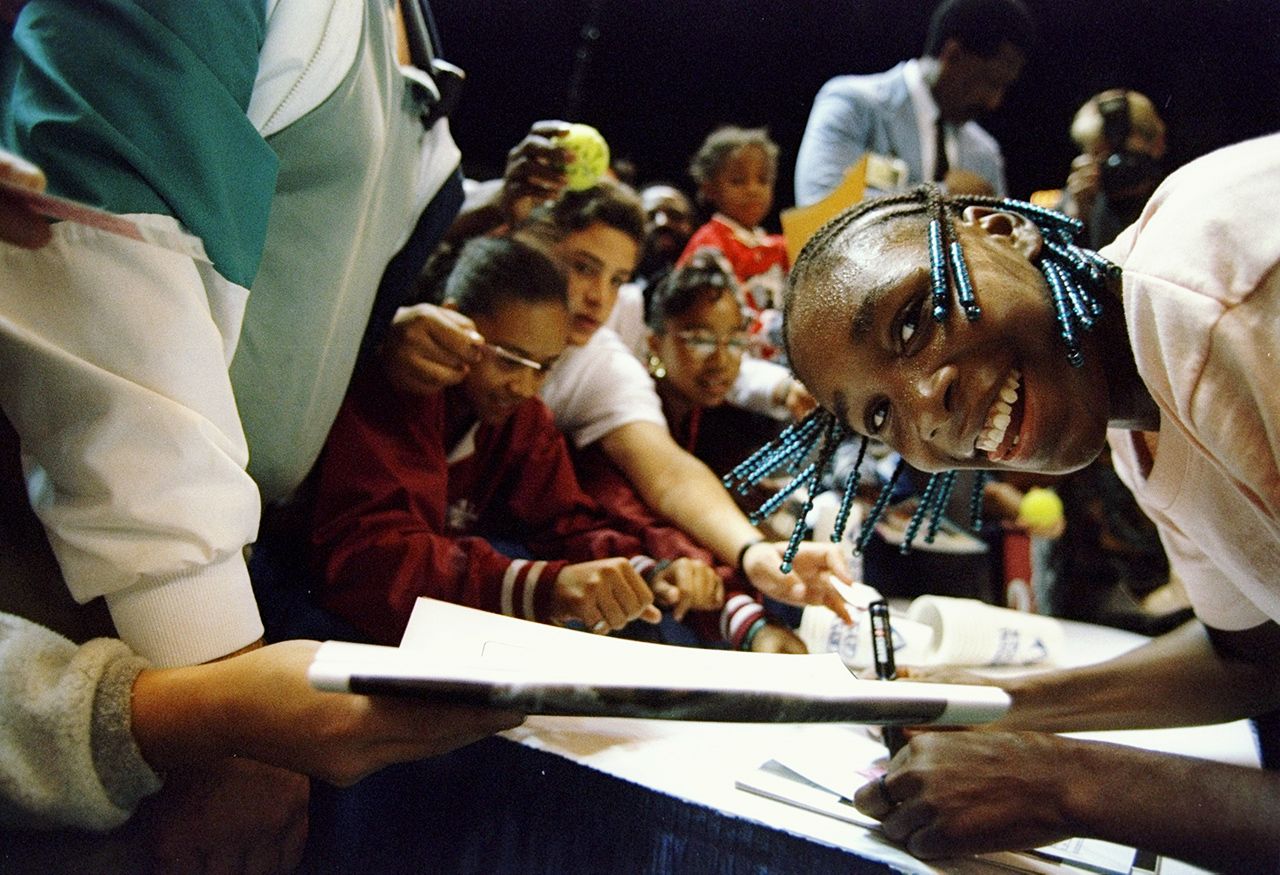
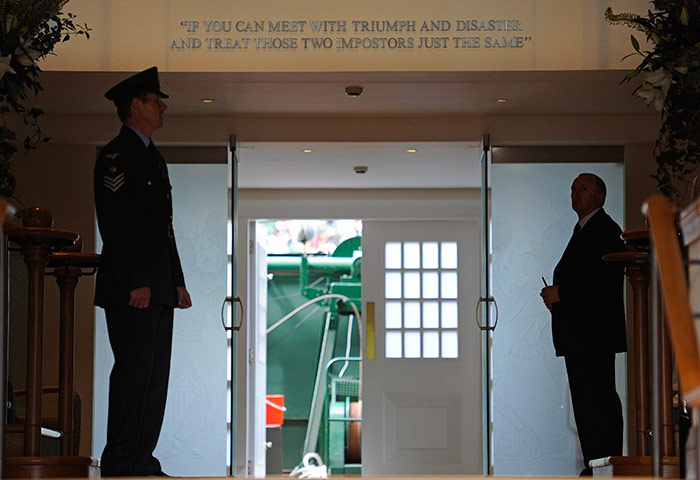
Having appeared in tennis to anyone not like a teenager, Williams was initially considered “arrogant” and “inappropriate”, but over the years it became an unconditional authority, the embodiment of dignity and labor ethics - directly from the poem of Kipling, the lines of which are met by every “Wimbledon” central court: “And you will be solid in luck and in misfortune, which, in which, in entities, the price is one. ” She often answers questions with short, but calling punchlins, who ask for the heading: “The better the opponent plays, the better you play”; “We both had a racket, and therefore the chance to win”; “About every match, I know that it will not be simple for me. But he will not be so for my rival. ”
It seems that it was always known about Vynus: nothing is impossible for her, because she refuses to admit that she cannot. Therefore, a rare young tennis player after the first meeting with Williams does without the words “This is an honor for me”; Therefore, Maria Sharapova, once defeating Vinus in her not better shape at the Australian open championship, rejoiced much more violently than after any other victory in the third circle.
And that is why the disease fell on Williams with such a heavy load. As a person who was talent and upbringing all his life from one height to another, it was difficult for her to realize that her possibilities no longer depend on her alone; That suddenly there were obstacles, which she may not be able to overcome. “It turned out that there are things that I are not able to influence. After that, I had to seriously rebuild, but I look at it as another test, because in my whole life I have never surrendered to anything. I lost and learned lessons - but I never threw out the white flag. ”
Return to the top 5 tennis players in the world
These searches of the new themselves lasted for Williams for more than one season and were accompanied by torment on the court and mediocre results. Universal admiration for her selflessness soon replaced with polite perplexity. Vinus began to be accompanied by retirement - sometimes in direct text - especially since her interests never closed on tennis. Back in 2002, she founded the design bureau V*Starr Interiors, engaged in the design of residential and commercial spaces, in 2007 launched the Eleven sportswear line (in which she first performed herself, and then attracted other tennis players), in 2010 wrote a book about the psychology of success , and received a second higher education a couple of years ago-in the field of business management.
But Williams from tennis did not leave. She suffered defeats that would be humiliating in another context, suffered condescension, suffered, as the common English -speaking wisdom “fake it till you make it” tells - “pretend until it becomes true”. As a result, in 2015, for the first time in seven years, the athlete won three titles per season, in 2016 for the first time in six went to the semifinals of the “helmet”, and at the age of 37 she played in two “helmet” finals and became the leader of the season in the number of matches won in four most important tournaments. At the decisive stages of the “helmets” of tennis players, Williams was not after Martina Navvatilova in the mid-90s, when the total tennis level was many times lower. On the finished US Open, Williams played in the semifinals for the first time in seven years and was two glasses from the victory over the future champion Sloan Stevens. Now, six years after the diagnosis, which put the end of its invulnerability (and almost buried his career), Williams returns to the five strongest tennis players in the world.
“People love sports so much, because everything in it is at stake. Here and now. There is no reserve option, the second double, the opportunity to erase everything and write down all over. You either won everything, or lost everything. For the sake of this, we are killed - because everything that is not a victory is a defeat, ” said Vinus Williams at the beginning of the year on the way to the final of the Australian Open.
“Sport is a model of life, and it shows what the human spirit is capable of, how we can fight, no matter what. No matter how we give up, no matter what happens, ”she continued her thought this week on US Open. And although she ended the tournament with defeat, the championship of Vinus Williams has already become a legend.
Valery Lee