
Translated material
The amateur historian claims that he found the code for the mysterious manuscript of the war of the 15th century. Supposedly this is a treatise on female health
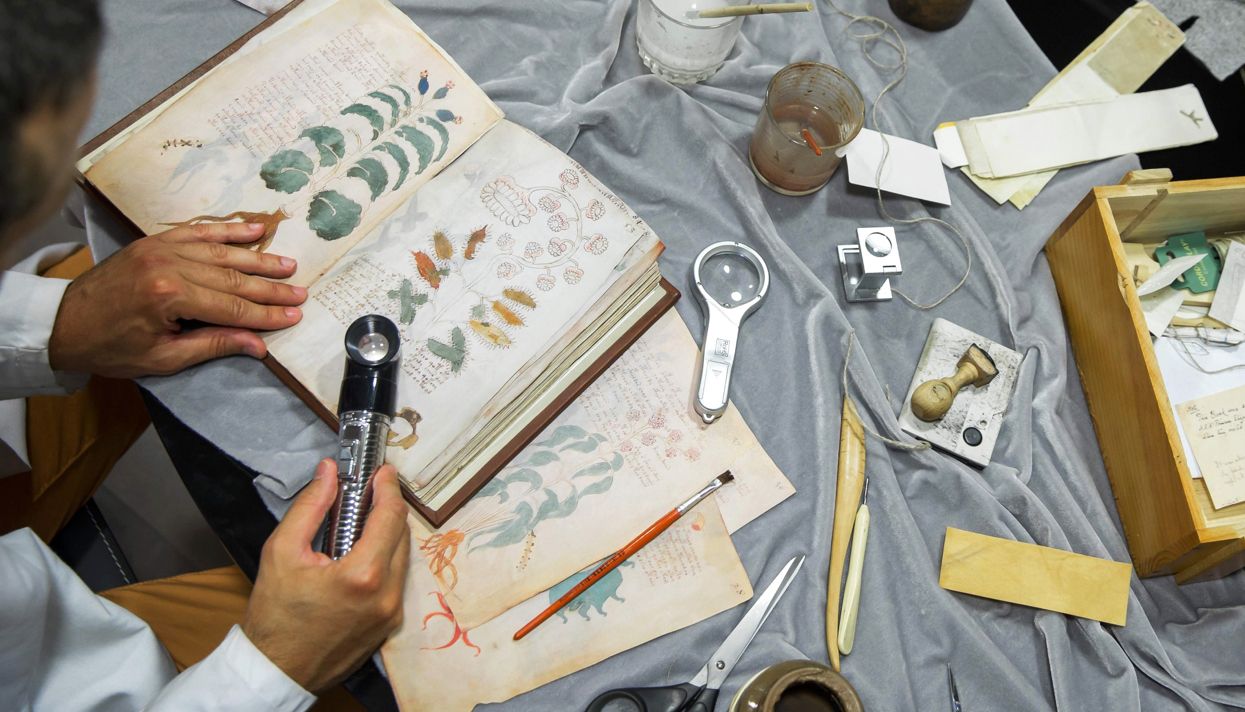
In early September, in the influential British literary and critical magazine The Times Literary Supplement (TLS) published an article by amateur historian Nicholas Gibbs on the unraveling of the secrets of the famous war manuscript. Medieval manuscript, written in an unknown language - and with the same amazing illustrations - still could not decipher the leading scientists and cryptologists. The scientific community in the plausibility of the new version doubted.
The manuscript of Voinich has been trying to decipher for more than a hundred years-since the Polish-Lithuanian bibliophile and antiquely Mikhail-Vilfred Voynich discovered her at Villa Mondragon near Rome during the secret sale of the Archive of the Jesuit College. Voinich acquired the manuscript along with other books from the college library in 1912 and dedicated the rest of his life to decryption - but did not succeed in this. After the death of Wojnich, his wife Ethel, the author of the novel “Disde”, popular in the USSR, sold the book to the famous Bukinist Hans Kraus, and he, in turn, handed it to a scientist. Since 1969, the manuscript has been stored in the library of rare books by Bainek of Yale University; It is completely digitized , so anyone can try to approach its decoding.
In addition, in 2016, the Spanish publishing house Siloé bought the rights to replicate the manuscript: the publisher promised to release 898 exact copies that reproduce even the texture of paper, spots and damage to the original. Despite the high cost (from seven to eight thousand euros per copy), about 300 pre -orders per replica were immediately received by the publishing house.
Why is this manuscript so noteworthy?
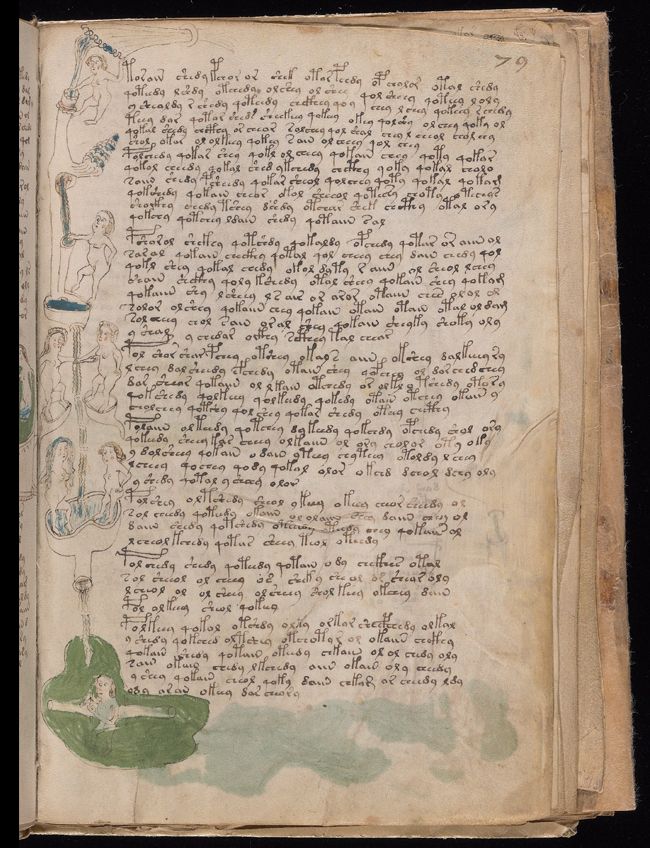
Nobody knows about anything this book, nor in any language, nor who its author (Wojnich himself mistakenly believed that it could be the English monk and the philosopher of the 13th century Roger Bacon). The 240-page manuscript is written using the alphabet unknown to science, although it has a familiar division into words and paragraphs using indentation. Scientists can not even confidently say - this is a natural language, artificial or cipher.
Researchers put forward the versions that this text is a complete nonsense: either the mystification, or the work of a person with a mental disorder. Throughout the 20th century, historians, linguists and famous ciphers - in particular, cryptographer William Friedman, who hacked the code of the Japanese Purple encryption machine during World War II during the Second World War. None of them managed to decipher the manuscript line.
In addition to the text, the book has many illustrations that are divided into “botanical”, “biological”, “astronomical”, “cosmological”, “pharmaceutical” and “receptive”. These are either diagrams or figurative images - plants, vessels and naked women splashing in green water. Moreover, most plants also look implausible. In 2013, American botanists said that they managed to identify only 37 plants from 303 depicted in manuscript (some - from the New World). All this allows scientists to assume that the war manuscript can be a medical or pharmaceutical document, but what kind of information he contains and what was written for is still unclear.
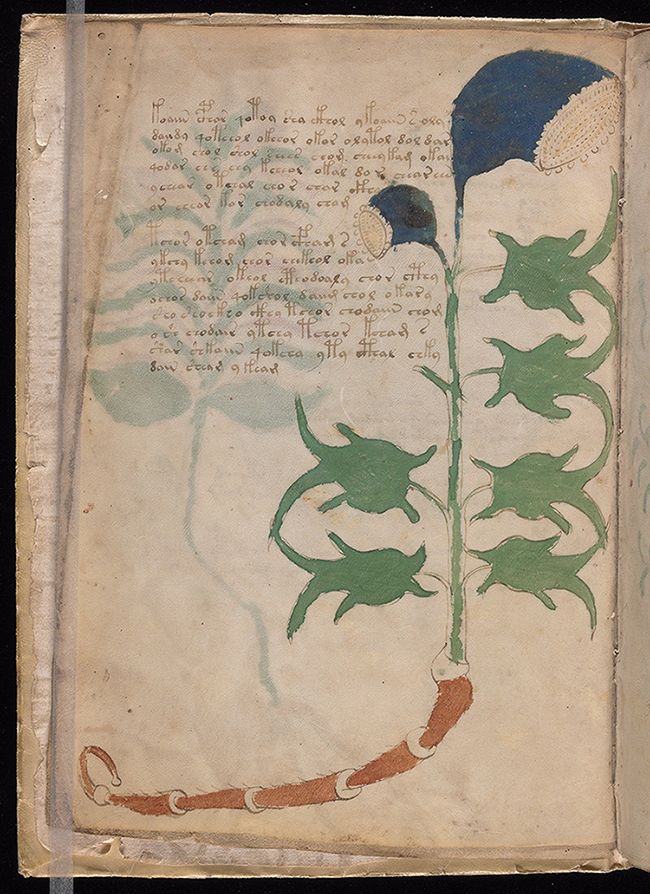
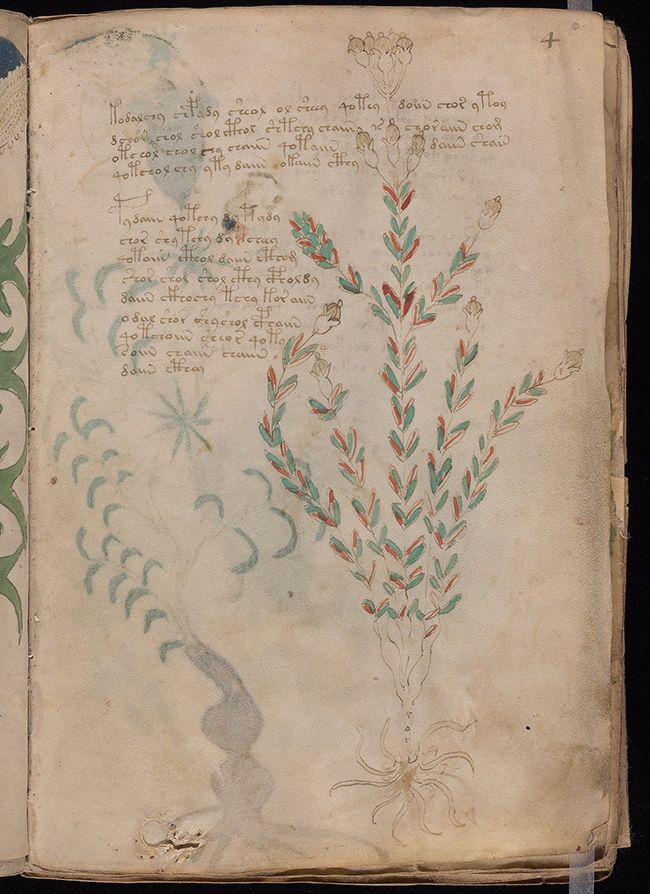
In 2013, the situation was partly clarified by the research of the theoretical physicist Markolo Montemurro from the University of Manchester. The information analysis method he developed showed that in the text of the manuscript, at least it makes sense. The fact that in the text part there are certain patterns inherent in natural languages, scientists spoke earlier. At the same time, the structure of the words of Manuscript is not repeated by any European language. For example, in a manuscript, atypically little repeating characters were used-about 20-30 different “letters”, and several dozen characters are repeated only once or twice. According to another version, this text may be the result of a recording of some Asian language using the alphabet specially invented for this (there really were such cases).
The only thing that is reliably known about the manuscript is the time of its appearance. More precisely, the period in which the pages of the book were set. In 2011, physics scientists from the University of Arizona found that the parchment on which the manuscript is written about six centuries: the radiocarbon analysis method allows dating the pages from 1404 to 1438. At the same time, the text itself could be written later (the age of ink is impossible to identify in this method) - but, according to scientists, it is unlikely that mystifiers could find so many of the old unused material after the XV -XVI centuries.
What did Nicholas Gibbs know and why is he not believed?
Attempts to decipher the manuscript of Voinich do not stop, and, as scientists themselves write, several times a year someone reports that he succeeded (but in fact not). The author of the publication in TLS was an unknown in the academic environment, amateur historian and artist Nicholas Gibbs. According to him, he first encountered the manuscript 15 years ago, studying his roots (supposedly they go back to the English herbalist of the 16th century Thomas Fromonda), and then returned to her at the request of an unnamed television channel.
Nicholas Gibbs claims that the manuscript of Voynich is a medical reference book on female health, the content of which should be clear to anyone who studied medieval medicine, as well as the works of Galen and Hippocrates. Actually, Gibbs is confident that the author of the manuscript has just processed several well -known works on this topic (both medieval and antique). First of all, he mentions a collection of medical texts of the XII century “Trotula”, named after a woman-doctor from Salerno, and the text “De Balneis Putelanis” about the benefits of thermal sources under the Napopol, written in the XIII century. For example, Gibbs discovered a clear similarity of illustrations in the manuscript of Voinich and Trotula, dedicated to women's health and leaving for himself, including the treatment of gynecological diseases. However, the researcher mentions that this was more or less clear before him, and then moves to a more mysterious part-the language of the manuscript.
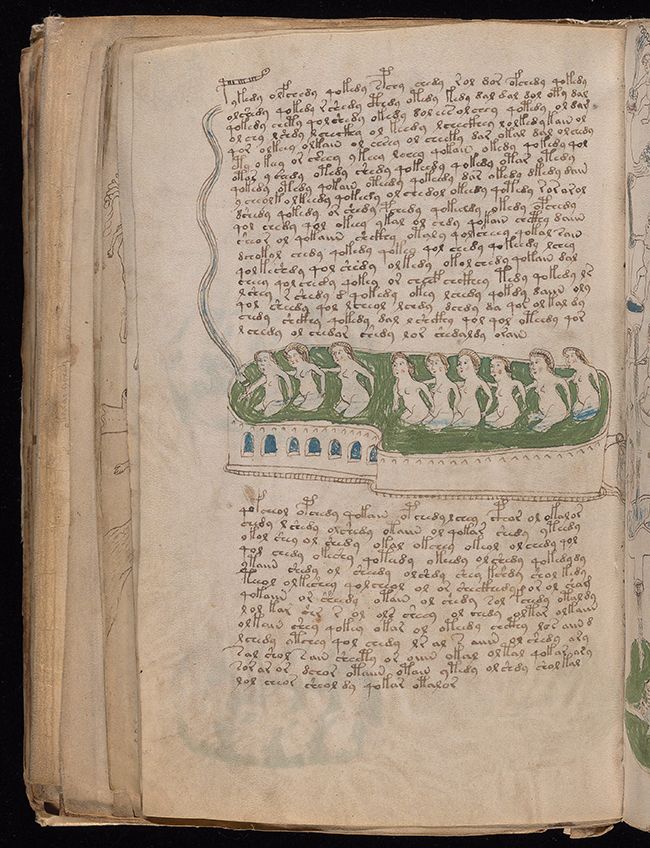
According to Gibbs, this is a kind of transcript, and each symbol is not a letter, but an abbreviated word. The historian claims that he learned at least two symbols in the text - and these are Latin ligatures (signs composed of two or more letters of the word). The publication even gives two lines from the manuscript supposedly deciphered by Gibbs; At the same time, he came to the conclusion that the book lacks the names of plants and diseases. In his opinion, at the end of the book there was to be a catalog, but it was lost (the fact that the manuscript could be thicker was really assumed before), and many pages were confused. All this makes manuscript difficult to decrypt.
The scientific community reacted to the article by Gibbs skeptically. The head of the American Academy of Medipvystry, Lisa Davis, was surprised that TLS generally began to publish an article by Gibbs, and said that in the Bainek library he would be defeated for the right in a minute. The employee of the European Space Agency Rene Zandbergen, who has been studying the manuscript for many years and leads the website Voynich.nu, also noted that the published text of Gibbs is too short to be considered a serious analysis. Gibbs critics emphasize that most of his conclusions are not new (this applies to the general medical orientation of the text and the similarity of illustrations with images in “De Balneis Putelanis”), but the “sensational part” about the manuscript language consists of only two paragraphs and so far looks unconvincing. According to Davis, Gibbs theory will benefit if the researcher can present it to the public in more detail. For example, in the form of a book.
Olga Strachovskaya