
Translated material
Little will not be punched
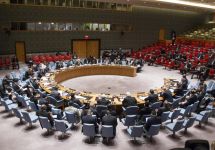
The UN Security Council unanimously adopted a resolution on tightening sanctions against North Korea, the UN information center reports . The decision was a reaction to the sixth nuclear test conducted by the DPRK on September 3.
The document imposes a ban on the purchase of North Korean textile products, including fabrics and partially finished products. In addition, the resolution prohibits the sale of gas condensates to the country of gas products to the supply of oil products to the DPRK. By the end of this year, North Korea will be able to purchase a maximum of 500 thousand barrels, and later deliveries will be limited by 2 million barrels a year. Currently, the DPRK consumes 4.5 million barrels per year.
The UN Member countries are prohibited from issuing new work permits for DPRK citizens, except when it is about humanitarian assistance or denoclialization programs.
The resolution allows you to inspect the court in the open sea in case of suspicion of transporting prohibited goods to North Korea or from it. However, such an inspection should occur with the permission of the countries under the flags of which they go.
Initially, the United States insisted on a more stringent version of the resolution. In the American draft document, it was about the total embargo for oil and the freezing of assets of the North Korean leadership abroad. It was also proposed to freeze the assets of Air Koryo airline, the North Korean armed forces and structures related to the army and the Korean labor party.
However, China sharply opposed this. After negotiations, which lasted almost a week, only sanctions against a number of party and military structures were in the project. The restrictions regarding the army itself and Air Koryo had to refuse.
The Permanent Representative of Russia at the UN Vasily Nevenzha called the underestimation of the Russian-Chinese initiative to resolve the situation on the Korean Peninsula “a major mistake”. According to him, Moscow "is convinced that it is possible to take a threatening threat from the Korean peninsula not all with new sanctions, but exclusively by political methods." Nebenja called the Russian-Chinese approach "a reasonable and realistic alternative to the ultimatum logic of sanctions, which has repeatedly proved its failure."
Financial and economic pressure measures on the DPRK are practically exhausted, the Russian diplomat said. "Further restrictions can be equivalent to an attempt to strangle its economy, the introduction of the country's total blockade and provoking a humanitarian crisis," said Nebenja.
At the same time, the Russian Permanent Republican emphasized that Moscow does not accept the claims of North Korea to the status of a nuclear power. “Russia supported all UN resolutions requiring the termination of the nuclear missile programs in the interests of denuclearization of the Korean peninsula,” he said. “Accordingly, we supported and support sanctions imposed by these resolutions, aimed at encouraging the DPRK to comply with the requirements of the Security Council.”
China urged the United States to restraint against North Korea. “We hope that the United States will take into account the principles of refusal to change the regime in the DPRK, refusing to destroy the current regime in the DPRK, to accelerate the pace of unification of the Korean peninsula and will not send troops to the north of the 38th parallel,” said the Party Protection of the China at the UN Liu Zai.
On August 5, the UN Security Council in response to two launches of intercontinental ballistic missiles carried out by North Korea in July, adopted the next package of sanctions against the DPRK. He prohibits the UN members to import coal, iron, iron ore, lead and seafood from the country, hire new workers from North Korea and open new joint ventures with this country. The US State Department noted that this would reduce the annual profit of the DPRK from exports from 3 to $ 2 billion a year. Now, sanctions hit the textile industry - the second largest article of the DPRK export after coal. In 2016, the export of textiles brought the DPRK economy 752.5 million dollars. The DPRK sells 80 percent of textiles to China.
On September 3, the DPRK announced that she tested a hydrogen bomb , which can be used as a warhead for ballistic missiles. The UN Security Council held an emergency meeting in connection with this test. The US Ambassador to the UN Nickei Haley called to take "the most stringent measures" in relation to the DPRK. “It’s not too late, we must use all the diplomatic measures at our disposal,” she said. Haley also stated that countries that support economic ties with Pyongyang contribute to the growth of nuclear ambitions of the regime.
On September 5, Russian President Vladimir Putin at a press conference in China stated that the DPRK would not refuse to develop nuclear weapons under the pressure of sanctions, as he considers this program a security issue. "Yes, they, as I said at a meeting with my colleagues yesterday, will eat grass, you see, but they will not refuse this program if they do not feel safe." Therefore, according to the president, the use of any kind of sanctions will be "useless and ineffective."