
Translated material
Masonic coins
To begin with, the question in this article will not be about ordinary coins. Moreover, the heroes of our story - tokens (tokens) - are not recognized as a payment tool. The Masonic lodges in the United States have been minted at the same tokens since 1880; They were given to memory of the newly accepted members of the box. Sometimes these tokens were made with a bouting on the circle of an American cent, more often - independently.
In 1926, E. A. King compiled the Masonic Chapter Pennies catalog, which totals hundreds of varieties of the same tokens. Many of them serve as unique samples, because the Masons did not part with them all their lives; However, at Internet ages you can find many cheap options.

The tradition of presenting such tokens is associated with the parables of workers in the vineyard from the twentieth chapter of the Gospel of Matthew; Masonic coins are a reminder of dinaria - a symbol of the mercy of God (the picture of Rembrandt, illustrating this parable, is stored in the Hermitage).
Matt. 20. (1) For the Kingdom of Heaven is like the owner of the house, who went out early in the morning to hire workers in his vineyard (2) and, having agreed with the workers in dinaria for the day, sent them to his vineyard; (3) Having left about the third hour, he saw others standing on the merchant (4) and told them: go to my vineyard, and what to follow, I will give you. They went. (5) Again, leaving about the sixth and ninth hours, he did the same. (6) Finally, having left about the eleventh hour, he found others standing idly, and says to them: what are you standing here all day idly? (7) They tell him: no one hired us. He tells them: go to my vineyard, and what will follow, get. (8) When the evening came, says Mr. Vinogentor of his ruler: call the workers and give them a fee, starting from the latter to the first. (9) and those who came about the eleventh hour received dinaria. (10) The people who came first thought that they would receive more, but they also received dinaria; (11) And, having received, they began to murmur to the owner of the house (12) and said: these latter worked one hour, and you equalized them with us, who suffered the burden of the day and heat. (13) He said in response to one of them: friend! I do not offend you; Didn't you agree with me for the dinar? (14) Take yours and go; I want to give this latter the same as you; (15) Isn't I in my own way to do what I want? Or is your eye envious of the fact that I am kind? (16) So the latter will be the first, and the first last, for many called, and few elect.

Masonic symbols, the name of the box, sometimes the initials of the accepted brother, were depicted in the tokens. Often, they minted the face value “One Penny” (recall that Penny is the traditional name of the coin in one center). Sometimes these tokens were minted with several small stamps for each part, and he apparently increased another tradition - the rinsing of the Masonic symbols on modern American cents.
Unlike real Masonic cents, they do not even have memorial value; Stamps for such a rod can be bought on the same ebay. However, such activities are a violation of the US legislation prohibiting the change in money (the US Code, Section 18, Chapter 331).
However, there were Masonic tokens that served as a payment tool. True, they were used not in the USA, but in the UK and a hundred years earlier, at the end of the 18th century. The lack of a small coin led to the fact that the merchants began to mint their own surrogates. And if so, then, in addition to the direct function and advertising of their own enterprise, tokens could also be used to promote their views.
The Masons took advantage of this opportunity when in 1790 the Prince of the Wales was elected a great master, and minted in 1794-1796 several varieties of tokens with a nominal with a nominee and one pence with the symbols of the Prince of Wales and his own.
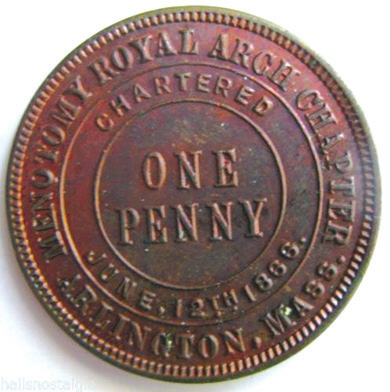
The bed of the great arch of Menotomi, Arlington, Massachusetts; June 12, 1866
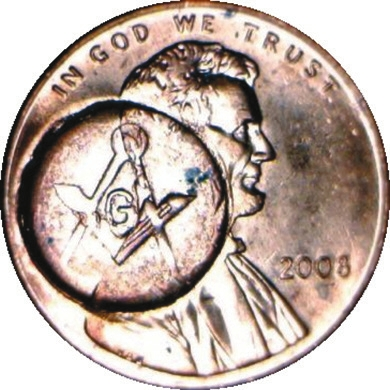
Modern Obtaining on the Central Center 2008 with a linkoal

M. G .
Source: Morrieson HW Masonic Tokens of the Eighteenth Century // British Numismatic Journal. 1917. Vol. 13. P. 165–168. Illustrations: Condertoken.net .