
Translated material
Ostriches say goodbye to the sky

Who does not know the African ostrich, the largest of modern birds, or his Australian relative of Au? Their ancestor knew how to fly, and they forgot how to: their wings are too small to raise a massive body. Modern systematists have established that the ability to fly emu and ostriches have lost independently of each other. However, the calculations of molecular geneticists could not explain the mechanism of this process. Cynthia Faux, a clinical assistant college of veterinary medicine at the University of Washington, and Dr. Daniel Field from the University of Bata (Great Britain) proved that, despite the external similarity of EMU and ostriches, the mechanism of loss of the ability to fly with them is different [1].
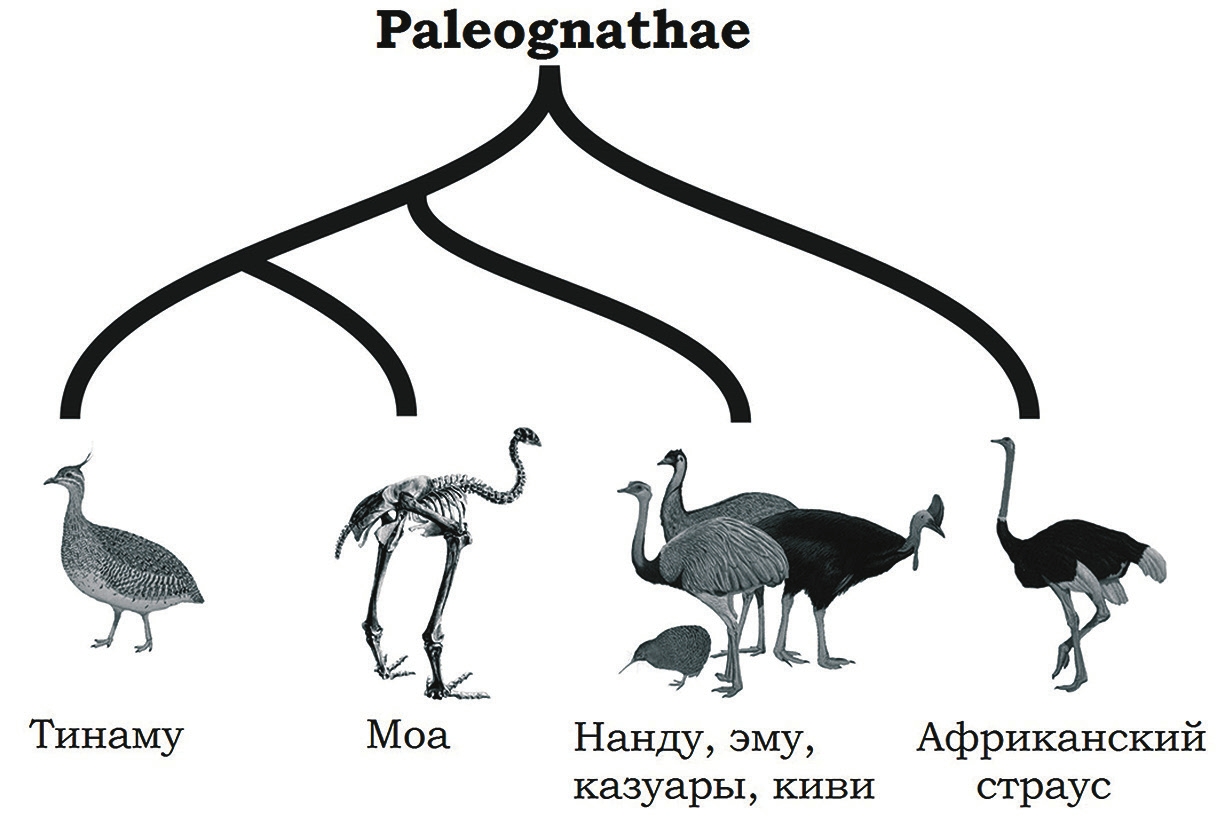
Recent studies of bird genomes have led to a revision of phylogeny (the history of the development of organisms) of modern birds (Neorniths). Now they are subdivided into two groups: Beskille Palaeognathae and having a keel Neognathae (newcomers). In turn, the Palaeognathae group includes a detachment of flying tinamous (Tinamiformes) and four modern detachments of the Beskille -non -altitude birds Ratitae: casuariformes, kivoid (AptygiFormes), tutorials (RheiFormes), ostrhy -shaped. (Struthformes), and ostriches are distinguished into a separate branch.
Ratitae also belonged to the extinct New Zealand MOA and the Madagascar epiorda. Beskille birds are in complex family relationships (Fig. 1). According to genomic evolution, the general ancestor of all the Paleogonat had a relatively small body and knew how to fly. Tinamu retained this ability, and the rates lost, and this happened repeatedly.
The bodies of embryos grew at different speeds. At the ostrich she was the greatest; The Emu embryo is growing faster than the chicken, but slower than Tinama and ostrich. However, the emu develops longer, and therefore the wrapper emu in size exceeds the chicken or chick Tinam. The larger is only a chick of ostrich, which grows in an egg not only for a long time, but also quickly.

A) Participants in the experiment, red lines indicate the loss of the ability to fly.
C) The growth rate of wings relative to chicken. For ostriches and Tinama, it is higher in EMU - much lower [1]

Embers of EMU grow very slowly. The researchers suggested that the small ancestor of EMU and casuars almost stopped developing, so that his descendants were able to increase the size of the body. The rejection of the late stages of development of some parts of the body (in this case of wings) is called pedomorphosis.
Similarly, the Galapagos bmp Phalacrocorax Harrisi , and the extinct Stefensky bush, the Traversia Lyalli , the Birds larger than their relatives, and their wings are small relative to the body, refused. Pedomorphosis, presumably, gave rise to non-lethal drantes, now extinct: the Mauritian Raphus Cucullatus and the PEZOPHAPS Solitaria , as well as the modern genus of the Tachyeres spp ducks.
African ostriches have a different situation. They extended the growth time of the body and wings, without reducing the speed of the process, even increasing it; And these are signs of another mechanism of development, permorphosis - adding new stages of development to existing ones. The ostriches from the wings did not refuse, they prevented them from climbing the air too large. Modern ostriches use their wings to demonstrate during the wedding season.
If the ability to fly lost the common ancestor of the emu and ostriches, their front limbs would develop the same way. Since this does not happen, they forgot how to fly independently of each other.
Scientists have proven that the “non -cultivation” of ostriches and emu has a different nature, and the external similarity is caused by a similar way of life. These studies are important for understanding convergent evolution, but the work in this direction is not yet completed. Cynthia Fox and Daniel Field would like to study the embryonic development of other species of Besily birds, both modern and extinct, and hope that they will have the opportunity to continue research.
Natalia Reznik
1. Faux C., Field DJ Distinct Developmental Pathways Underlie Independent Losses of Flight in Ratites // Biol. Lett. 2017. 13: 20170234.
2. Baker AJ, Haddrath O., McPherson JD, Cloutier A. Genomic Support for a Moa - Tinamou Clade and Adaptive Morphological Convergence in Flightless Ratites // Mol. Biol. Evol. 2014. 31: 1686–1696.