
Translated material
“The priest - flock” - this form of the concert goes into the past ”
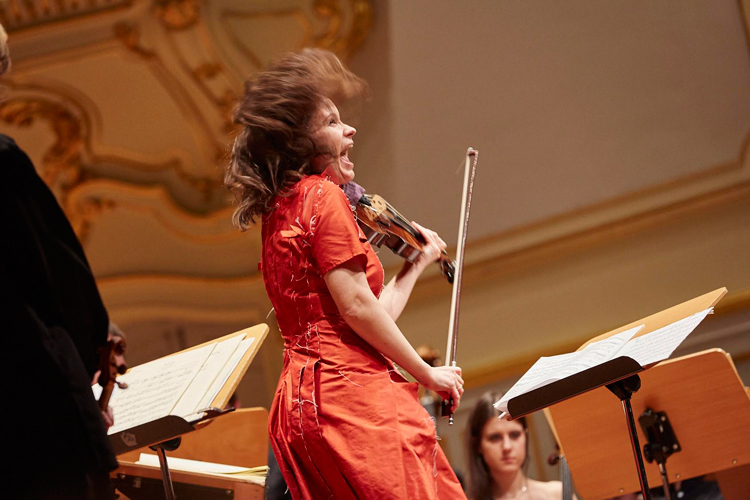
This summer, Patricia Kopachinskaya spoke at the two most status European festivals. In Salzburg, she played Berg's violin concert along with the Perm Musicaeterna orchester and Theodor Custezis, having received frantic applause and unconditional recognition of the selective audience. And at the recently finished Lucerne festival, she acted as Artiste étoile - in the official rank of star.
Her invitation to such a significant and responsible position was justified in the booklet as follows: “The artist follows in a special way, radically reviewing the very identity of classical music.” The violinist was surrounded by such attention, care and affection of others that she literally bathed in them. However, Pat is easy to love: she has a slight character, a cheerful disposition, a sweet smile, and some foolishness and the immediacy of emotional reactions even more have to her. In a small period between rehearsals and concerts with Patricia, Gyulyar Sadykh-Zade met.
- How did the rehearsal of the concert go?
- Very good. Here are such wonderful young musicians, they are remarkably playing modern music: not formally, but with all their hearts. I am amazed. I hear how ready they are to rehearse, how well the text is learned. Adult orchestras are not preparing for rehearsals as they are!
- This is because the Academy youth orchestra conduct a rather strict selection every year. They rehearse about a month, play a bunch of new music, even travel on tour. So at the festival there is a full -fledged, very high -quality orchestra of modern music.
- Here, in Lucerne, an amazing platform was created for the performance of modern music. If it were 20 years ago, when I was a student, I would come here to learn. They have such coaches! From Klangforum Wyen , Ensemble Modern , Ensemble Intercontemporain - they literally engage in each musician separately.
Now we have rehearsed the violin concert of Ligeti - one of the worst works for the orchestra. Rather, for the ensemble - there is not just an orchestra, but the ensemble of tools. And everyone, playing this concert, reaches the boundaries of their capabilities - depending on where these boundaries pass from. And I was surprised, shocked and terribly grateful - they played excellently, and it was very easy with them. From these guys you are simply charged with some kind of energy.
Despite the fact that dad was an honored artist of Moldova, none of my relatives was a communist. I am very proud of this.
-Yesterday I watched how you sat in the hotel living room before rehearsal and listened to something, prepared ... Are you teaching a musical text by ear? By the way, do you have an absolute rumor?
-Actually, yes, absolute. But since I started playing the baroque violin, he “went” a little; For a second, I can suddenly lose the exact feeling of soundness.
- And this, by the way, is a problem; In different ensembles, depending on what period they play, the system can move. And what, do you rebuild your baroque violin every time?
- If the ensemble provides this, then yes, I will rebuild the violin in advance.
- Why am I asking? You play a lot of music, for the performance of which you need prohibitive intonational accuracy. How can you play a concert of Liegeti without absolute hearing, I simply can’t imagine. And you also play that you get simple, understandable, almost common music - this is how in the bartock violin concert, for example. Phrases - with recognizable speech intonation. Not everyone knows how to clarify the meaning of the played music and so convex to give it.
-And I do not know how to do otherwise. If I ask me to play normally, in conservative, I will sound terribly trite, it seems to me.
- You studied at the conservatory in Vienna. But your childhood passed in Moldova?
- Yes, I left for Vienna with my parents when I was 13 years old.
- So you emigrated?
- Yes, but I grew up in the small town of Orgeev, with my grandparents. Until six years old I grew up in their house; Mom and dad were very busy, they played in the folklore ensemble, dad on cymbals, mom on the violin. They constantly went on tour, and my sister and I grew up in the care of grandfather and grandmother. Now mom and dad live in Vienna, and I moved to Bern.
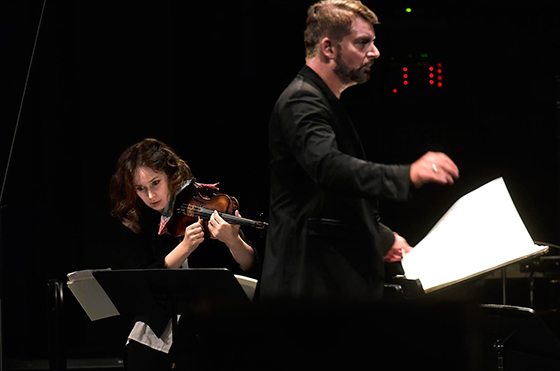 © Peter Fischli / Lucerne Festival with conductor Mattias Pincher
- Here, in Lucerne, you performed in a night unplanned concert with your father and ... was that your sister?
- No, that was my mother! She will be very happy that she was mistaken for my sister, I will definitely tell her.
- Yes, hand to her, please. So, it means that until the age of six you lived in the village. Bosomic childhood?
- Not at all. My grandmother and I went to church, studied the Bible. Grandfather was a veterinarian, he was respected in the city.
- I don’t understand: what is the Bible, what church? Was it Soviet times?
- Yes, but we are Moldavians. Grandma and grandfather practically did not speak Russian. They could, but refused to speak Russian. It was clear to them that, on the one hand, the Russians are liberators, but on the other hand, they established their regime in Moldova. And we are able to maintain our national integrity at the genetic level, live according to our principles, even at the household level ...
- This is called "internal emigration."
-Yes, yes! And, despite the fact that dad was an honored artist of Moldova, none of my relatives was a communist. I am very proud of this.
- Among cultural figures in those days, one could get the title, being non -partisan. It was relatively vegetarian times. Previously, the intelligentsia in the republics was simply shot.
- Yes, my great -grandfather was shot. He disappeared, but it was clear that he was killed. But my other great -grandfather and great -grandmother were sent to Siberia like kulakov. They put him in the carriage and sent. They were already old, barely survived. Some chairman of the collective farm in Siberia took pity on them and took it to the collective farm. And the only thing they managed to take with them was seeds. In my opinion, these were seeds of tomatoes, potatoes and onions. And there, in Siberia, they raised all this, the locals looked and surprised. Their son went voluntarily with them. And then he took them from there when Stalin died.
I perceive the noise of the street better than the symphony of the jar.
- A sad story, but, alas, typical. The Stalinist rink of repression swept over almost every family in a former union. And in what year did the Bolsheviks come to Moldova?
- the Soviet government either came or left; It seems before the war or during the war. Either the Romanians came, then the Russians ...
- Then it is clear why my grandmother took you to church and the Bible. For 30-35 years, it is impossible to completely etch the previous lifestyle and culture; On the example of the Baltic countries, this is very clearly visible. So, in 1989, even before everything completely fell apart, you left for Vienna. What was it - official emigration or have you become "defeators"?
- Yes, refugees. At first we left officially, at the invitation ... and remained. I remember it was the eve of the New Year. My grandmother stands on the platform, and I and my mother on the train. The platform swam, the train started. I then seemed to be numb. The grandmother's tears flowed ... And my mother asked her not to cry, because they could follow us. For me, a child, this ... as if cut off something from you. Amputation ... Yes, amputation of the homeland. I still feel this wound, still ...
- In those days when they went abroad, they said goodbye forever, as if a man was dying. And you grew up in the village, therefore, probably, the departure was especially difficult. The feeling of a small homeland - it develops in childhood: from smells, sounds, shapes of clouds, landscape. And this is already for a lifetime.
-Actually, I quickly grow up to new places. Wherever I live, no matter what language I speak, my friends immediately appear,
- You communicate freely in German and in English, not to mention Russian. You studied at the Vienna Conservatory - although the former "ours", as I understood.
- Yes, I studied with Dora Schwarzberg, Evgenia Alekseevna Chugaeva - I am very grateful to her, she is just a sorceress. Once she was an assistant Yankelevich.
“And you also had Boris Kushnir.”
- Yes, right. Every two years I have passed from one teacher to another; I was called the "Kolobok".
- Your family found himself in Vienna, in a foreign city. And how did you live? Have you started learning the violin play - did your parents support you in this?
- My parents completely trusted me. We, like everyone else, went through all the trials that fall out to emigrants.
- Did your father continue to speak? The Tsimbali is a very popular tool now.
- Yes, now they write a lot for Tsimbal. Hinz Holliger, for example, often uses cymbals. Stravinsky, Kodai, Bartok, Dudye, Etvash - all wrote for Cymbal. Different peoples have many varieties of this tool. In essence, this is such an architect, a prototype of keyboards, with an original ringing timbre.
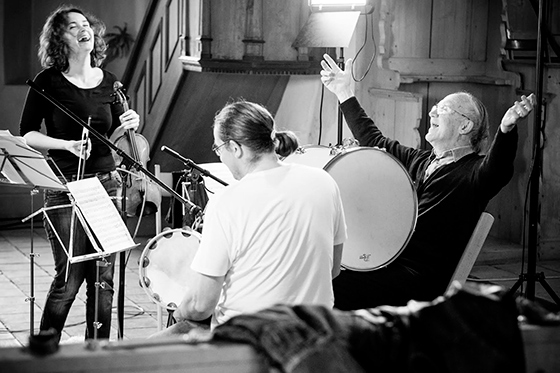 © Marco Borggreve with Hinets Holliger
- And why did you need to study in Vienna also composition?
- Classes of the composition are what formed me as a person, as a musician. After classes, I became the one who I am now.
“But you mainly concert, and not write music?”
- Well, yes, I earn bread with a violin. But my favorite pastime was a composition. New Vienna School, that's all. We went to the lessons of harmony, counterpoint, analysis of musical forms, and all this was insanely interesting to me. I was constantly given the works of my colleagues, and I played right away, without preparation. Therefore, my idea of concert activity is when you perform a new, just written music. The composers I play are always with me. I communicate with them directly. Even if the composers are called Bach, Beethoven and Tchaikovsky.
- Now it’s clear why you are so easily and naturally performing modern music. Her language is dear to you. Your ear was not brought up on classical harmony and not on the tonal system ...
- Absolutely! I perceive the noise of the street better than the symphony of the jar. For me, this noise is music. Here, around our hotel, repair work is underway, they change the road surface. I listen to this noise with pleasure, he completely captivates me. He is closer and more understandable to me than even the music of romantics.
- Radical statement! But the crack of chipped hammering hammers is incredibly annoying, I even plug my ears.
- And for me it is all - music. I don’t feel the music of romantics, for me it is something dusty, like old things taken out of the closet.
-That is, for you the music of the classic-romantic period is a museum?
- The museum, and everyone around knows how exactly this museum is to play. You will play differently - they will be. Public opinion is worse than guillotine. And I think: if you take it for a well -known essay, try to make it new, interesting, fresh. So that people hear him again, see, feel.
I learned a lot from my teachers. But then it took a lot of time to get out.
- I agree with you: why take on well -known works, if you have nothing to say new about this music?
- Not even a new one, but - your own! Find yours and tell you. But honestly. No need to specifically come up with novelty for the sake of novelty.
- Well, let's say, you and Krentzis started Berg's violin concert with a tiptoe made their way to their places. And at this time, two violins played the melody of the Carinthian song that Berg uses in the concert - quietly so, thinly ...
- Yes, I will explain why. The fact is that Berg devoted this concert to the girl - the deceased daughter of Alma Mahler. And the concert is called "Memory of Angel." So, in my opinion, Berg had in mind more than one angel. This concert meant more for him. In this music, his own sadness is captured, his mourning of the unfulfilled - after all, he was not able to know the joy of paternity. And Berg had a daughter, she was born from a maid when Berg was only 17 years old. The girl was quickly removed from the house, and Berg's parents did not recognize anything, his sister organized everything. She raised some money and paid a pension to this girl. The child grew up, but Berg did not see this. The girl was called Albina, apparently in honor of her father; Being already an adult woman, she came to his funeral.
- Probably, he was seriously worried about this story. Those who knew him said that he was a very delicate, quiet and sweet man.
- Yes, but do not forget that he lived a double life. Take at least his second opera Lula - the main character had a real prototype, and he brought himself in the image of Alva. There were many different bergs in it.
And in this Carinthian song the text is this: "Birds on a plum tree woke me up in the bed of Miazel." Miazel in the Austrian dialect is Mary. And the maid was also called Maria. It seems to me that this cannot be a coincidence, Berg did nothing at all by accident. He knew what he was writing about. This song and Khoral Bach - they appeared in the concert not by chance. And the deceased Manon Gromius, the daughter of Alma and Walter Gropius, in my opinion, simply reminded him of his own daughter.
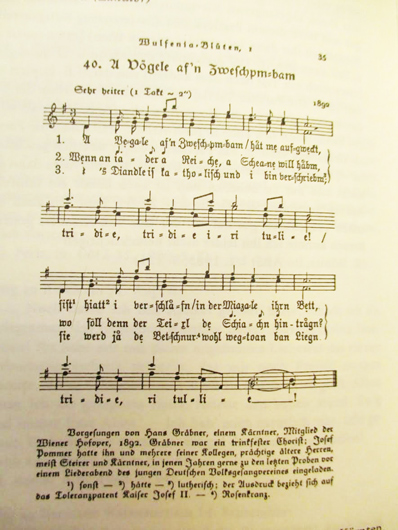 Notes of the Karinthian song about Miazel, which Berg used in his violin concert
It seemed to me that this moment should be emphasized somehow. Just even if you start the concert unusual, it will refresh its perception. I was very happy when I played with the Musicaeterna orchestra; Every tool was heard, every voice. It turned out chamber music - all the elements of the text were worked out, it did not work out by itself. A thorough, painstaking work on rehearsals was carried out. And in Salzburg, a special moment happened at the concert; As if we all merged into one. And they all felt it. That's why I love to play with the Kurentzis orchestra.
- Sometimes you sit in his orchestra with the first violin - as then in Perm, at the Diaghilev festival.
- Yes, I sometimes play with them in the orchestra, and not only behind the first remote control. I sometimes sit in the last rows. And on the symphony of Beethoven, I stood in the second violins. They accept me as their own. In general, the Kurentzis orchestra is like a big family.
“You, of course, fascinated the Marcus of Humanizer .” I listened to your program with him from the writings of Utvoshlskaya, but not in Perm, but a year earlier, at Musikfest Berlin in September 2014.
- Yes? Have you been there? And we have already recorded a disc with Marcus. He is a completely amazing musician. When we rehearse, this is not a rehearsal. We seem to enter some other dimension with him. We are almost not talking - there is nothing to talk about there. There is only music. He is a high intellectual, in fact, he knows a lot. But his knowledge is interconnected with other gifts with which he is endowed with God. He has everything present: intuition and intelligence. And different sides of his personality are surprisingly connected. It is very important that a person finds this unity in himself. Usually we are all so scattered, we will rush to one extreme, then into the other ...
- It's good that he returned to Salzburg, everything is so happy ...
- Well, of course! Because he is a real musician. Marcus not only does something new-he builds the road, paves the way. And only then on this road is erected at home. He has each program suffered. When composing them, it proceeds from purely musical things: how this music is combined with another, what connections arise between the works or, conversely, contrasts. For example, he told me for a long time that Utvulskaya should be played with old music: such parallels arise!
- You play in the Lucerle of Bartok, Kurtag, Liegeti and - together with the family - Moldavian doyans. Hungarian theme - what is it connected with? I understand Moldova, Hungary is close, but still not the same thing. Although, on the other hand, Transylvania, from where Kurtag and Liegeti came from and where Bartok and Kodai were looking for the most archaic layers of Hungarian folklore, formally belongs to Romania. Do you deliberately build such a plot-the Hungarian-Romanian?
- Everything is simple: we are connected by love for folklore. Saying “all”, I mean Ligeti and Bartok. I do not think that Liegoti is dead. And, by the way, Sandor Veresh is also with us when we play Ligeti. And Holliger is also with us - because he studied with Veresh. And Kurtag studied at Veresh. And Veresh studied from Bartok. And Ligeti studied with Bartok. We all dance together.
Bartok once said: "I speak in Bethov’s." And Kurtag said: "I speak in a banking." This is all, in principle, the same thing, just the material is differently decorated. And the violin concert of Liegoti is more than a concert. Liegety is also a designer: the entire violin concert is made up of musical allusions from different times. Figuratively speaking, he builds a new cathedral from old bricks. There is heard by Guillaume de Masho: a crazy hospital, only a violin and a flute. At the same time there is a choral. Stravinsky and Vivier live in this music, there is Jezualdo, even the late Haydn quartets. When Liegoti was in the hospital, he studied Haydn's quarters before writing a concert. And there you can hear Shimanovsky ...
The composers I play are always with me. I communicate with them directly. Even if the composers are called Bach, Beethoven and Tchaikovsky.
- Well, you can agree to anything ... There is a well -known phrase: "Everything that was before me is mine." One way or another, the composer extrapoles all his personal background to his essay.
- Yes, this is a comprehensive process. All composers need to be hugged. As they say in Moldova - to give them all to eat. To stay and pray together.
- The theme of the current summer Lucerne festival is “identity”. And your reasoning is surprisingly logically embedded in this topic. Но из чего складывается ваша собственная идентичность? Вы родились в Молдавии, учились в Вене, живете в Берне…
— Моя идентичность мне самой неинтересна. Но что касается музыки — я люблю каждый раз открывать новые миры и обживаться в них. Я бы хотела, чтобы мне дали свободу находить свой язык, свое повествование. Поэтому я не очень люблю дирижеров: они хотели бы заковать меня в кандалы своих интерпретаций, навязать собственное слышание вместо того, чтобы меня поддерживать.
— У вас очень специфический звук. После вашего концерта с родителями я начала понимать его природу: так звучат юркие, быстрые, легкие карпатские скрипочки. Фольклорная манера игры — она у вас на генетическом уровне?
— Я многому научилась у своих педагогов. Но потом понадобилось много времени, чтобы разучиться. У меня есть свой акцент — говорю ли я на языке Моцарта, Бетховена или Берга. Я играю по-крестьянски; меня интересуют земля и небо — ну и то, что находится между ними, тоже...
— Поэтому вы выходите на сцену босиком? Чтобы чувствовать токи, идущие от земли? Или это часть имиджа?
— Нет, это не часть имиджа, имидж мне только мешает. Я меняюсь в каждом произведении, меня самой как бы нет, моя индивидуальность растворяется в тексте автора.
— Однако публика с удовольствием опознает две приметы вашего облика: босоногость и платья швами наружу. Разве это не строительство имиджа?
— Нет, совсем нет.
- OK. Тогда зачем вам босоногость?
— Это очень удобно. Я не могу играть в туфлях, они мне мешают. Скрипка у меня по-другому звучит, когда я босая. И потом, так я меньше боюсь.
— То есть ощущаете себя твердо стоящей на ногах?
- Yes, perhaps. И связь какая-то тоже есть.
— Энергетическая подпитка от земли?
— Тело важно. Когда меня учили не двигаться во время игры, у меня просто все хуже получалось. Но когда я двигаюсь с музыкой, тогда она — моя и я тоже — ее. А еще мне кажется, что у пьес есть души. Они где-то обитают, в каком-то другом мире. Иногда они к нам приходят — через композитора. И мы должны учиться говорить с ними, общаться, как с детьми. Они все очень молодые. Их нужно привести за ручку в наше время, все им показать, объяснить на языке нашего времени. Не на старом языке, иначе выходит ложь. Надо говорить как есть: мы здесь и сейчас. Что будем делать, в какую игру играть?
— Вы упомянули, что играете барочную музыку. Когда, с кем?
— Скоро у нас будет проект с Il Giardino Armonico , будем играть Вивальди и современную музыку. Заказали молодым композиторам написать пьесы, которые будут вставлены между концертами Вивальди; можно и новые каденции написать. Мне бы хотелось, чтобы Вивальди пообщался со своими коллегами, отвечающими сегодня за творчество и креативность.
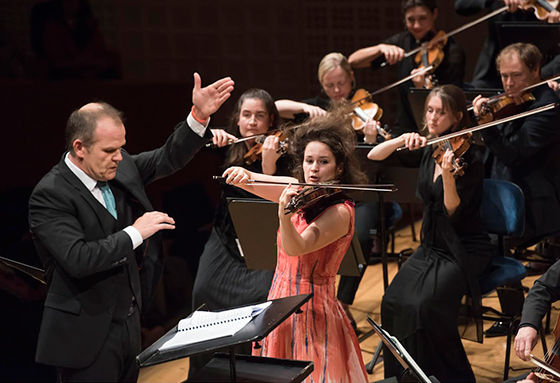 © Priska Ketterer / Lucerne Festival C дирижером Франсуа-Ксавье Ротом в Люцерне
— Что это за фестиваль, который вы возглавите в 2018 году?
— Ojai Music Festival . Он проходит в маленьком городке рядом с Лос-Анджелесом. Прекрасное место, там очень красиво, идут опенэйр-концерты в открытом зале, и зал этот всегда переполнен. Фестиваль существует, по-моему, уже лет 70. Там бывали и Стравинский, и Шёнберг — все те, кто во время Второй мировой войны эмигрировал в Голливуд. Так что у фестиваля долгая традиция. Там выступают феноменальные музыканты, быть приглашенным на фестиваль Ojai — большая честь. Идет он всего четыре дня, но концерты — с утра до вечера: в парке, в музее, на улицах. Есть ночные концерты и даже концерты, проходящие на рассвете. Это один из самых прогрессивных фестивалей в Америке.
— Много ли у вас ангажементов в Америке?
— Я обычно работаю с St. Paul Chamber Orchestra . Это оркестр, который функционирует без главного дирижера и без услуг концертных агентств. Когда оркестр имеет только одного дирижера — репертуар ограничен. Ведь один человек не может все исполнять одинаково хорошо. У каждого дирижера есть свои репертуарные пристрастия и приоритеты. Что-то у него получается лучше, что-то хуже. Поэтому принцип этого оркестра — работать с четырьмя-пятью дирижерами — имеет свои преимущества.
Мы с ними переиграли много современной музыки. Сейчас им, правда, дают деньги только на исполнение американских композиторов, такую вот новость я недавно узнала.
— Долго ли вы будете руководить фестивалем Ojai ?
— Только один год, такие правила. После меня будет Барбара Ханниган, потом Мицуко Утида.
— Каждый раз фестиваль возглавляют практикующие музыканты?
— Да, и я считаю — это хорошее правило.
— Я просмотрела ваш график гастролей — он довольно напряженный. Бухарест, потом Солт-Лейк-Сити… как вас туда занесло, в такую даль?
— Мы долго искали оркестр, который бы согласился сыграть со мной Шёнберга. И мой хороший друг, бывший флейтист Тьери Фишер, согласился. Мы будем исполнять «Лунного Пьеро» Шёнберга, и я там буду петь, то есть не совсем петь — речитировать. И еще играть на скрипке.
— А есть ли планы выступлений с Курентзисом и MusicAeterna ?
— Да, осенью мы собираемся сыграть Скрипичный концерт Берга в Москве и Петербурге.
— А если глобально — какие у вас планы на жизнь?
— Планы? Освобождаться от ненужного балласта, заниматься тем, что действительно важно.
— А что для вас ненужное?
— Не нужно стремиться нравиться людям. Не стоит расстраиваться, если ты кому-то не нравишься. Не стоит переживать из-за того, что пишут о тебе критики. А нужно — точно знать, что ты хочешь сказать в этом произведении людям. И говорить это как можно ярче и острее, так, чтобы не оставалось никаких неясностей или недоговоренностей.
— Разве вас не любит критика?
- It doesn't matter. Если кто-то тебя не любит — просто не играй с ним, и все. Мне надо идти дальше, но с ясным пониманием того, куда я иду и зачем. Много времени уходит на ненужное, а ведь жизнь коротка. Я еще и мама, у меня растет дочь, ей уже почти 12 лет, и она во мне очень нуждается. И это главное, что я потеряла, — я мало общалась с дочерью.
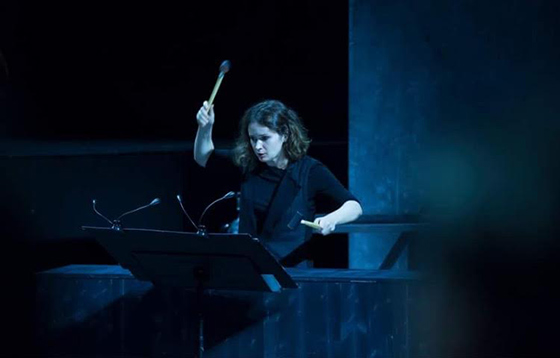 © Priska Ketterer / Lucerne Festival Проект Dies Irae, прошедший в Люцерне
— У нее сейчас, должно быть, сложный возраст. Как она живет без вас? Вы же часто бываете на гастролях.
— Привыкла. Как и многие дети музыкантов. Слава богу, мой муж — невролог, и он всегда дома. И наша дочка при нем. Он меня полностью понимает и поддерживает, и это большое счастье.
Если же говорить о только что осуществленных планах, то здесь, в Люцерне, мы вместе с музыкантами Jack Quartet и ребятами из Люцернской академии современной музыки провели проект под названием Dies Irae . В центре композиции — « Dies Irae » Уствольской, я играла на ударных. Вокруг этого произведения мы исполняли музыку Игнаца Бибера, Джорджа Крама, Джачинто Шелси; все это сопровождалось светом и видео. Еще был задействован хор, который сидел прямо в зале. А я ходила по залу и играла на скрипке импровизацию на византийскую одноголосную мелодию.
Мне интересно выходить за рамки традиционного концерта, придумывать что-то необычное. Просто стоять на сцене и играть по сценарию «священник — паства» — такая форма концерта отходит в прошлое.
— Драматический театр давно двинулся по этому пути. Сегодня театр выламывается со сцены и даже из зрительного зала, разворачивается в необычных пространствах, на улице, становится интерактивным. И, похоже, концертный ритуал тоже подвергается трансформации…
— У меня был проект Bye - bye Beethoven . Мы с Малеровским камерным оркестром играли «Прощальную симфонию» Гайдна наоборот — справа налево. Идея была такая: почему мы все время играем старую музыку, смотрим назад? Мы должны вперед смотреть.
Там была выстроена стена на сцене, и в финале стена надвигалась на оркестр. Оркестру приходилось бежать, захватив пульты, все это выглядело как кошмарный сон. В конце концов на сцене оставались только я и литаврист. Он колотил по этой стене… и потом начиналась современная музыка.
— Метафора ясна: стена сметала старье с корабля современности и расчищала место для новой музыки.
— Да, такая была идея. Типа — хватит поклоняться мертвым памятникам прошлого. Их нужно снести и дать место современной музыке. То, чем мы дышим, то, что мы слышим, — это музыка нашего времени. А мы не владеем ее языком, не говорим на нем. Это страшно и опасно, потому что без овладения этим новым языком у нас не будет будущего.