
Translated material
What is IPSI?
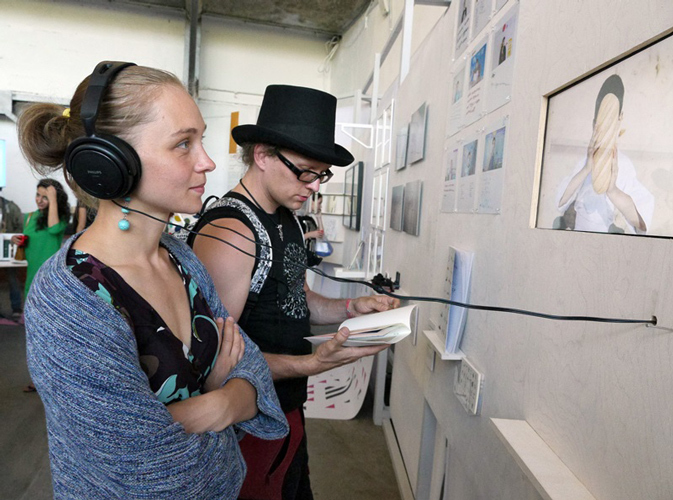
At the Institute of Problems of Contemporary Art is a set for the New Art Strategies . Colta.ru decided to find out what IPSI lives today, what difficulties she faces.
The Institute of Contemporary Art Problems , opened in 1992 by a group of artists and theorists of art, led by Joseph Bakstein, this year celebrated his 25th anniversary with a charitable exhibition and auction that took place in the Jewish Museum .
Over the 25 years of its activities, IPSI, the oldest educational institution in Russia, where contemporary artists have been preparing about 650 artists, including Viktor Alimpiev, representing Russia at the 55th Venice Biennale of Modern Art, the Kandinsky Different Years Prize, Aslan Gaysumov and Olga Kreytor, twice laureate of the Innovation Prize, Irina Korina, Irina Korina, Irina Korina, Irina Korina. A graduate, and now a teacher at IPSI Stanislav Shurip, a participant in the 13th “Documents” Alexander Sukharev and many others.
“In 2015, we made a two -year training. In the first year, students mainly expand their knowledge in the field of the humanities, get acquainted with the body of texts in the philosophy of art, the theory of culture, the sociology of culture, etc. They also read courses in the history of foreign and Russian art of the 20th century. The task of the first year of training is to master key concepts and categories, to decide on your preferences, to find yourself. In the second year, emphasis is on practice - students are preparing personal projects, although theoretical classes are also ongoing, ”says IPSI rector Anna Morozhnik. In addition, in 2016, new areas of study were opened in addition to the classical course “New Art Strategies”, oriented, first of all, to young artists, the institute began to prepare curators and art historians.
-We think to create a structure on the basis of the workshop that would exist along with the institute.
“There are main courses repeated from year to year that the current backbone of teachers reads - Stas Shurip (“ The history of ideas in the art of the second half of the twentieth century ”), Sasha Obukhova (“ Unofficial/Modern Moscow Art. 1956–2000 ”), Irina Kulik (“ The main trends in the art of the second half of the twentieth century ”), Antonio Juse (“ History of the Video Art ”), Andrey), Andrey) Parshikov (lectures and practical laboratory “Art System”), and additional ones that can change every year. Each year, new lecture courses that were not in previous years are added to them. For example, we had classes on feminist theory with Alla Mitrofanova and artistic criticism with Valentin Dyakonov, Oleg Aronson came to us with lectures “The Experience of Non -Lithual Democracy” came to us. In the spring there was the course “History of the Russian Art market” with Milena Orlova-a very useful thing. In addition, during the year there was a reding group, which was not there before, ”the second-year student Galina Leonova, who is studying in the specialty“ Theory of Art ”, lists. “I like how the educational process at IPSI works,” she continues. - The format is different from the usual institute - it is a playground and at the same time serious theoretical training. Naturally, not everything is so rosy, there are also frustrating moments. For example, not everyone “survives” even until the end of the first year. Because you really need to work hard, spend your strength and resources, constantly be included/oh in the process. I think that such training is not suitable for everyone. There are people who have already developed as artists/tsy (or think that they have developed), and training greatly breaks their system of values and ideas about the world. And violence, as you know, does not bring benefits to anyone. ”
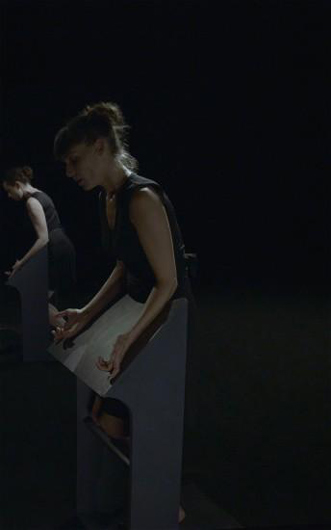 © Courtesy Gallery Ridzhina Viktor Alimpiev, Crown, 2012. Hard from video
Despite the constant development and transformation of curricula from year to year with the involvement of new teachers and specialists, in the art environment recently, it often came to the financial problems of the institute. The first call was the disappearance of budget places, then a charity auction, the purpose of which, obviously, was to maintain an IPSI afloat. Information about the problems with the material support of the institute is confirmed by Ganna Zubkova, an artist who came to IPSI as a student, but discovered that her knowledge gained in the magistracy of the Sorbonne, allow us to conduct a reding group. “Having entered the IPSI, I could not start training, because I did not have money for payment. I offered the management of my collaboration as an artist in exchange for the opportunity to attend lectures for free or for less money ... Unfortunately, the institute could not respond to my offer and give a free place or reduce payment, because, as I was explained, the institute is in a difficult financial situation (therefore, as I understand it, free places have been canceled). ” Ganne was offered to pay the semester in parts, and she considered it a good solution in this situation. “I would like to note that the institute knows how to meet in any issues ... In the end, I decided not to start the educational process as a student, but to maintain interaction: I offered the IPSI a program of Reading groups for the first year.” The institute accepted the artist’s proposal, found space, having agreed with the Triumph gallery, and classes began. “In the first, introductory, lesson there were about 35 people (almost the entire course), but the permanent composition was 7-10 people. It turned out that exactly the situation with the number of people who decided to continue their studies as a whole regularly. ” According to Ganna, it can really be said that the institute is now going through the best of times, although "in the difficult conditions in which the institute is located, the best of the possible, and often on personal enthusiasm of people." However, for seminars the artist was not offered money, she led it for free.
- Now we solved the most serious financial problems, we found money.
A separate delicate issue for IPSI is the status of Ilya Kabakov’s workshop on pure ponds - a premises transferred by the artist Joseph Bakstein (now he is a supervisor IPSI) After leaving for America, in which the institutions have been held since the 1990s. “I don’t know anything about the status of the studio, although I have heard from different people more than once that they want to take it from IPSI,” Ganna notes.
Bakstein clarifies information about the controversial status of the workshop: “We think to create a structure on the basis of the workshop that would exist along with the institute. It would be some kind of museum, a museum project dedicated to Moscow conceptualism and Kabakov's work personally. There will be no constant exposition, there will be some projects. That is, we want to do more projects on our own sites: exhibition, educational, and others. But the workshop in any case remains with the institute. ”
“Now we solved the most serious financial problems, we found money, so we will pay salaries regularly,” continues Bakstein. - This is an important component of what we do. The work of our teachers must reward. It was possible to find new funds, including thanks to the auction. ” According to Bakstein, the institute is now actively working with the Board of Trustees, is engaged in fundraising. “Just now, in early September, we plan to discuss our financial situation, including the question of whether budget places will be. If there is such an opportunity, we will do everything so that budget places remain at least in some quantity. We will act on the situation: carefully, but quite consistently. ”
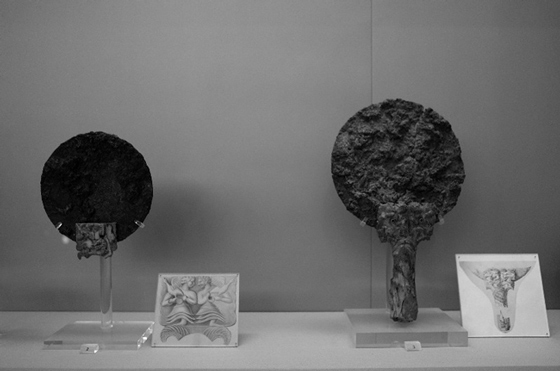 © Alexander Sukhareva Alexander Sukharev. Photos taken in a foreign land (from working material). Bronze mirrors that became faces, approx. 2600 BC
The information is confirmed by IPSI Director Svetlana Kalashnikova: “At the auction that last in June, it was possible to collect more than 2 million rubles. Not only students and graduates of different years responded to our call to provide work, but also artists who stood at the origins of the institute. We are extremely valued by such an attitude of the artistic community to our institute. ” According to Kalashnikova, in the near future “the institute will expand partnerships. Over the past year, the institute’s partners have become the auction house of Phillips , the Jewish Museum, the creative residence of “Chekhov # API ”, “ Art & Science Skolkovo”, a gallery on Solyanka, Sotheby ' S Realty International ". IPSI also plans to expand international cooperation. “For many years, the exchange program between the IPSI and the Goldsmith College, supported by Igor Tsukanov, has been operating for many years,” adds the director of the IPSI. -At different times, one-time programs were implemented with the Vienna Academy and with école National Supérieure des Beaux-Arts in Paris. Now we want to conclude an agreement with them on constant cooperation. ” It should be noted that earlier IPSI also organized joint projects with the Veland visual art school in Gothenburg.
- This tradition of independent artistic thinking and independent artistic practice was important - and we remember and develop it.
In general, regarding the future Institute of Bakstein is also optimistic: “It seems to me that we have already created a model of a certain educational program, which we consider important, valuable and successful. We think about how to preserve it, how to develop it taking into account changes on the domestic art scene. We think about what new projects to do in order to become a really noticeable, important and distinguishable structure of the international art scene. ” In his opinion, "now the young generation has more in common with what we thought (theorists of conceptual art. - Ed. ) In the first perestroika years."
“For example, I made my first exhibition in 1985, when it was possible to do something regardless of the existing state system. This tradition of independent artistic thinking and independent artistic practice was important - and we remember and develop it, ”says Joseph Markovich.
Regarding a number of competitors of the IPSI, among which today it is customary to call Rodchenko’s school and the Base Institute Anatoly Osmolovsky, Bakstein remarks: “This is still one circle, we are familiar with many friends, so we are discussing some important issues, we use each other's experience. It is important that we are engaged in one common thing, but everyone has their own specifics in the sense of approaches, curricula. Therefore, of course, we are in a state of dialogue, but we are trying, first of all, to realize our place in this context. And make accents. "