
Translated material
A completely new drama
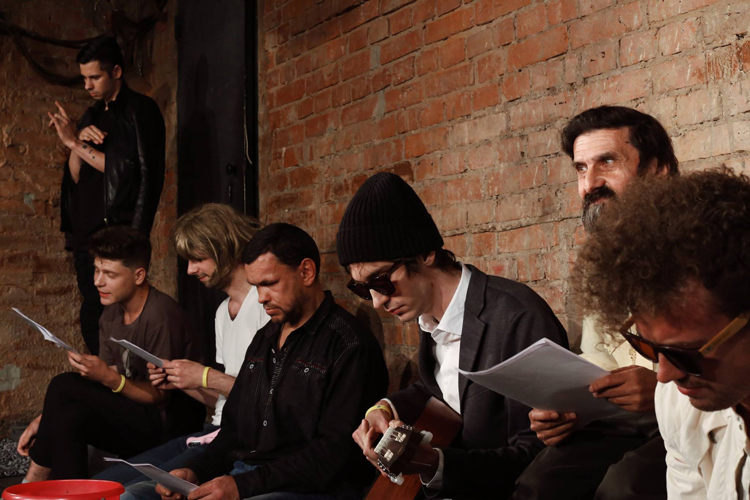
In the metropolitan “Theater.doc” the festival of young drama “Lyubimovka” ended. Andrei Pronin analyzes the trends recorded by the festival, and briefly annotates the selected plays from the competitive and out -of -competition programs.
The literary elaboration, which the founding fathers fought at the beginning of the century, fought with the New Drama, quietly returned and molested with a fire. There are a lot of “cultural” texts, but some of them are balancing on the verge of bad pretentiousness.
There are few examples of direct political statement, but the general feeling of “moral anxiety” is permeated by the vast majority of plays read on the “love” of plays.
An increasing place in the plays is occupied by Internet space, dialogs unfold in social networks, sailing, WhatsApp , telegram. How to adequately convey this on stage is a question. The problem of the Internet theater, the synthesis of theater and the Internet comes to the agenda. So far, only two directors have taken effective steps in this direction in Russia: Dmitry Volkostrelov and Radion Bukaev.
A significant pool of dramatic texts is devoted to the difficulties of teenage growing up. The absurdity of the fate of these plays (there are very good) is that their vast majority will not reach the addressee. The obscene vocabulary, without which a plausible reflection of adolescence is unthinkable, the theme of suicide, mandatory for all Romeo and many Juliet, doom these plays on the age qualification “18+”.
And in general, the most common phrase on the sidelines of “Lyubimovka” was “The play is excellent, but it is impossible to put it today in Russia.” Haunsky legislative prohibitions have long turned into real censorship.
Drama develops on top of borders. Drama from Belarus, Ukraine, Kazakhstan write magnificent plays that do not fall out of the general context, but partly setting it.
Gender equality reigns in the young Russian drama: the authors write plays, and, as they are customary to say among advanced ones, the author - on equal terms and without any discrimination.
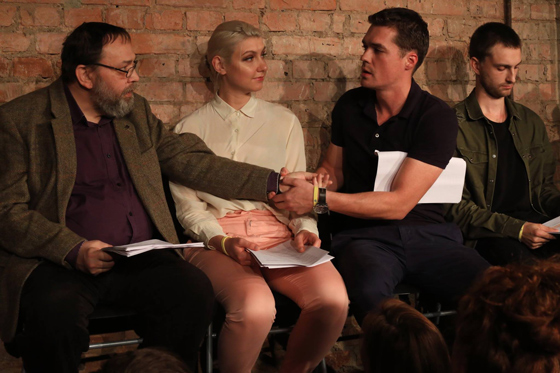 © Shamil Khasyanzanov / Festival "Lyubimovka" Reading the play "Seryozha Very Dumb" Dmitry Danilov
"Seryozha is very stupid"
Dmitry Danilov (Moscow)
A cunning play with an unexpected interruption of style in the finale. The trinity of Couriers is announced to the programmer Seryozha. Instead of giving him a certain promised package, they imposingly are at Seryozha at home and lead strange conversations with him, refusing to leave. Danilov, not without brilliance, conveys the specific speech habits of employees of the "bodies". You are waiting for a sad finale, but the wife of Seryozha is, it takes the couriers, deactivates a dangerous parcel in which something alive beats, and turns to the hall with white verses: they say, Seryozha is very stupid, is afraid of all kinds of nonsense, and then a terrible threat hung over him, and he did not even notice. A beautiful story about the victorious duel of a woman - the keeper of the hearth with agents of state terror.
"Grisha"
Inga wax (Los Angeles)
The everyday life of the Russian spy in America. The main character is breaking between the professional and personal spheres: on the one hand, the mysterious death of a Russian official in an American hotel (a clear hint of Mikhail Lesin), on the other hand, separation from his four -year -old son Grisha, who, in the absence of his mother, began to speak a three -story obscenity. Grishins Matyuki sound protested against the world of lies and adaptability, which separated him from his mother. The action of the play is entirely focused on the Internet, which gives it documentary, although the post -facts ask you the question: is it not Barton Fink in a skirt before us? And do these dialogues sound exclusively in the minds of a novice screenwriter, trying in vain to compose a spectacular synopsis for an American film school?
"How I began to talk to Tolik"
Yosya Olishevsky (Smolensk)
Strong old -lended monopiece. Unable to withstand unlucky and social instability, the main character finds an imaginary friend, and this is a brick named Tolik.
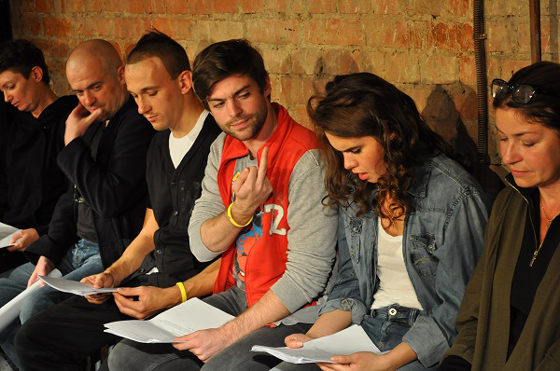 © Maria Krupnik / Festival "Lyubimovka" Reading the play "Code of the smokers" Konstantin Steshika
"Code of smokers"
Konstantin Steshik (Minsk)
Steshik composes a world in which comics and cinema are equally adjacent to the prose of everyday reality. The main character-a frostbitten killer guy-turns out to be no less than Jaggernaut himself, and only a policeman who is well oriented in the filmography of the Cohen brothers well-oriented him.
"Murder"
Brothers Porypalev (Barnaul)
At the festival, they whispered that under the surname of the mysterious brothers, someone who wished to remain an unknown, perhaps a well -known playwright was hiding. “Murder” is a “crime and punishment” on the contrary. Bogdan kills a person and does not experience any remorse, wants to experience - but it doesn’t work out. Existential.
"I'm on Shostakovich, 5"
Polina Korotych (St. Petersburg)
Unfulfilled lyricism, strengthened by good knowledge of the material. Berries and holidays of students of the St. Petersburg State Institute of Cinema and Television. There are witty dialogs on professional topics.
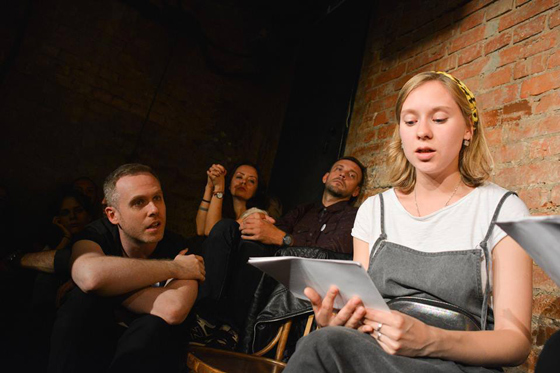 © Dasha Karetnikova / Festival "Lyubimovka" Reading the play "Karas" Marina Dadychenko
"Crucian carp"
Marina Dadychenko (St. Petersburg)
A powerful and strange play that begins as an anecdote and ends like a mystical trip. A mother asks Skype’s daughter how to kill a trembling crucian carp bought in a live fish. The mother at this time is in Varanasi, the "city of the dead" on the banks of the Ganges. You do not immediately understand that this session of electronic communication seems to be between the test and the world world.
"Pylorama plus"
Natalia Milantaeva (Moscow)
One of the hits of the festival. The proletarian Sanya loves Katya. The praying praying Katya married a musician from the Philharmonic, brings up a disabled child and is quite indifferent to the dignity. Sanya drinks in black and touches with his mind, starting to discuss her intimate problems with the workshop machines-a brutal flight, sexually ambivalent imported milling milling milling mill, a simple-minded sharpener and emotional circular saw. A rare case of a modern play, in which a working as a protagonist is a worker, and he is depicted quite sympathetically.
"From the school"
Andrey Ivanov (Moscow)
Ivanov is a master of spectacular intrigue, not without reason the reading attracted such mastodons as Evgeny Pisarev and Pavel Lungin. Mamenkin son Seryozha, a teacher of philosophy in vocational schools, is attacked by a simple, stupid, impudent Patyushnitsa Tanya, strongly in love with him. The possessive instinct of this “custicans” reaches frightening intensity, besides, on her premises, a passionate whiter-apparatus, who, if that, can slaughter. It all ends very well: Seryozha manages to circle everyone around the finger, convince the criminal to strangle the tank, get a new macbook as a gift and emigrate to Malta. All the way you warmly sympathize with the hero, and in the finale you understand that he is a rare, patented scoundrel.
The play is excellent, but it is impossible to put it in Russia today.
Elsbet
Gulnara Golikova (Kirov)
An amazing play that collaborates the articles from “questions of philosophy”, ending with a list of used scientific literature, comparing a late medieval monastery with a modern military town and reflecting on the performative nature of religious life.
"Christmas"
Anton Loskutov (Sergiev Posad)
A detective, wrapped in a magnificent literary wrapper, at times resembling a folkner and more like prose than a play, although this circumstance can be a good challenge for a strong director.
"Red Room"
Oleg Mikhailov (Yekaterinburg)
The colorful village eccentric people as if from the play of Gurkin or Lobozerov turn out to be frightening nonhumans, and the cute village with fairy -tale caves - a well -coordinated factory of murders. Beautiful Peizans kill tourists flattering to visit caves, expropriating them with bank cards and mobile phones. Mikhailov sticks a dozen knives in the back of soilism and beautifully turns knives in wounds. A deceptively old-fashioned play resembles Sorokin, only insinuating, deftly juggles Bazhov’s images and ends in hopurovsky: Mikhailov meticulously kills each of the characters. The dramatic "village" here is deconstructed sequentially - at the levels of the language, plot, poetics and ideology.