
Translated material
20 years later
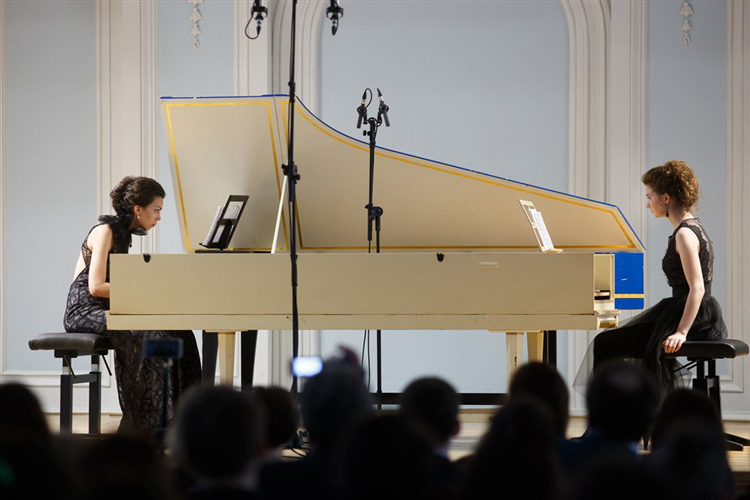
The faculty of historical and modern performing art of the Moscow Conservatory lives a friendly family, looks a little sect from the outside and has been conducting an invisible fight for musical truth for 20 years. Here, for the first time in Russia, they systematically abandoned the inertness of traditions and began to teach musicians to re -open up huge layers of repertoire from the Renaissance to the present day. A lot of truly unique programs, two hundred graduates around which life always seething, all Moscow Baroque and a good part of the alternative areas of academic music came out of here. However, you have to pay for the right to be dissimilar to others. Alexey Lyubimov, Olga Filippova, Philip Nodel and Elizabeth Miller tell about their sorrows and joys.
Go to your place, and you will see that in 20 years you will have everything
Alexei Lyubimov: Having shutting all this story, I felt like a European. In 1997, we were given carte blanche, and the first five to six years, enthusiasm was such that we simply did not notice difficulties. Our landmarks were teachers who came from Europe and gave master classes. The faculty quickly began to teach young musicians who were trained on historical instruments abroad: Olga and Yuri Martynov, Olga Ivusheikova, Philip Nodel, Nazar Kozhukhar, Pavel Serbin, Olga Filippova.
Olga Filippova: At first there was no systemic training in the game on historical tools, but only the idea to go to them as part of the academic course a certain repertoire. Olga Martynova, who focused on the Parisian model of education, was preparing the first keyboard programs because she and Yuri Martynov studied at the Paris Conservatory with Ilton Vyunitsky. I studied the English model, watched the programs of the Royal College and the Royal Academy of Music, went and listened a lot. Then we realized that we needed a full -fledged class of a chamber ensemble on historical tools. When the oven began to come to us, the chamber orchestra of the faculty arose, and there was an opportunity to do large projects.
Philip Nodel: I studied most with Alfredo Bernardini and even thought to move to him in Amsterdam, but he said: “Look: we had no ancient music in Italy 20 years ago, and now Italian ensembles are everywhere. Go to yourself, be there, and you will see that in 20 years you will have everything. ”
Where do you have a renaissance harp?
Nodel: At the Department of Puffers, it all started with a flute and two teachers who still teach, Olga Ivushekova and Oleg Khudyakov. There were no other oven in 1997. I studied at FISI, never studying it, although the idea of the Goby class was already then. Andrei Piskunov, perhaps the only one who played on the Barochnoye Goboy was supposed to be the first teacher, but he was so financed in Khanty-Mansiysk that he had left and for 20 years there. He managed to give me baroque goba and teach something. Thanks to Fisia, I began to go to master classes, met Alfredo Bernardini and Marcel Ponsele.
Later, the class of Cyril Rybakov appeared, I took the Goboy class, Leonid Guryev - pipes. We still do not have a valtor and basin, but these specialties appeared in the Gnesin special school, where a baroque elective opened; We hope that when the children grow up, they will have the opportunity to enter FISI.
Lyubimov: They constantly ask me: where are you at the Renaissance and Baroque Harfs, where is the vocals? But it is difficult to break through new bets, not to mention the opening of new specialties.
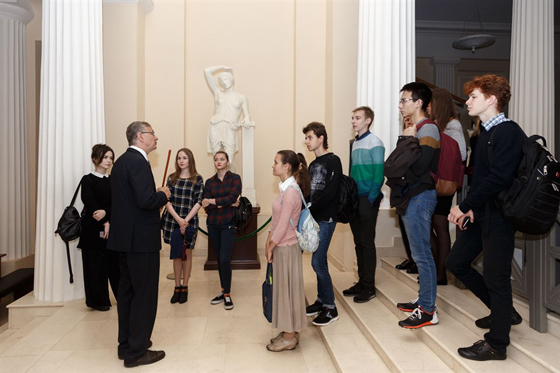 © D. Rylov Excursion on the building of the Great Hall of the Conservatory for freshmen of the faculty of historical and modern performing art and vocal faculty
There is no stable market
Lyubimov: In Russia, the demand for old music performers is much lower than in Europe. The graduate school opened ten years ago, before that many graduates went to continue their studies abroad. There they had concerts, orchestras, ensembles, and they stayed there. Some have made a successful solo career.
Nodel: still few people are engaged in ancient winds, because we do not have such a stable market as, for example, in Holland or in France. To play on a historical tool, one must have a job on modern, all my colleagues are soloists of famous orchestras. When they get bored there, they are happy to play baroque and classics.
Filippova: But the more specialists, the more we have large projects and jobs, the more musicians remain here. Today, people often leave to expand the horizons, and then return and make interesting projects. New ensembles and long -term large projects appear - for example, Philharmonic subscription with baroque operas. There are many of our graduates in the Musicaeterna orchestra.
Do you know how many years we fought for the Philharmonic?
Lyubimov: Our compositions are not very suitable for large scenes. There are many sites in St. Petersburg, and Moscow did not accept us for a long time. Do you know how many years we fought for the Philharmonic? Only in recent years, she noticed us, and now we were offered to make a number of baroque programs. The second season is the Mozart! Subscription! In the chamber hall, in it, our keyboards play historical instruments. This year I proposed the cycle “Romantic Music on Romantic Piano” in Philharmonic-2, I myself will play Schubert, and Yura Martynov-Chopin. There will be four or five instruments of the middle of the XIX century. Subscriptions are sold out, and the Philharmonic sees this success.
Filippova: In Moscow, few promoted chamber sites. There are beautiful small and Rachmaninovsky halls of the conservatory, but they are densely occupied by academic and curricula. The promising platform is a Bashmet center, there is a Pushkin Museum and the Tretyakov Gallery, but we need new places where there would be a constant flow of the public. In St. Petersburg, the situation is more prosperous, there are many palaces and museums where people go, and here we are forced to promote both the program and the hall.
However, the chamber halls of the conservatory always respond to our projects. Our creative initiatives are really not limited, and until recently we were not limited in the curriculum, all ideas were accepted, and the rector always supported us. Now the situation has become more complicated because there is a unification of education. In addition, due to large-scale repairs, we are temporarily excommunicated from the Rachmaninsky Corps, which was the main thing for us.
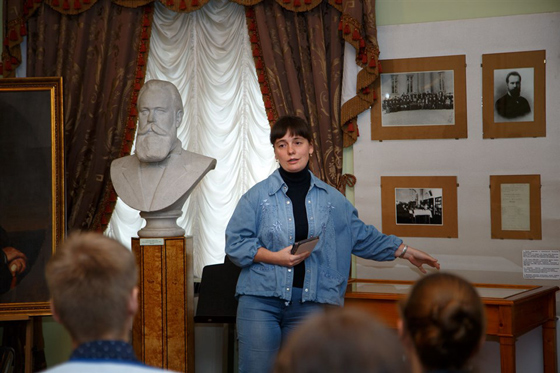 © D. Rylov Researcher at the Museum named after N.G. Rubinsteina Alina Albertovna Salm
I am not interested in watching from the side of how my colleagues will hang
Lyubimov: Fisia was created as a structure, isolated from the rest of the academic faculties of the conservatory, they looked at us askance, but they could not do anything with us. In the early 2000s, this confrontation, it seems to me, intensified. Now everyone understands that competition at a musical level is a meaningless thing, because we are engaged in completely different things. But now there are other forms of impact to ensure instability. With our norms, plans and elementary needs, we do not fit into the All -Russian Standard, which wants to make everyone equal. Become everything the same - but we can’t do it. Therefore, there is a struggle with us, not the same.
I have extreme pessimism in relation to what is being done in the country and in culture. We need a constant exchange with Europe, and since this communication is closed, it becomes doubly difficult. After seventy, I could quit everything, leave and go about my business, but I wonder what will happen next. I am not interested in watching from the side of how my colleagues will hang.
Elizabeth Miller: We have not only a educational structure, but also a large educational, concert and managerial center, where the life of a certain direction takes place. By and large, God himself ordered us to exist as a separate institution with his license, his premises. We can organize this, but I am afraid to get the right licenses.
Filippova: In the conservatory there are structures that go beyond the academic program and exist in a format similar to us. “New Music Studio” is a graduate school, an ensemble, and a research center. There are such structures in many European universities, the faculty of the Chamber ensemble of the Vienna University is built according to a similar model. However, we understand that the conservatory is inconvenient with us.
Nodel: But still, we exist at the Conservatory for 20 years, why move somewhere? It is better to change standards with your example and help colleagues open similar faculties in other universities.
We had a corridor and staircase
Lyubimov: We suffer from the disorder of our conservative life. If other teachers can deal with at home, this is impossible for us, because there is only here the harpsichords and ancient tools are scattered by the classes where other faculties are engaged in, until 19:00 there are group lectures, and we have no access there. My spun is in the tutor in the hostel. Another tool arrived specifically for our concerts in September, but then I will be forced to pick it up. Nowhere to put it.
Miller: In the Rachmaninovsky corps, we had 318th grade, and it seemed that everything was bad. But there we had a corridor, a staircase and a conference room, and now we understand that in fact everything was cool. The program for the competition in Bruges that I won, I learned on the stairs. Then Rakhmaninovsky was closed for repairs, we were evicted to the fourth corps and the third year they have squeezed there. At first there was one and a half audiences, where we belonged to half the time, then it was reduced to two hours a day, and we took the tools from the classes. Now we are again in the corridor, but at least no one forbids us to play during the day. We are engaged, it happens, simultaneously together, the three of us, we take the tests in the corridor. But it also became worse because the tools have to be carried through the street. In the Rachmaninovsky hall, we could transfer them on our own, now we need transportation, and carriers do not work for free. Before some concert, the adjustor suddenly told us: and this tool is not conservative, I will configure it for so much money. Moreover, the concert, as usual, for us was non -sagonorar.
Lyubimov: The conservatory has no money for carriers and settles. I'm not talking about the purchase of tools. All the tools were bought at Tigran Abramovich Alikhanov, and one was presented to us by Maxim Vengerov. My tools in the conservatory are not enough now, I was asked not to hold them here - there is no place, and the conservatory cannot serve their conservatory.
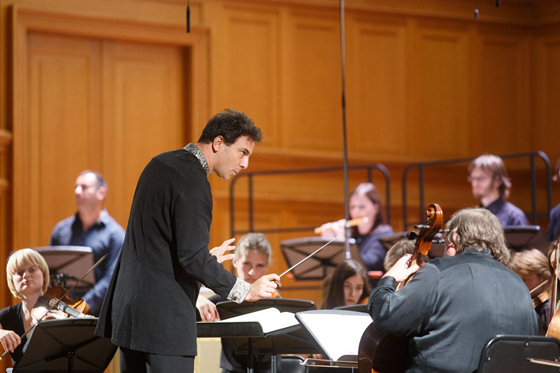 © D. Rylov Chamber Orchestra Fisia. Conductor - Ruben Dubrovsky, Austria
Here's the virgin lands is worse
Miller: Our conversation sounds like a stream of terrible complaints. I want to dilute it. I grew up in France, studied in Moscow with Alexei Borisovich, went to graduate school in America, but returned because here is the virgin lands harder. I understood how much I had to rake, but there is no such world like ours. Here is the conquest of the environment, here you constantly generate something new and try to root this new one. In the year before last, the guys from Perm arrived from Perm, not from some city where there is nothing, but you ask questions in the exam and get terribly naive answers: “What baroque conductor do you know? “Kurentzis.” And that's it. There are people who do not know at all that there is such a big marvelous world, and I want to open it for them.
Lyubimov: This is a problem of general education, which has always been closed and only now begins to open. People are sitting in their ease and do not know what is happening in the world. Or they know, but they do not project themselves. The middle and initial links do not help us. For example, in the CMS, both teachers and the directorate simply deny our direction. Recently, they decided to close the harvesting class.
Filippova: But the situation is changing. We realized that we must do something ourselves, and last year we conducted master classes at the school at the conservatory, came and showed what we were doing, brought their students. Marina Katarzhnova has a wonderful program, stringed applauded her and asked for more. After that, we had a brilliant technique, and we realized that it was working. We invited the director of Chopin's school Elena Ivanovna Gudova to the State Commission, and she became convinced that we have very interesting musicians of a completely different format.
The Gnesinsky school practically became the center of ancient music in the middle level, concerts, summer schools are held there. The lectures that we read at the conservatory helps a lot. This year I took the pianists of the usual faculty and teach them General Bas, who will need those who will work in theaters and face a baroque repertoire. They perceive everything with great pleasure. Now many keyboards, flutists and violin in entrance exams are playing historical instruments.
Lyubimov: But in general, you still have to overcome the inertial idea that those who cannot pass the competition for academic faculties come here. But this is far from the case. More and more people are going to study with us consciously.
What do you allow yourself?
Miller: Irritation causes our approach to the repertoire of the XIX -XX centuries, because it is “their” repertoire. What do you allow yourself? Who plays Chopin like this? When we perform Beethoven and Mozart on the piano, sometimes we encounter complete rejection. The guys from academic faculties come to me at the chamber ensemble, and when you begin to tell them the simplest things about the classic repertoire - the quarters of Mozart, the Beethoven trio - you find a completely white sheet, but a lot of interest. They have a feeling of a different, more healthy approach, which was previously alien to them: after all, not everyone understands that the tradition, which was considered universal for many years, is just one of the local ones.
Arriving in Moscow, I entered the third year of the Merzlyakovsky school for one elderly lady, professor of the conservatory. To the first lesson, I brought the prelude and fugue of Bach - I was kicked out after 15 minutes. She said: “My students have been playing like that for 55 years - here they take a pedal, and here they take a mormad. You will play the same way, but you don’t want to - don’t. ” The next time I flew out with Beethoven's sonata, and after three months I transferred to another class.
Lyubimov: There are musicians who still live in the Karayan era, and we live in the Gardiner era. Often students blindly follow their teachers, and teachers - the former traditions. But the traditions were played, and there is nothing in common with the original source, even romantic, in them. The conservatory is taught the same language, they say “play in the style of Bach or Beethoven”, forgetting that the style consists of many parameters: knowledge of grammar, spelling, emotional filling, correct and incorrect accents. Why do we prefer old tools? Because they lead to understanding this language, it is impossible to study Mozart’s language on a modern piano.
Miller: You can return to the piano, having this knowledge. But it is the historical tool that gives a clear hint.
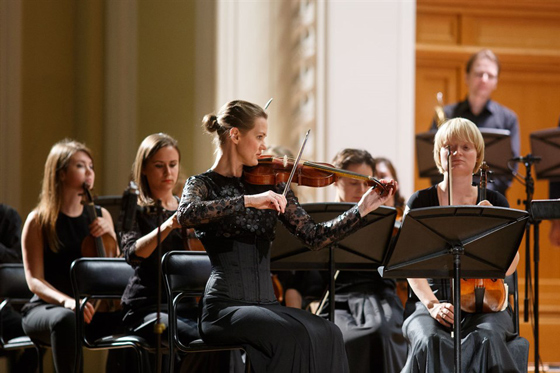 © D. Rylov Chamber Orchestra Fisia
There is no meat in Rachmaninin
Miller: When I studied at the school, they presented us as the truth, that Rachmaninov is a wonderful pianist, but he did not know how to play his things, that now we know how it should. But our teacher Seryozha Kasprov according to Rachmaninov Big Special. He sends students to listen to Rachmaninov’s notes, they return, they scratch their turnips, he shows them everything on the instrument, explains, and they write enthusiastic posts on Facebook: for the first time in my life I heard what I heard only on the records of the beginning of the last century!
Filippova: A wonderful formula - "We know what the composer wanted." For some reason, we know everything for the composer. But YouTube has records and interviews of the students of Clara Shuman, who explain in detail her methodology. You can listen and understand that there is the continuity of schools: Rachmaninov and students of Clara Shuman - this is almost one time. And this is not so far from the classics. There is no meat in Rachmaninov.
Our students have a different look, a different basis, from a different point they look at this repertoire - not only back, but also forward, from baroque and classics. Our teachers go from academic faculties and those who want to play on a modern tool, and not on historical. Dmitry Sinkovsky, for example, transferred to us to the fifth year from the orchestral faculty and entered the graduate school.
Nodel: The uniqueness of our model is in its universalism: a musician, most equipped with everyone, including instruments. It is impossible to earn only on a traverse-flash or baroque goboy, so everyone playing on historical instruments, and plays very well on modern ones.
All these years, not only graduates, but also people from the outside have been drawn into our orbit. In 1994, on the basis of the ancient ensemble of the conservatory, the Nazar Pocket Symphony ensemble arose; Now it has been transformed and has a second composition - the Viool ensemble unique for Russia. In 2003, the Pratum Intergum orchestra appeared - these are graduates and teachers of Fiius and musicians from St. Petersburg. The freshest project, completely assembled on the basis of FISI, is the Les Moscovites orchestra. Noting a sad anniversary, 250 years since the death of Teleman, for the first time in Russia we played entirely its main large cycle - “T Afelmusi K” (“Table of Music”).
Lyubimov: Our diocese is precisely historical music, not ancient, because now it can also be called an ancient romantic one. Мы не теряем академической платформы, из нашей среды выходят прекрасные академические пианисты, струнники и духовики. Саша Бузлов и Дима Прокофьев занимались у Гутман, Марк Пекарский воспитал замечательных ударников, ученики Олега Худякова — востребованные флейтисты. Иван Бушуев, один из самых блестящих наших выпускников, играет в МАСМе. Из недр факультета вышел «Персимфанс» Пети Айду, нынешний состав ансамбля ударных Марка Пекарского — абсолютно фисиишный проект.
На юбилейном концерте в Большом зале консерватории 10 сентября была смешанная программа, составленная из разной музыки. Абонементов юбилейного блока два. Первый — «Переклички эпох. Двойные портреты»: Моцарт — Ксенакис, Гайдн — Мартину, Перселл — Найман, Шуберт — Сильвестров. В этих программах задействованы старинные и современные инструменты. Второй цикл — транскрипции, тема, к которой мы обращались и раньше. Транскрипции существовали всегда, до появления нотопечатания и звукозаписи это был способ распространения музыки. Переформатированные сочинения заняли у нас четыре программы. Еще один проект — продолжение и окончание цикла всех сонат Бетховена на исторических инструментах.
Мы распространяем энергию вовне
Филиппова: У нас совершенно особые отношения между студентами и преподавателями. Для проекта в БЗК нам был нужен большой состав оркестра, и к нам пришли наши выпуски разных поколений. Практически все 20-летие ФИСИИ на сцене.
В моем классе сложились контакты с Венским университетом, где я училась, уже несколько моих учеников продолжают образование у моего педагога Вольфганга Глюкзама. Вокруг него образовалась музыкальная семья, и он тоже говорит, что никогда не встречал такой атмосферы и теперь не может без этого жить. Мы распространяем энергию вовне.
Любимов: Я сроднился с моими коллегами, и не только со старыми, но и с новыми. С ними я нахожу общий язык, может быть, даже лучше, чем с коллегами старшего поколения, с той же Наталией Гутман, с которой мы очень дружим, но идеологических соприкосновений сейчас у нас практически нет. Я как могу помогаю молодым за границей, регулярно сижу на конкурсах, стараюсь свести их с фирмами звукозаписи. Это трудно, но я чувствую себя счастливым, когда что-то получается.
Я слишком робко использую свой авторитет. Наши «противники» от меня много лет не могли услышать ни одного злачного слова, не умею я... А сейчас не знаю, удастся или нет.
Нодель: Сначала надо 20-летие отметить.