
Translated material
Ballistopad
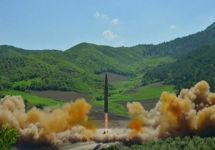
North Korea again conducted a missile test, reports Reuters. The intercontinental ballistic missile launched from the surroundings of Pyongyan flew over the Japanese Hokkaido Island and fell into the ocean at a distance of about 2 thousand kilometers east of it.
According to the US military, the North Korean missile flew 3700 km, rising to a height of 770 km. The Japanese authorities warned Hokkaido residents of missile alarm on television and through SMS messages.
The United States, Japan and South Korea demanded that emergency consultations of the UN Security Council in connection with the next launch of the rocket. The Council of People's Commissars will take place at 15 o’clock in New York time (22 Moscow time).
"The international community must unite and send North Korea a clear message that it threatens the world around the world with its actions," said Japanese Prime Minister Shinzo Abe. He called the launch "unacceptable."
US Secretary of State Rex Tillerson appealed to all countries to take new measures against the North Korean regime. "The ongoing provocations only deepen the diplomatic and economic isolation of North Korea," he said.
Tillerson separately called on Russia and China to take specific measures against the DPRK. “China and Russia must declare its intolerance to these reckless missile launches, taking direct actions on its part,” Tillerson said. “China supplies North Korea most of its oil, and Russia is the largest exploiting northern Koreans forced labor.”
On Tuesday, the UN Security Council unanimously adopted a resolution on tightening sanctions against North Korea in response to the sixth nuclear test conducted by the DPRK on September 3 . The document imposes a ban on the purchase of North Korean textile products. In addition, the resolution prohibits the sale of gas condensates to the country of gas products to the supply of oil products to the DPRK. By the end of this year, North Korea will be able to purchase a maximum of 500 thousand barrels, and later deliveries will be limited by 2 million barrels a year. Currently, the DPRK consumes 4.5 million barrels per year.
The UN Member countries are prohibited from issuing new work permits for DPRK citizens, except when it is about humanitarian assistance or denoclialization programs. The resolution allows you to inspect the court in the open sea in case of suspicion of transporting prohibited goods to North Korea or from it. However, such an inspection should occur with the permission of the countries under the flags of which they go.
Initially, the United States insisted on a more stringent version of the resolution. In the American draft document, it was about the total embargo for oil and the freezing of assets of the North Korean leadership abroad. It was also proposed to freeze the assets of Air Koryo airline, the North Korean armed forces and structures related to the army and the Korean labor party.
However, China sharply opposed this. After negotiations that lasted almost a week, only sanctions remained in the project against a number of party and military structures. The restrictions regarding the army itself and Air Koryo had to refuse.
The Permanent Representative of Russia at the UN Vasily Nezenzya said that financial and economic pressure measures on the DPRK are almost exhausted. "Further restrictions can be equivalent to an attempt to strangle its economy, the introduction of the country's total blockade and provoking a humanitarian crisis," said Nebenja. At the same time, the Russian Permanent Republican emphasized that Moscow does not accept the claims of North Korea to the status of a nuclear power.
On September 5, Russian President Vladimir Putin at a press conference in China stated that the DPRK would not refuse to develop nuclear weapons under the pressure of sanctions, as he considers this program a security issue. "Yes, they, as I said at a meeting with my colleagues yesterday, will eat grass, you see, but they will not refuse this program if they do not feel safe." Therefore, according to the president, the use of any kind of sanctions will be "useless and ineffective."