
Translated material
Failing inside Bjork
The BJORK Digital VR exhibition was brought to Moscow-about how the singer experienced her gap with the artist Matthew Barney

On Tuesday, September 19, in Moscow, the 7th Moscow International Biennale of Contemporary Art began , to which artists from 25 countries brought. One of the most anticipated projects presented on Biennal is the BJORK DIGITAL Immersive exhibition: a series of VR production dedicated to the parting of Bjork with the artist and father of her daughter Matthew Barney. "Medusa" recalls the history of their relationship - and how the singer was experiencing a break.
“My rampant feelings scare you, and my apocalyptic obsessive ideas are bored with me. Maybe I loved you too much? This obsession broke me, either sings, or cries, or shouts the charges in a short black dress, making her way through the cave somewhere in Iceland. She falls to his knees, grinds the ground with nails, hits itself in the chest and, as a result, gets to the surface - deserted, but at least green and living. This woman is a 50-year-old pop-star Bjork, a dress (which looks simultaneously with armor and chains that fetter her body) was specially made by designer-tributist Iris Van Herpen, and the VR-artist Andrew Thomas Juan, the author of the video clips of Tom Yorka and Sigur Ros, shot.
A ten -minute video (more precisely, two of its versions) show in a dark room on two screens, between which the audience is clamped: Bjork, stumbling, falling and rising, stubbornly goes forward, and it is impossible to dodge her emotions. This is Black Lake - the first hall at the exhibition "Bjork Digital" and at the same time the name of the central track from the last plate of the singer "Vulnicura". The album, on the cover of which Bjork is depicted with breast-vagina, like the exhibition, is dedicated to her gap with the artist Matthew Barney-and that period after the completion of the relationship, when you fall to the bottom, and then try to float somehow.
Cosmic overalls and black t -shirts
Icelander Bjork and American Barney met in 2000 in New York. She came to the American premiere of Lars von Trier’s “dancing in the dark”-a musical tragedy, where she played a blind and immigrant worker who ended her life on a gallows. Barney, on the other hand, only came out the next part of the Cremister (the cycle of multi -figure, high -budget and filled with symbolism of experimental films), in which he himself played Gary Gilmore, the killer and Mormon, who chose the execution, instead of a petition for pardon, was released.
At this point, Bjork had three hitic albums and a prize of the Cannes festival for the best female role, Barney had four “Kremaster” and the prize of the Biennale Venetian; Shortly before that, The New York Times called him the most important American artist of her generation. Both became famous in the 1990s and were real stars of contemporary art and pop culture-strange, but brilliant. Endlessly experimenting and changing the masks, both entered the Golden Fund of modern culture at least one of their many images: Bjork-“Girl from the North” in a dress (in which the singer came to the Oscar in 2001), and Barney-a white-skinned apprentice in a fur hat and with a torn mouth from “Cremister-3”.
But even the out -of -day Bjork scene remained an eccentric “Icelandic Elf”, while the former football player and model Matthew Barney clearly shared his life and art. It seemed that he, like Steve Jobs or Mark Zuckerberg, perceives clothes as a uniform. The contrast between Barney and Bjork is visible in any picture of the couple: inconspicuous jeans, rough boots, black t -shirts or barney shirts “grounded” Bjork with her space jumpsuit , silk kimono and dresses embroidered pearls. It seems that it was about Bjork that the English -speaking expression to Wear Heart on Sleeeve was invented: she “carried her heart on the sleeve”, while Barney in her uniform remained impenetrable. Even his assistant Paul Pizoni, who worked on sculptures for the “cremaster”, called the artist secretive: “You never know what you get involved in him until you find yourself in the process.”


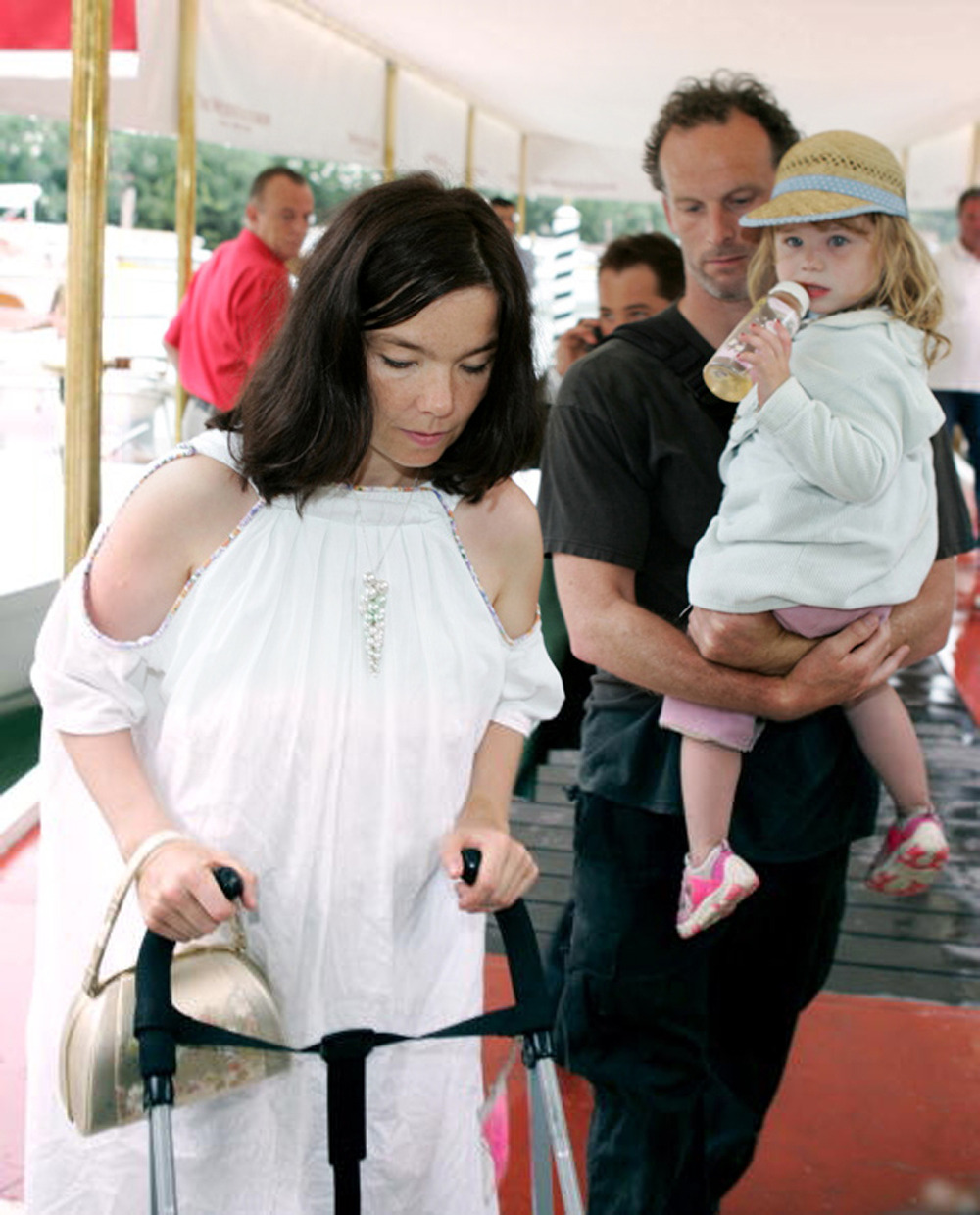


“I love him. I love him. I love him. I love him, ”Bjork conjured on the 2001 record“ Vespertine ”, recorded at the very beginning of their relationship. The singer (apparently on the stage and outside her) was always a lump of pulsating emotions - and this rampant sincerity either bribed or repelled. She seemed to try to turn herself inside out too and at the same time hug the whole world, switching from a brushing whisper to a cry in a second. Barney, with his tendency to structure and abstract everything, looked like her complete opposite. “And this is one of the reasons why he is so fascinating me,” said Bjork. -He still remains a mystery to me: a person who is not at all obsessed with emotions and experiences. Wow".
Para Enigma
In 2002, the couple had the daughter of Isador, and this is more or less all that was known about their relationship. One of the most frequent words that were used by their address is Enigma : Bjork and Barney were public figures, whose life actually had little known. As the Canadian TV presenter Jessica Ellen explained their magnetism (dedicating a whole column of how for many years it was their fan), they were "incomprehensible, absolutely in love with each other, deep and avant -garde." That is, the reference alliance of two artists, where each was an independent size, is the same kind as John Lennon and Yoko, Ulya and Marina Abramovich, Kim Gordon and Terston Moore. With one exception: in his personal life, Bjork and Barney were together, and in art - strictly separate. At the start, they agreed that they would not intervene in each other's work.
Nevertheless, in 2005, they still got a joint project. Bjork and Barney to the first (and last) time worked together - on the artist’s film “Drawing Restraint 9”, to which the singer wrote music. Both played the main roles in it; The Independent named the painting “Tristan and Isolde” by Matthew Barney. A conceptual tape of two and a half hours was almost entirely shot on a Japanese whaling vessel. So far, 25 tons of Petrolatum hardened on the deck in oval form (one of the artist’s favorite materials from which Vaselin is made), a peculiar ritual that refers to Shintism took place in the bowels of the vessel: Bjork and Barney prepared for the tea ceremony, met, crowned, or crippled each other, or were engaged in love - and fell into the open sea.
In the climax, both took out knives and slowly cut each other; The bleeding incision on the hero’s hip exactly resembles how ten years later a open wound on Bjork's chest on the cover “Vulnicura” will look. According to her , how Matthew Barney works with characters more resembles a sculpture. “We literally fly each other during the film, separate our legs and float after the ship with two whales. This is little like an acting game in the spirit of Dustin Hoffman, ”the singer said about the film.
Working with a partner, according to her, was a kind of challenge. “I need intimacy, I need contact,” Bjork explained. - I need a compromise. And with him there are no compromises. I’m all about the narrative, and he is about anti -narratus. ” But, from the very beginning, realizing that they had opposite approaches, they dared to unite and prove that in fact they are one. Barney himself was in a more rational position. According to him, the decision to play in the film himself was much practical than autobiographical. “I do not know how to work with actors,” the artist confirmed. “So it was easier to tell a love story with the help of an example from life.” In a sense, according to him , Bjork was a radi-mide for him-a found object in the tradition of Marseille Duchan.
Music as a way to survive parting
On January 18, 2015, the eighth album of Bjork “Vulnicura” was leaked on the Internet, which was announced just a few days earlier; It was planned that it would be released no earlier than March, but the release had to be urgently transferred. On January 20, it became available on iTunes, after which he headed the top iTunes in 30 countries and held on this place for a week. On the cover of the record shot by the avant -garde photographers inz & vinoodh, a wound in the form of a vagina gathered on the chest of Bjork, and around her head was a kind of yellow halo - the color symbolizing healing, as the singer later explained. And his topic was the subject for secular news, so discussed that even the actress and director of the “girls” Lina Danam , answering the question of Hollywood Reporter “What did you google?”, Admitted : “Photo by Bjork and her ex -husband.”
Rumors that Bjork and Barney broke up in the press back in 2009, but Vulnicura was first -hand certificate - a kind of psychotherapeutic experience that the listener lived with the singer. In unexpectedly straightforward texts, Bjork has documented the whole process of breaking up with a partner - more precisely, her experiences: the foreboding of the decay of their family, a severe experience of the gap and its consequences. The singer could not resist direct accusations; The album was even reproached for the fact that only “one side” is presented in it - supposedly Bjorka blamed exclusively Barney, and he portrayed herself a saint.
In an interview, the singer refused to talk about the events that became the basis of the record, referring to the fact that everything is said in the songs, and, judging by the conversation on PitchFork, it was still painful for her. At the same time, every time speaking of her music, she came to life. “It was the most fascinating and easy studio experience in my whole life,” she said about cooperation with the producer of the album, an ARCA electronist. “Although the topic of the album was the most tragic for me.”
Matthew Barney himself did not react to the fact that their discord with Bjork was described in such detail herself - and the singer is mentioned in a glimpse of the artist who came out six months before the release of Vulnicura. A few months after the release of the record, the artist demanded equal custody of their 12-year-old daughter. “Bjork is sacrificing Isadors with emotional comfort for his own selfish needs,” the artistsaid in the lawsuit. “She believes that as a mother has more rights to a child than I, as a father, and also continues to consider me the only culprit in the rupture of our relationship and the collapse of the family.”
Virtual reality Bjork
In the summer of 2016, Vulnicura turned into an art project “Bjork Digital”, which was introduced in Sydney (and since then he visited Tokyo, Mexico City, London, Reykjavik and Barcelona). This is a series of halls, in each of which a group of spectators literally plunges into tracks from the album-for most of them the VR artists shot videos that need to be watched with Samsung Gear VR glasses. If on the album Bjork laid out the listener all the approaching, then in the BJork Digital halls she has nowhere to go closer: she sings and dances right in front of the viewer, the remaining one on one, almost touching her hands, suddenly dives somewhere to the side of the back and appears from behind. And it is worth lowering (or lift) the head, as a harsh Icelandic rocky shore or bottomless cosmos will be underfoot.
In one of the numbers, perhaps the most dizzying (in the literal sense of the word), the viewer falls into her throat-and in the final of the exhibition, the singer is reborn into a neon demon and, together with the viewer-participant, rushes through a sparkling tunnel to a huge heart-vagin. Like parting, this is not the easiest experience and not always pleasant, but it is at least interesting to go along with Bjork. Now this can be done in Moscow; By coincidence (or the irony of the curator), three works by Matthew Barney were also brought to the Moscow Biennale.
Olga Strachovskaya