
Translated material
Prophet at your table
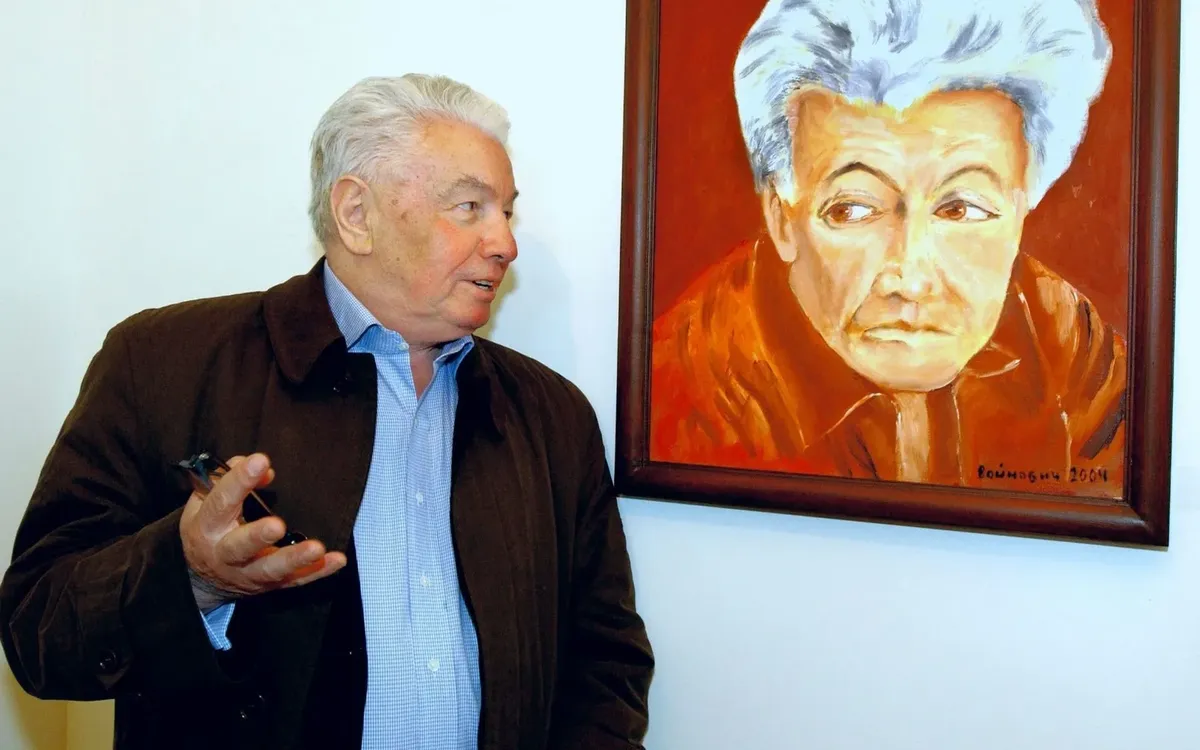
Stanislav Belkovsky for the 85th anniversary of Vladimir Voinovich
And you, then, are you just officially considered a writer? And do you even have a document, what are you a writer? "Moscow-2042"
The Russian writer is either a boss or a prophet. And if he is not the first and not the second, then this is no longer a Russian writer, but something unusual type of salon improviser.
(A small preventive remark: for the purposes of this text, the concept of “writer” is used exclusively in a male gender. The feminity here is inappropriate, alas or fortunately.)
Find seven differences
You can, for the first time, distinguish the seven differences of the writer-chief from the writer-prophet.
- The boss constructs his own life. Thoroughly and with meaning. Each step, any action, every word should lie down in the planned design of life with a correct, inseparable element. The fact that it is impossible to smoothly add to the already sophisticated is discarded. The planned result of such design work is a large biography of the writer-chief. Similar to the main components to someone's great biography from the conditional past. But not repeating the predecessor, but reproducing it, as it were, on a new round of a dialectic spiral. Therefore, the life of the boss is a continuous ritual. For the implementation of which a separate chief of the protocol is needed, even if the unsaturated writing head living inside.
The Prophet lives on a hunch. He does not have a solid life strategy. He is glad to every new day, but not very upset if such a day does not happen. We will all be there, in the end. And how to live-someone who for some reason holds the prophet on this side of the plot will tell. The protocol for such a case is not required at all.
2. The chief is absorbed in the arrangement of the real world. He wants to at least in some direction to remake his country and, although partly, the whole globe. To achieve this, he needs power. Not only and not so much literary as real, political. Perhaps not a direct named power, but mediated by psychologically and mentally dependent politicians and officials.
The Prophet is engaged in an exceptionally imaginary world. Who invents himself and which he rules himself. Untrumentally, without annexes and indemnities. Therefore, the influence in the real world would be excessively burdensome for him. In addition, the Prophet, unlike the boss, does not see the fundamental protected border between these two worlds.
3. The boss is not that he writes ... He rather says. Spreads. His statement is sacred, therefore it should be perceived in one way or another by ear. All kinds of quotes and da-tzu-bao are born from the system of such statements. Partially consisting of words that the boss never said, but this is not important. The boss cannot write “good” or “bad”, these categories are not applicable to him. He does not produce fiction, no matter how vulgar this term is, but generates world-historical significance.
The Prophet exactly writes - with the help of any devices available to him: from the tablet (they say that it is inconvenient to write there, if only with an external keyboard) to a pencil. He writes, as God puts on the soul. As in the case of an undeveloped life, the Prophet tells what came from somewhere in it. Where is this unknown, especially to himself.
4. The boss believes in God officially and formally. To believe in the primary ones means to assume that such a concept is necessary, at least based on the above paragraphs 1, 2. He is a deputy of God on specialized issues. And in order to serve as a deputy, there must be the first person to whom you are directly obeying. You cannot be a deputy of the one who is not. Therefore, let it be so far. The life and activities of the boss are legitimized by the boss, the cheat sheet for whom the boss prepared himself. So that he in the dust of his care about humanity inadvertently does not forget anything.
The Prophet believes in God unofficially and, rather, unconsciously. At a conscious level, he cannot answer himself or others to this question. And why? Everyone here has their own. The Prophet, moreover, often not admitting to himself, scurrying to God: after all, he is so perfect, and you ... and forgives you, the unfortunate, your clumsy life.
5. The boss constantly creates a system of evidence of his own being. The permissible evidence includes: officials (writers' or not), titles (from deputy to duchy), title (from Major General and above, there is still a hero of labor), award (from the National bestseller to Nobel). The basic coefficient of the boss (BKN) is the ratio of the size of his biography, for example, from Wikipedia, to the total volume of literally written (said). The more BKN, the better. Ideally, if this coefficient at some point surpasses a unit, but such precedents in the history of literature (at least Russian) have not yet been recorded. Seems.
The Prophet sometimes recalls that there are something correctly good in prizes and other awards. Then he sucks a little under the spoon. But since he is not a boss, the Prophet does not understand the true meaning of all regalia-ceremonies. He opened the window into the garden, inhaled the neighboring pine tree, rolled 150 g for inspiration - here you have the entire state prize, awarded in private.
6. The boss must be alienated from his flock, she is also a target audience. Otherwise, the sacred distance will disappear, without which there is neither the status nor the self -awareness of the boss. Alienation is achieved in several traditional ways. The first is complete inaccessibility. The boss lives on an island where there is no access to anyone. True, two dozen television cameras hid in the bushes, and other bosses, state and/or international, with fresh prizes (awards) in Diorov pockets, are from time to time. But the simple mortal path is closed there. The flesh and blood of the boss are protected by the entire power of his personal first department. The boss is allegedly terribly lonely, in the meaning - lives in the world and on the yura.
The second way is a deliberate complexity. Thoughts and language. So that one who is not able to understand this is more and more delighted.
The Prophet does not hide at all from those who know about its existence. And he does not hide from the unbearable either. He may well sit down at a very unfamiliar table and treat himself than to be offered. But in the writer's dimension, the Prophet is alone and really. He has no satellites, no assistants, no donors. There is only him and what he is going to state. Its island is intangible, and because of which it is surrounded by a starless ocean.
And - the prophet is always simple. He formulates himself in a completely understandable language. That is why many do not want to understand and recognize it.
7. The boss is always right. If he is wrong, the problem is solved in two ways. Firstly, the boss always has an extensive loud Klaka who will explain to the unreasonable world why their leader is not mistaken, because cannot be mistaken under any circumstances. Secondly, if the boss can always say: it turned out as if not in my opinion, but in fact, in my opinion, because thanks to me. For example: I said that the USSR would not collapse, but it collapsed with my own efforts, so ... the boss really seriously considers himself a prophet. For his epic prophecies, he is thanks to his lifetime. Of these, the mausoleum is gradually but steadily composed.
The Prophet does not consider himself a prophet at all. And he is almost always wrong. In the middle and on a short wave. Its correctness comes to the surface after decades and centuries. And if they thank him, then more often after that.
Vladimir Voinovich-one of the very few Russian-acting Russian writers today. And he is real, because the Lord saved him from temptation to become a boss. And the Lord does not save from such things at all.
We will try to say thanks to him today, on the day of the obvious anniversary.
Archetypes
The Russian writer is also good, who can say about the Russian manual (and not only about himself and external circumstances) something archive. Voinovich succeeded.
Here, for example, Ivan Chonkin. This is the main character of Russian civilization. The same Ivan-Durak that can never use favorable circumstances, but wins thanks to all troubles and misfortunes. Ivan-Durak is not able to die-it would have gone too much. And he draws the energy of unconscious heroism out of everyday life, which seems to be fabulous in the Russian dimension.
To tell you how to close the bombing of a bomb or open a hydrogen bomb, anyone can. To give the modern Russian world (in a good way) a detailed portrait of a fool is an exclusive.
Or, say, Genialissimus Bukashev from Moscow-2042. A typical Russian intellectual who sincerely thinks that his fantastic mind will allow him to rule Russia and Russians. Holy simplicity! Power here (and everywhere in general, probably) is, rather, peasant, earthen, intuitive. The intellectual should (maybe) be on the patch. If he does not understand this and gets away to go to the end, then he will destroy himself (completely), and the country (partially)-you really destroy such a country, while Ivan-Durak lives and acts, he is a soldier Chonkin.
Well, Sim Simych Karnavalov. Voinovich of the premium flaw out at one time - and continues to flaunt - because many saw Alexander Isaevich Solzhenitsyn in this character. But nothing comes to Solzhenitsyn, of course. At each stage of our history there is such an indispensable Simych, and by no means necessarily in literature. Now, Mr. Karnavalov, the politician A.A. Navalny. The Prophet both here and for this time turned out to be right.
Vladimir Voinovich wrote a list of Russian archetypes. And the list, as we know from our linguistic past, is a fairy tale (well, remember, the audit fairy tale, etc.).
Storyteller
Voinovich is a classic of a Russian fairy tale. That is, a story that initially does not claim to be any reliability, but is read as something completely reliable and genuine. When completely invented more authentic than the unacceptable.
Therefore, if you try to enter our current anniversary into some tradition (although this is prohibited, and the reception is not necessary for anyone), then he appears to be a direct heir to Evgeny Schwartz. Shadows, naked kings, monsters - whether it be dragons or inhabitants - they are all present in Voinovich’s novels. Let not be called so solemn. But what's the difference.
Hemingway
If I were asked to determine the image of Voinovich in great Russian literature, I would say this: this is a satirist-cheemingway.
Ham left us some of the most important principles of the Soviets, among which:
- You need to write without adjectives.
- You need to find a cocky word, Le Mots Just, which will say everything for itself and for all.
- Do not write more than you really want to say.
Voinovich, who was also a satirist, followed all these covenants. Even if I did not always guess. The prophets are generally inaccessible - such utilitarian abilities are simply useless to them.
Live
It is necessary to live in Russia for a long time, then ... - said Korney Chukovsky.
Vladimir Nikolaevich obediently followed this Maxim.
Sometimes it happens that you suddenly hear about the anniversary of the big writer and think: how, this is still ...?
You won’t think about Voinovich for anything. He is completely immortal, like his heroes, Ivan Chonkin and others. In the literal and banal sense of the word "immortal." As if what kind of elixir sipped, from the right jar.