
Translated material
Anatoly Vasiliev staged the first performance in Russia for 11 years. Why is it important?
In Moscow, they will show the premiere of "Old Man and the Sea" according to Hemingai

The founder of the "School of Dramatic Art", director Anatoly Vasiliev since 2006, has been living in France since 2006 and has not been working in Russia, but this summer he made an exception for the Chekhov festival and staged the performance "The Old Man and the Sea" based on the story of Hemingay on the stage of the Vakhtangov Theater. They played the performance only twice, two more shows will be held on September 30 and October 1. At the request of Medusa, the theater critic Anton Khitrov tells how Vasiliev’s return to the Russian scene turned out, from which a new performance is made up and why it is certainly worth seeing.
Vasiliev
Anatoly Vasiliev - of those artists who categorically do not suit the default settings. He wonders again and again the questions “What is the theater?”, “What could the theater be?” - And each time it gives a new answer. Now that the director does not work in Russia, the simplest way to make sure of this is to come to any performance of the Moscow Theater “School of Dramatic Art” and properly examine the theater building, built by the project of Vasiliev and his late co -author, the artist and architect Igor Popov. You will not see anything similar in any other theater: there is no ramp, no curtain, instead of the black box of the scene - in spun white space, instead of a standard spectator lobby - an imitation of covered street.
Vasiliev began in the 1970s as the author of the household psychological theater, became virtuoso in this matter and threw to engage in gaming, improvisational, and then ritual, mystical. This is the only director in the latest history of our theater, which has passed such a complex evolution. The “School of Dramatic Art”, created by the director in the late 1980s, was organized in fundamentally different than the usual repertoire theater: the performances were composed for years, all the work was imprisoned for a creative search, and not for the production of a finished product.
The last time Vasiliev released the prime minister in Russia 11 years ago - it was the play "Stone Guest, or Don Juan Dead." The long -term dispute with the city authorities ended with the dismissal of the director from him the created theater and moving to France, where Vasiliev works to this day and is not going to return yet. The general producer of the Chekhov festival Valery Shadrin managed to organize the “one -time” return of the director after more than ten years of absence.

Lyubimov
“The Old Man and the Sea” - Ommage Yuri Lyubimov, dedicated to his centennial. Before the first show, Vasiliev said that the story of Ernest Hemingway was one of his favorite books of his senior associate. Like the soloist of the premiere of Alla Demidova, the director at one time worked under the leadership of Lyubimov in the Taganka Theater: it was there that he released the famous “Sergo” based on the play by Viktor Slavkin, his last “household” production. The dazzling rays of the spotlights hiding the scene in one of the episodes of the “old man and the sea” is a direct quote from Lyubimov: the light curtain is his signature reception.
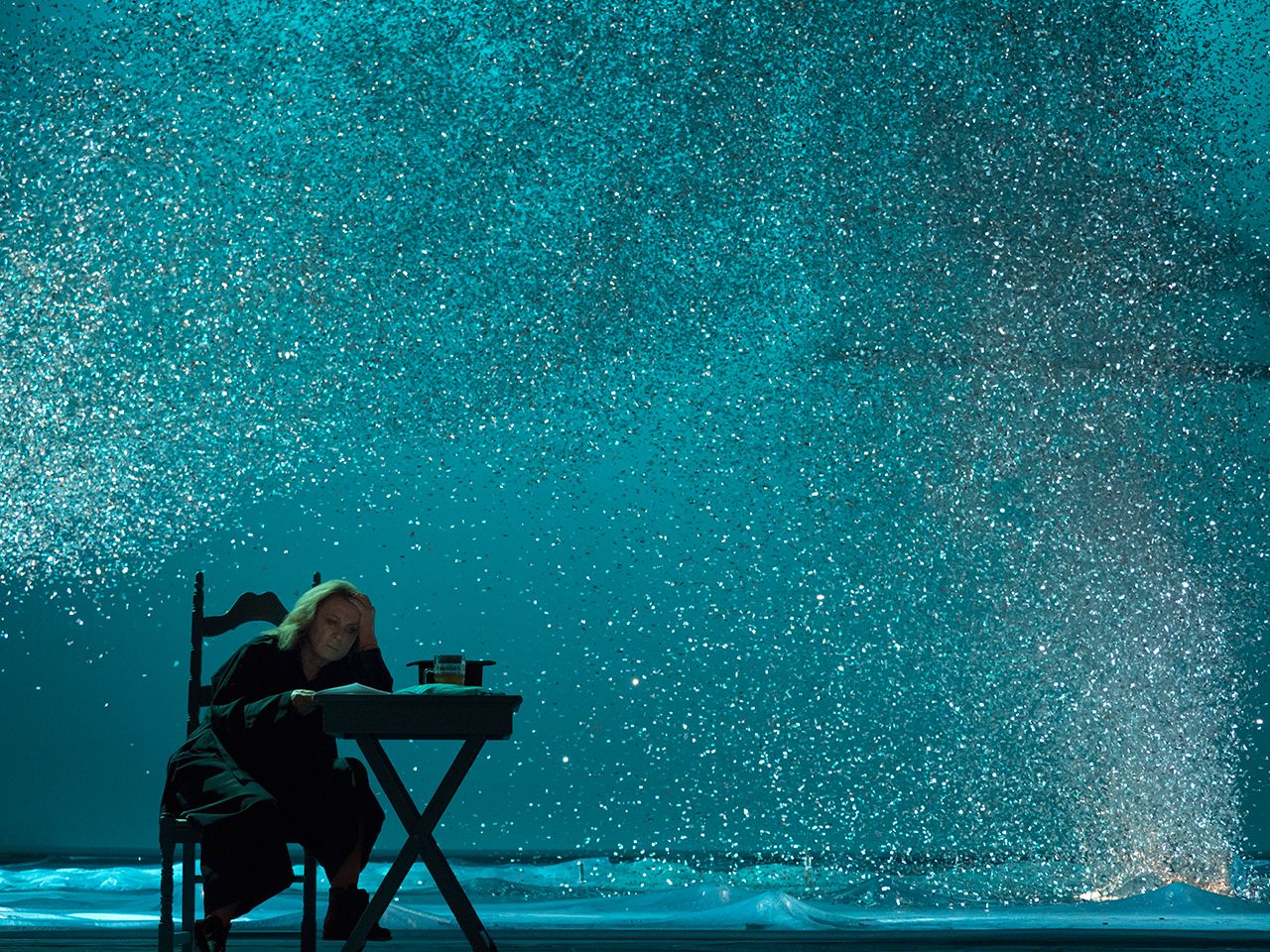
Vasiliev also refers to other theatrical traditions, in addition to the Taganka: his long-standing enthusiasm for the East, who once had the need for the “Iliad” with Asian martial arts, affects the performance. Dressed in the black servants of the Proscium move as if in a rapid, which resembles leisurely actors of the Japanese theater but (bamboo canes enhance this impression). In one episode, the sleeping old man is the Golden Leo - a richly decorated doll from traditional Chinese dance. The performance is not to occupy spectacular visual solutions at all - which is only a climax when the rag sea dotted with sparkles “boils” under the influence of invisible machines.
Demidova
But the most important here is the two -hour solo of Alla Demidova. The actress, who has been going on for several decades on advanced theatrical searches, working with the first directors of her time - Lyubimov, Viktyuk, Terzopoulos, the same Vasiliev - in recent years entering the stage almost exclusively in poetry concerts, and in full -fledged performances participate very rarely.
Demidova does not play literally old Santiago; In the program, its role is called "from the author." For two hours, she holds the text at hand, not so much for insurance, but out of respect for writing work: she does not want to give the words of Hemingway for her own (in poetic concerts the actress follows the same rule - no recitation from the sheet only from the sheet). In general, the director’s plan excludes any pretense. After reading Santiago to the straw hat, Demidova puts on a black cylinder - the artist’s headdress, but not a fisherman: they say, you understand that I am not an old poor cubic.
The actress reaches kinship with the character not through acting, but through genuine momentary experience experienced on the stage. She spends these two hours alone with a thousandth hall, like an old man - alone with the ocean, relying only on the strength of her voice, like Hemingway hero - on the strength of his hands (the microphone has tightly entered into theatrical practice, but almost does not use them in the “old man and sea”).
Santiago is not the only "hypostasis" of the actress. The director laid out Hemingway's story into three voices: the old man, the sea (read - rock) and land (society). A fragment about the attack of sharks sounds in the recording; Demidova reads him with a special “affirmative intonation”, which Vasiliev teaches actors - as if after each word there is an exclamation mark. A living artist motionlessly listens to the phonogram of her own voice: they say that there is nothing to object to a person from flesh and blood when the sea speaks. And the final paragraph of the story - about the tourists who came to stare at the skeleton tied to the boat - Demidova says with a microphone in her hands. This is her third and last hypostasis - a weak voice of an ordinary, “land” person.
"Old man and sea"
The scenography, composed by the director personally, picks up an analogy between the artist and the fisherman, likening the sea to the theater (or the theater - the sea). The translucent blue “sails” take off under the gols, becoming theatrical paradugi , then go down to the floor with a multilayer curtain. The light in the auditorium goes out when night comes over the ocean, and lights up with dawn. At the climax, a large fishing rod does not drag the fish, but a blue “sea” carpet covering the scene, like a stage, and there is a hero’s prey.
Both Demidova and Vasiliev are easy to substitute themselves in the place of Santiago: after all, they read Hemingway's story as a universal story about the artist. The history of art, and especially the theater is the history of ambitious, but not fully implemented in the theory, were brilliant, but in practice for various reasons, external or internal, they died ahead of schedule: something was frankly utopian, something was not supported by contemporaries, and something was destroyed by authoritarian power. Stanislavsky, Meyerhold, Vakhtangov and Anatoly Vasiliev himself with his revolutionary theater-laboratory-any large director of the domestic theater to one degree or another, the old Santiago, who caught the fish and brought the skeleton, majestic, but incomplete.
Anton Khitrov