
Translated material
Sandarmokh and Barschy Mountain
In the Petrozavodsk court, the fourth month is the process in the case of the Karelian historian, the head of the regional branch of the Memorial, Yuri Dmitriev. He is accused of making pornography - photos of a naked adoptive daughter. Dmitriev himself says that he photographed a child for guardianship authorities. The historian is famous for the fact that for many years he searched for the burial of the prisoners of the Stalinist camps in the Karelian land and opened a number of “burial grounds”. Among them are “Sandarmokh” and “Badger Mountain”. This September, along with students of the Moscow film school, Anna Yarovaya, an ANNA Yarovaya Internet magazine, went to these places. She wrote a report for the "friend", and the school students sent their illustrations.
The first day. Sandarmokh
“The word“ Sandarmokh ”does not have an accurate translation or definition, but there are many versions of the appearance of the word,” the historian Anatoly Razumov began his tour of the memorial complex.
The group is driving from the cold, rain beats on umbrellas and hoods, but no one complains - and is it appropriate to talk about complaints when there are hundreds of pits around you, in which there are thousands of executed people.
-Someone says that the word "Sandarmokh" appeared from the nearest toponym-the tracts of Sanddormokh, where there were hayfields; It often happened that toponyms gave the name to such finds, but I did not meet such a name on the maps. There are assumptions, for example, that “moss” is a swamp, “Sandard” - Sanka, Alexander, but at the heart of this version - only consonance, ”the historian continues.
Anatoly Yakovlevich can talk about Sandarmokh for a long time. For him, the compiler of the St. Petersburg martyrologist, the researcher, this place is extremely important. But on this tour, he is not so much a specialist in Stalinist repression as a friend of Yuri Dmitriev. He tirelessly talks about Dmitriev-Druug, Dmitriev-Helogee and how important, but very difficult to do it is a very important but very difficult matter.
- I performed here at the bottom of the memory of victims of repressions on the fifth of August this year. It is important that it is on this day, on the day of the beginning of a large terror, such a memorable event is held here. There were a lot of people here. Several hundred people. And according to the director of the Medvezhyegorsky district museum Sergei Koltyrin, this year every day people come here as much as it has never come. For Dmitriev, this is very important, says Razumov.
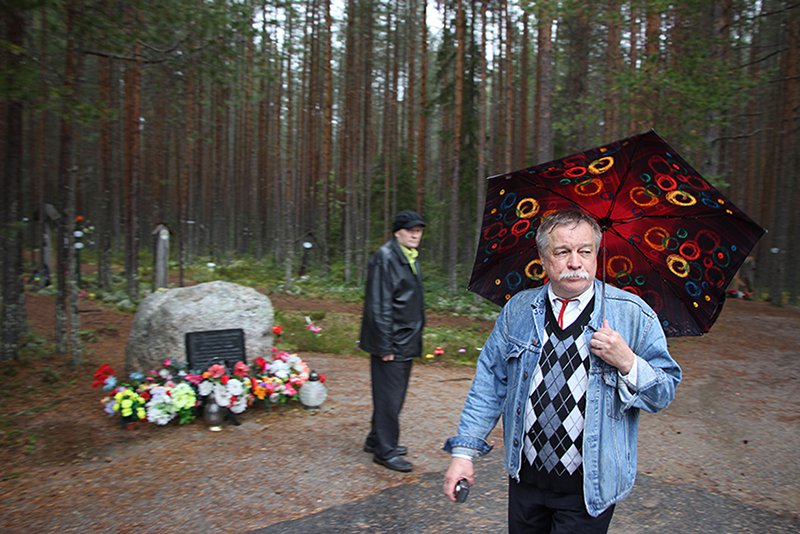 Anatoly Razumov
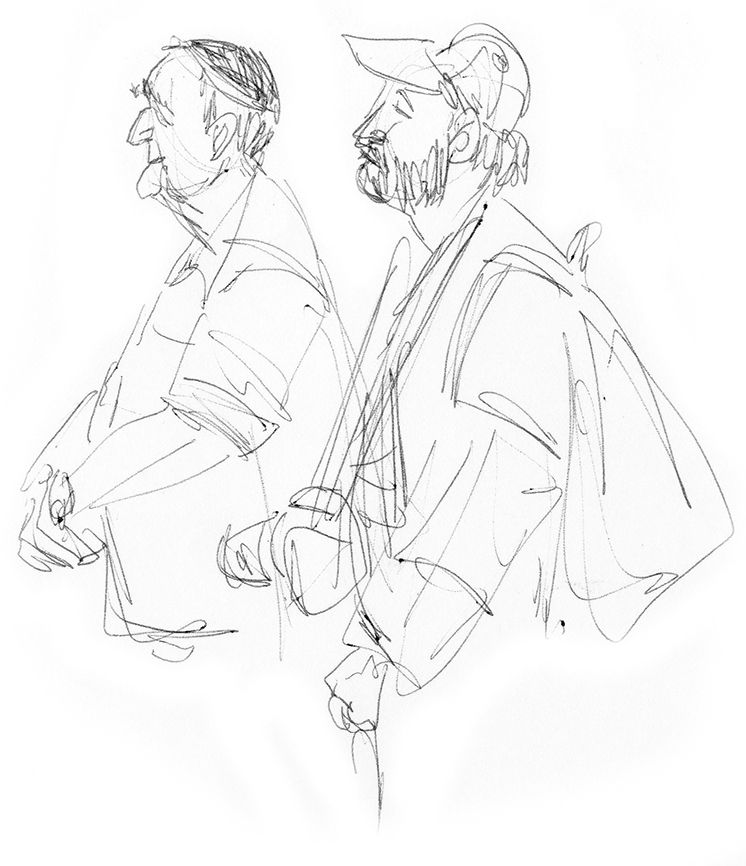
  Irina Karatsuba (historian), Valentin Kaiser and Anatoly Razumov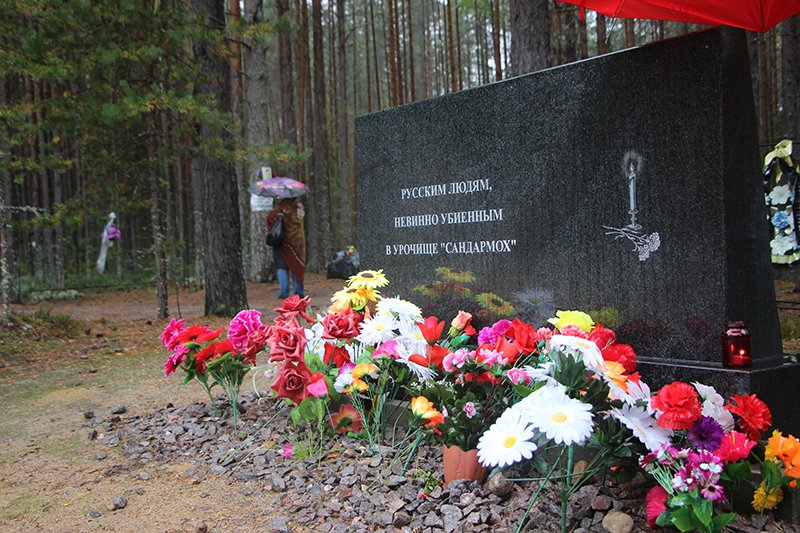
These words are confirmed by Katerina Klodt - the eldest daughter of Yuri Dmitrieva, who came to Sandarmokh with her son Danil. She was twelve years old when her father took her with him on an expedition to Medvezhyegorsk district. Then, in the summer of 1997, they found Sandarmokh.
“I was as much as my son now.” Dad called my brother and me, but we refused. That morning, when he left, I woke up at six in the morning, stopped him on the threshold, gathered and went with him. And I remember how we walked for a long time, looking for how my father argued with Irina ( Irina Fliga-the head of the Memorial Scientific and Formation Center in St. Petersburg-the editor note ) about the place, but in the end he began to dig and found. Then, due to age, I did not really understand the significance of this find. Fear came with age. How many people were killed here and why is scary, ”said Katerina.
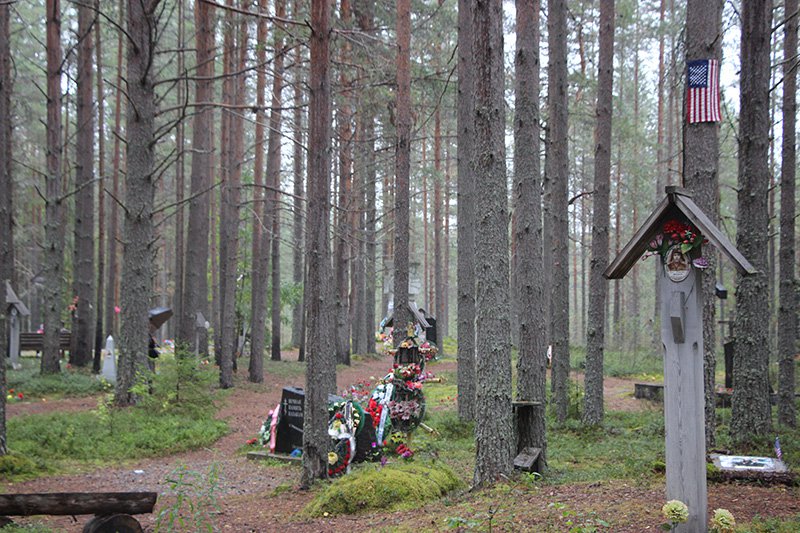
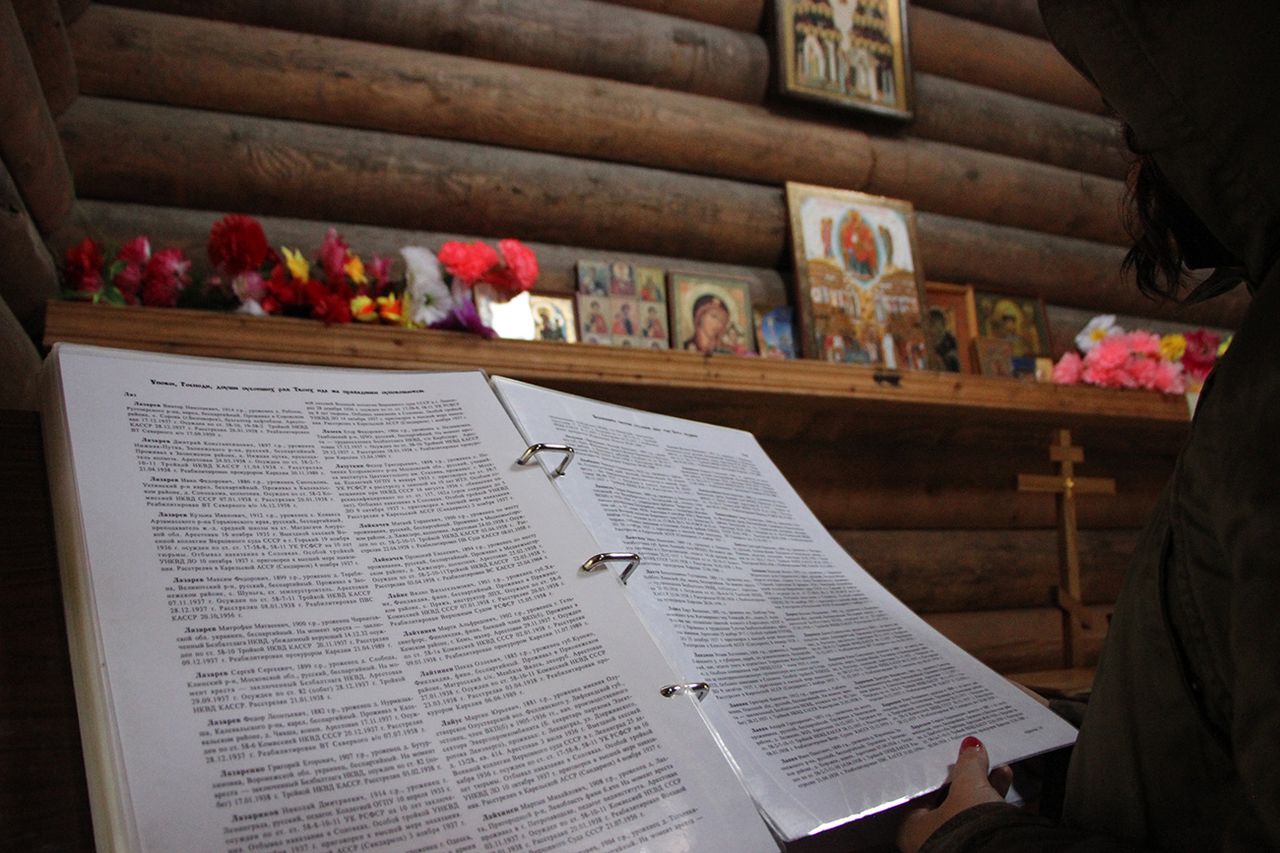
The strength and sorrow of this place is felt everywhere: each pit, where there is a memorial sign of a “pigeon” ( Colb with a roof ) with a photograph of a person shot here; in memorials established by people of different nationalities; In the chapel, where the names of seven and a half thousand people, who were shot in this place in 1937-1938, were collected on three hundred and laminated pages.
Sandarmokh became one of the largest in the north-west of the victims of mass executions of large terror. According to archival data, for fourteen months, three and a half thousand inhabitants of Karelia, about three thousand prisoners of the White Sea-Baltic Combine, a thousand hundred and eleven prisoners of the Solovetsky special purpose, the so-called “Big Ulovetsky Stage”, were shot here. Representatives of more than sixty nationalities were buried in Sandarmokh: two thousand one hundred and fifty -four Russians, seven hundred and sixty -two Finns, six hundred seventy -six Karelians, four hundred and ninety -three Ukrainians, two hundred and twelve Poles, one hundred and eighty -four Germans, eighty -nine Belarusians.
The memorial well conveys the geographical scope of terror and the uniformity of the tragic destinies of those who were “equalized” by repression and execution. Orthodox and Catholic crosses, granite monuments to people of different nationalities, flags and mourning tapes in colors of various countries, photographs of those whose graves became known to relatives thanks to the activities of the Memorial.
- There are no official monuments. All monuments are made by people, diasporas. Yura saw that that way. And it’s very good that it is. This is a folk memorial, ”Anatoly Razumov summed up the many hours of story.
Sandarmokh, a symbol of preserving the historical memory of the victims of terror, in spite of everything, gradually takes its place in the minds of the inhabitants of Karelia. “Patriotism is to take your child to Sandarmokh and tell what kind of place it is,” said one of the speakers, ordinary Petrozavodsk, at a recent protest rally in the capital of Karelia. And the Karelian philosopher and poet Yuri Linnik dedicated the sonnok to Dmitriev, which begins with the words "you hear an echo of a long -standing execution."
The second day. Badger Mountain
The little Karelian village, which is not even on the navigator map. For an hour, we have been going from the lamp, along the White Sea ( BBK ), along a broken primer. The weather is no longer so harsh: the rain does not pour, but only drizzles. At the entrance to the village-a blue sign with a white-painted inscription "8th gateway". There are three times less than yesterday: only the former and current students of the Moscow film school, comrades Yuri Dmitriev in expeditions for Solovki, and journalists remained.
- Go to the place five kilometers with a huck. But, as we say, this “hack” can be from five kilometers - in these words our group is met by a local resident, hunter Sergei.
At the eighth gateway, BBK boils work: pour the road with a crushed stone, pour concrete blindings, install automation. During the time that we spent on the checkpoint ( you just can’t go from one shore to the other, the guards behind the guards are machine guns ) and on the way along the canal, we did not see the gateway in action. According to our guide, the channel is no longer used as often as in Soviet times. There is a maximum of three or four vessels per day. It used to be more than twenty.
Sergei knows the forest, which we are heading for in search of a memorial, by heart: he lived all our lives in the village of eighth gateway. We go quickly, a group of nine people periodically stretches, but no one wants to lag: Sergey is not a professional guide, says quietly, does not make stops, gives all the information on the go - we listen and hold the pace.
- Yura often came here, everything was looking for a cemetery, but I did not believe me that it was here. He said that in the distance from the canal no one would bury, ”Sergei tells about his find.
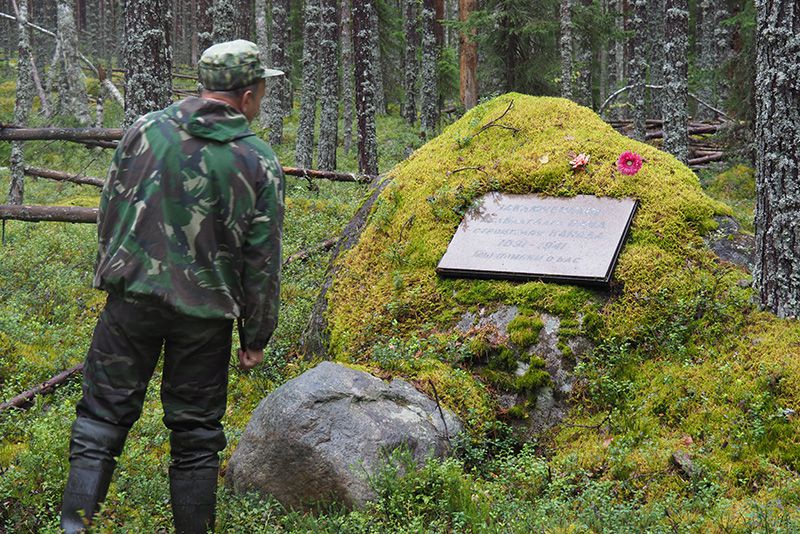
At the beginning of the 2000s, during hunting in this area, Sergey stumbled upon a badger holes. But it was not so much interested in animals as what they dug out of the holes along with the sand.
-I saw a mountain of sand next to the hole, I look: someone's bones lie nearby-well, I think, maybe what a beast. And when the skull rolled out of my next parish, I already realized whose bones there is, ”Sergey recalls.
According to the hunter, he brought Yuri Dmitriev here in 2003, in the year of the seventy years of BBK. As the Karelian media wrote then, the place on the researcher made a special impression.
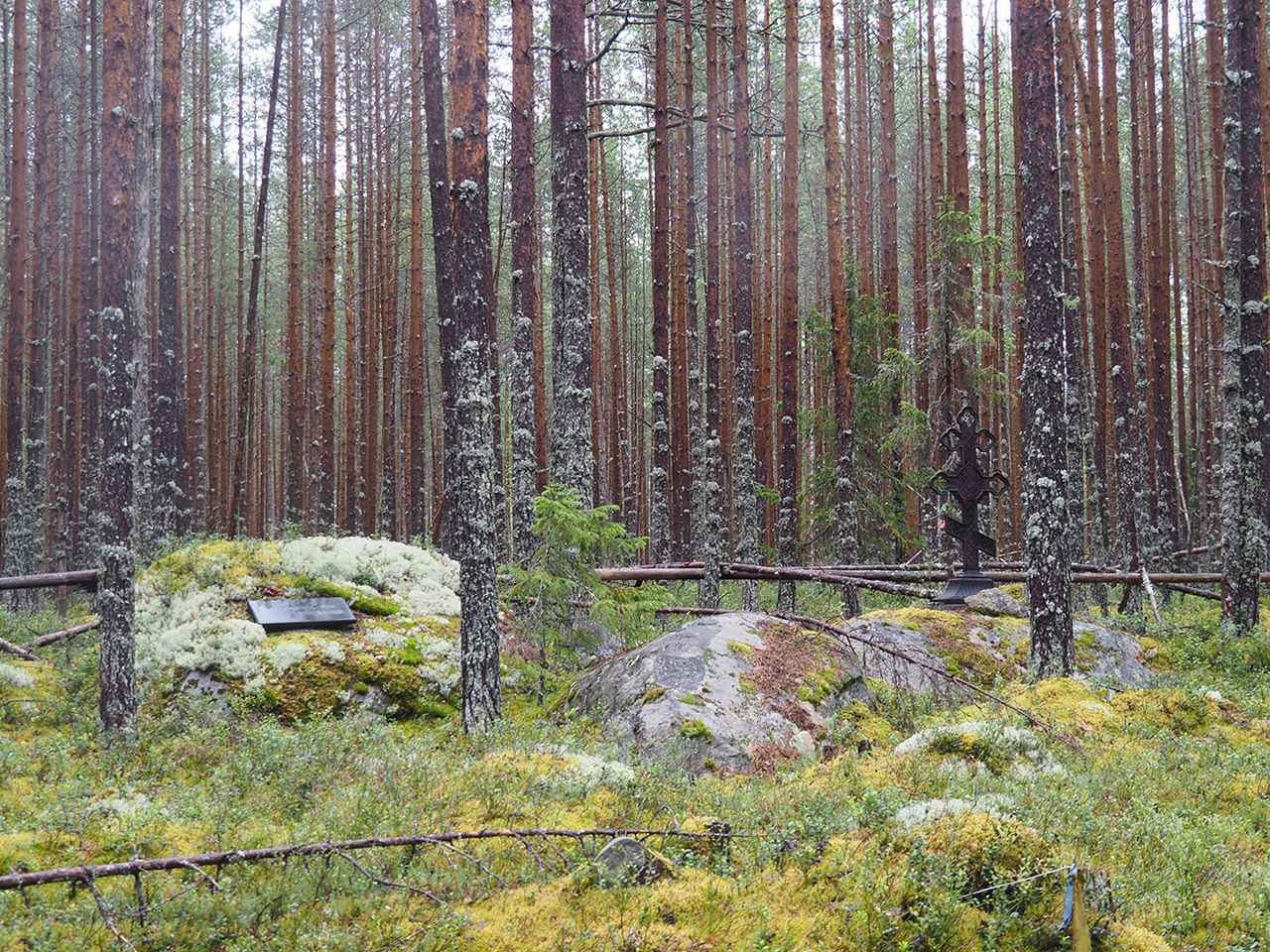
- In the dense forest, the ranks of the sagging pits of the correct geometric shape were visible. The linear dimensions are different. To make sure that this is exactly what I am looking for, I opened one of the pits. At a depth of about a meter, the remains of four people were discovered, including, as I managed to determine, one woman aged eighteen to twenty-two years and one man of twenty-five to three years, ”Dmitriev said in an interview.
Already in 2004, Dmitriev organized a large expedition to this place. He took the students of the Moscow film school. They lived right in the forest, in tents. In a few weeks, a researcher with volunteers did a lot of work: sixteen burials were opened, the boundaries of the cemetery were identified and marked - nine hectares, cleaned the territory, built bridges through streams, installed a memorial plate and a cast -iron cross. According to the researcher’s calculations, at least eight hundred graves are in this cemetery. The place was called a badger mountain.
"Construction of the century" and the cemetery of the century
The torn ribbons on the trees, the collapsed flooring, the pegs covered with moss near the grave pits, the rickety cross of sorrow-this place is cold not only because of the autumn rain. To imagine what happened here eighty -five years ago, a modern person standing in this forest in warm boots wrapped in an autumn coat holding a mug with hot tea in his hand.
One of the country's largest construction projects - a canal of two hundred twenty -seven kilometers long, connecting the White Sea with the Baltic through a system of nineteen gateways, was built in just twenty months. According to various sources, from 1931 to 1933, from two hundred to three hundred thousand people worked in the Karelian forests. The builders of the channel were prisoners: criminals, dispossessed, and “political”, accused of fifty -eighth article - everyone brought echelons to Karelia. About one hundred thousand people died during the "construction of the century". There are still no information about many.
They did not consider the builders of the channel for the people, they called them concluded by the “Canalarmians”, abbreviated as “Zeka” or “ZEK”, and this is the word that appeared. The conditions for life and work were terrible, but, in the opinion of the country's top leadership, fair, because they brought prisoners here for re -education, or, as it was called, “a distortion”.
Historians call the site between the eighth and ninth gateways the most difficult. Here, the builders-egs had to not only manually pour and compact the dam, but also crash into granite cliffs. Of course, no one thought about any safety precautions. As the associate of Yuri Dmitrieva wrote, the deputy and researcher of the Stalinist repressions Ivan Chukhin in his book “Canaloarians: the History of the Building of the Belomorkanal”, the winter of 1933 was especially cruel. The deadlines for the channel were delayed, so the work was transferred to a 24 -hour regime.
“People were not taken to the North and Southern camps, but put tents on the shore and organized a camp kitchen. Poorly dressed, without proper heating, half -starved, exhausted by overwhelming labor, many of them could not stand and died. In addition, during explosions, stones and fragments flew in different directions, crumbling and killing people. Dozens of people died a day, at first they were taken to a sanitary town, registered, and then buried, ”wrote Ivan Chukhin.
According to Yuri Dmitriev, it was the cemetery of the badger mountain that became the very place where the dead “Canalarians” were taken away. Will it become a place of pilgrimage to mass graves? Will volunteers arrange subbotniks, as in Sandarmokh? Most likely not: the road is too far and bumpy, to coordinate the transition of the gateway for too long, too harsh the BBK guard. Therefore, each such expedition, albeit without restoring order, is important for preserving the memorial.
... prisoners-"Canalarmians", abbreviated-"prisoner" or "zek"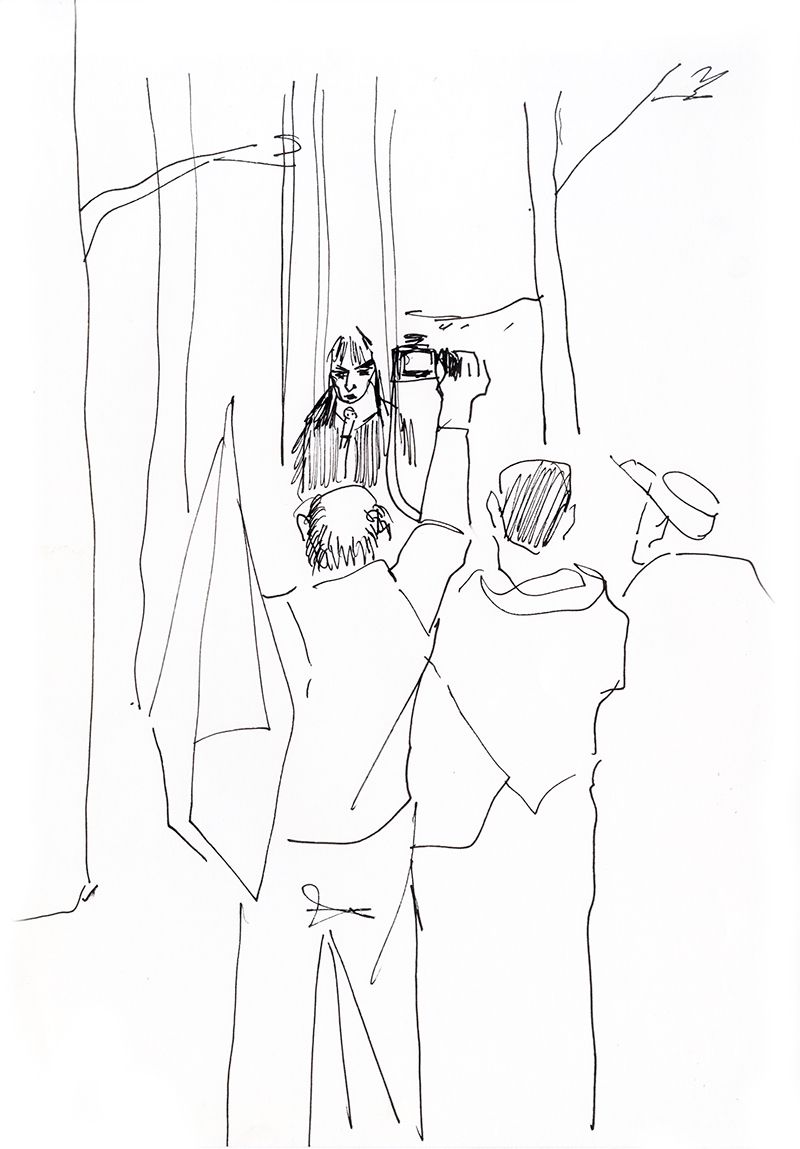
"Film -heater" will still return here, because for Dmitriev this is a special place:
- After the expedition of Yuri Alekseich, no one has been here for more than ten years. I wanted to see, to shoot places, ”says Yuri Mikhailin, a former student and current teacher of the Moscow film school. -There was also an idea to somehow put this place in order to save it. Yuri Alekseich in almost every interview says that Sandarmokh knows everyone, but no one heard about this place.
It was Mikhailin who organized this trip. He himself visited expeditions with Dmitriev on Solovki several times, but he had never been in this place, and few will decide now for such a trip. It is all the more amazing that the guys did not regret the time, money, wiped their legs - and came to Karelia to get to this cemetery. It seems that the conditions of the expedition do not cause much surprise for filmmakers themselves. They prepared for her.
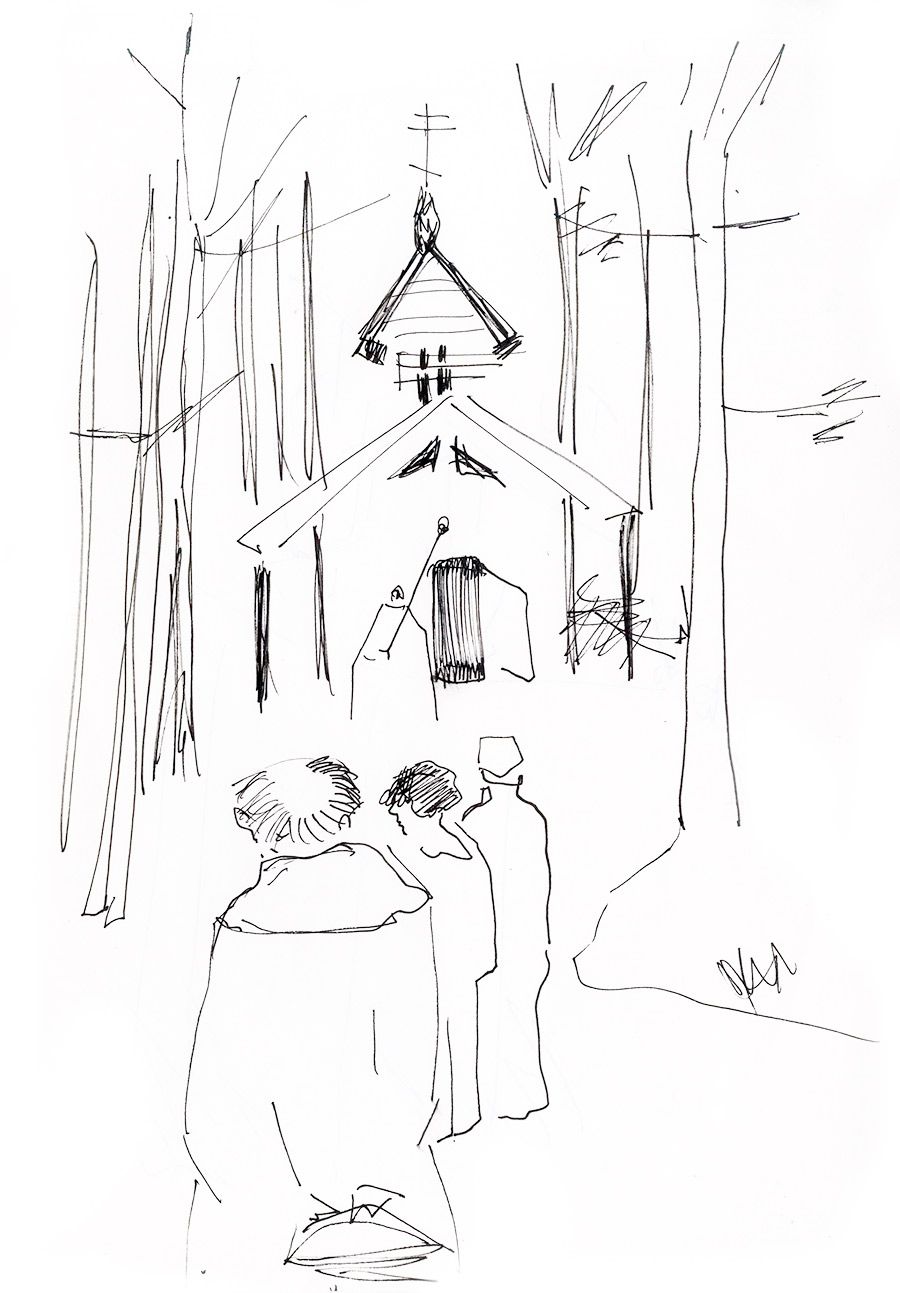
“We want to serve Lithuania,” the girl Anya interprets our desire to move on the return path. - This is a service that people outside the temple can read.
We step aside and observe. Karelian wilderness. Gray, damp, mosquitoes and midges. Young people with lamps in their hands read church text, sing. Goosebumps on the skin. But thoughts are not about a place, not about God, not about those who are buried here, but about what Yuri Dmitriev will say, when they find out what is happening in this place now. Probably thank, or maybe even praise.