
Translated material
What happens to the banks?
“Ugra”, “discovery”, Binbank-it seems that these are not the latest financial institutions from the TOP-30, which is sanitized by the Central Bank. What caused the credit market crisis and who will be as follows-the regular expert of the magazine, banker Oleg Vyugin, former chairman of the Board of Directors of the Bank of the Bank and the 1st Deputy Chairman of the Central Bank in 2002-2004 answered the questions of The New Times.
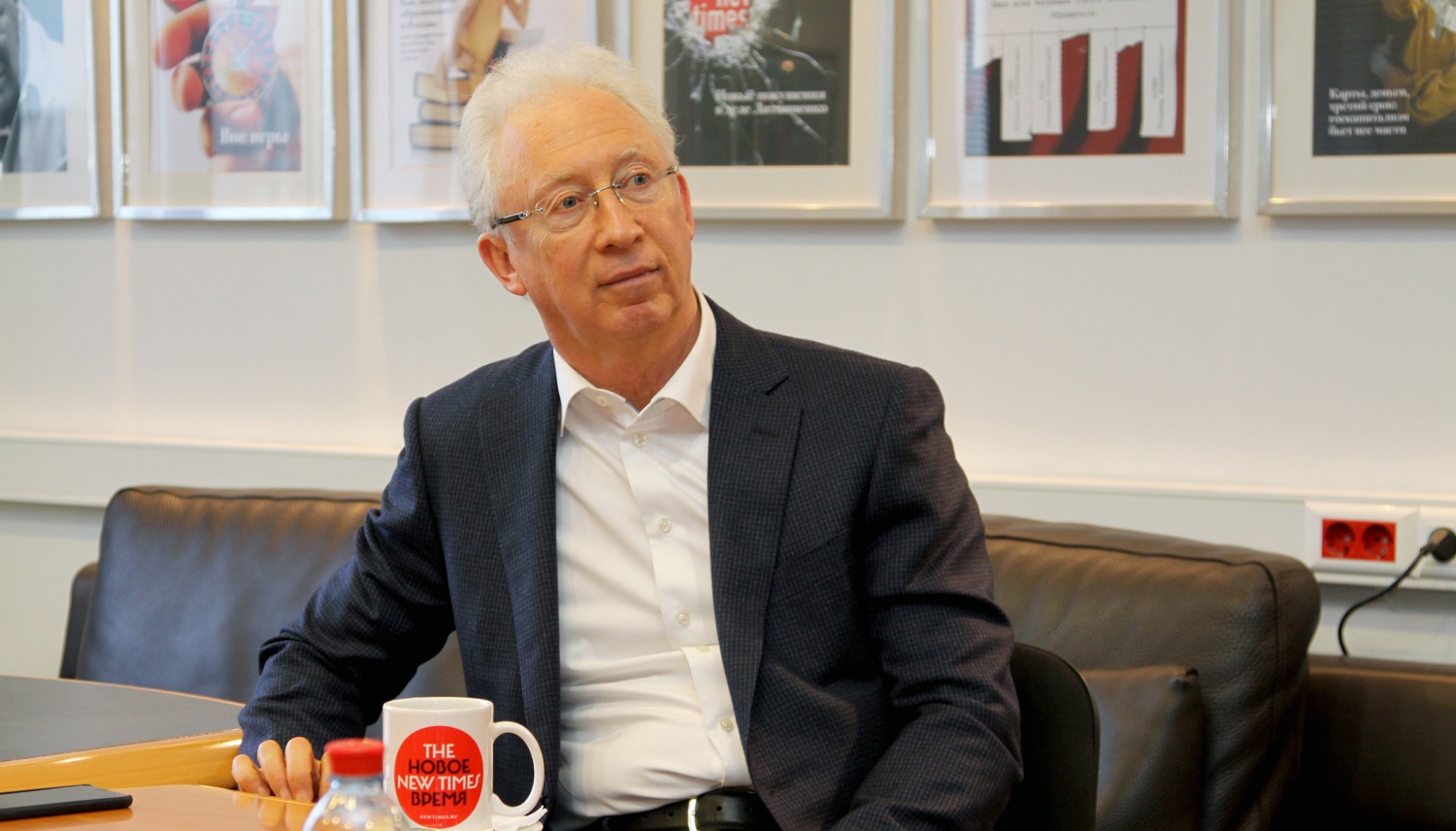
Photo: The New Times
Oleg Vyugin: In short - we are moving towards the state banking system.
NT: That is, the financial authorities deliberately go to the elimination of private banks?
No, these are to some extent forced steps. But it is important to understand the reasons, and they are the following.
State banks initially played a significant role in the Russian banking system - up to half of all assets belonged to state -owned banks. In a growing market with state-owned banks, private banks could somehow compete. But when the Russian economy stopped growing, when problems appeared, the run began from quality-customers try to leave for those banks where you can somehow feel calm. And this is, first of all, state -owned banks: they have a good service or bad, nevertheless high -quality borrowers, corporate borrowers go to them, because there are lower interest rates. And the holders of deposits go to them, because even if the bet is not very, but you can feel calm. And it so happened that the cream, that is, the highest quality borrowers, they, of course, first of all, went to Sberbank. And he, in turn, got the opportunity to filter the borrowers: those who did not take those who worse, they went to private banks. And they were forced to lend them, because it was somehow necessary to work. And thus accumulated problems on their balance sheets. Or credited their own shareholders, if any. Because how did the bank shareholders reason in this case? And so: we give money to the side, and it is not clear whether they will return, there is a big risk, or we give money to our own business, where everything is under control.
In short, problems have accumulated problems on the balance of commercial, non -state banks. Previously, the regulator, the central bank, closed his eyes to this, and with the advent of Elvira Nabiullina the rules changed: the Central Bank demanded everything in accordance with how it is customary in developed countries - it is impossible to lend your business if there are problems on the balance sheet, solve them. Either you decide them, or we, in the sense of the Central Bank, take actions.
"In short - we are moving towards the state banking system"
First, licenses were withdrawn. But it is clear that the review of licenses already among large banks is a very dangerous thing, it can become a political problem when a large number of people lose their money.
Then ( in May 2017. - NT), under the auspices of the Central Bank, they decided to create a fund of consolidation of the banking sector and simply pick up banks to this fund ( the Fund is under the control of the Management Company of the Consolidation of the Consolidation of the Banking Sector ”, the only owner of which is the Bank of Russia; the authorized capital of the company amounted to 1.5 billion rubles - NT). The main idea is that the bank, which is in a difficult position, does not stop its work and does not leave customers. This is right: it is also customary in developed countries. There are practically no cases in the modern market when a large bank closes by decision of the regulator - they make recapitalization, and banks continue to work. About this path, our Central Bank went along the way.
NT: In the list of banks that became customers of the consolidation fund, only two names are “discovery” and Binbank with daughters. Why did they allow to go bankrupt, for example, an exusprint?
Different situations: Judging by the fact that the media reports, they simply plundered everything in Zayproombank: a bank was created, which very skillfully took money from depositors. As for those two banks that will sanitize the consolidation fund, as the Central Bank says, management and shareholders did not steal - they simply ran into huge risks.
Moreover, the shareholders of Binbank, as reported by the ZMPPRU by the Central Bank Vasily Pozdyshev, generally introduced assets to the bank before going to the consolidation fund. That is, they seemed to put real assets against loans. But, apparently, they were not enough to completely preserve capital. However, it is not convenient for me to talk about Binbank, because six months ago I was a member of the Board of Directors of the Bank (Oleg Vyugin was the chairman of the Board of Directors of the MDM Bank, after which Sergey Maryin became the chairman of the board of directors with Binbank in the fall of 2016, and Bulkin became the chairman of the board of directors of the Safmar Financial Investment holding. - NT).
Time h
NT: *But why did big banks collapse right now? *
The bank in general can work in the absence of capital, .. probably it is worth explaining how regulation is arranged in the banking sector.
The bank should have a certain capital, say, 100 billion, then the bank is allowed to attract, roughly speaking, 1 trillion of liabilities. That is, take money from depositors, from companies. But no more. The bank’s attracted money can already be invested in securities in the form of loans and earn on this. However, if borrowers do not return the money, then the regulator says: you must restore capital by the amount of missing money. That is, if you have 200 billion out of 1 trillion, then you should make almost 200 billion on the bank’s capital. There are subtleties, but the scheme is approximately the same. Thus, when the situation is worsening, the shareholders are faced with a choice: either to replenish capital, or to live as it is.
Previously, the Central Bank to some extent closed his eyes to this-most likely because he did not understand how to be with such a situation. With small banks, he understood relatively simply: they can take a license from them, and the depositors are paid the amount guaranteed for insurance. It is so impossible with large - first of all, because large depositors, companies that work with these banks will lose a lot. Therefore, the Central Bank went along the path of creating a consolidation fund. And then, I suspect, the following happened. Having completed the work on the creation of the consolidation fund and already knowing about the situation in large banks, the Central Bank held a meeting and accepted the following algorithm: first, we make requirements for shareholders ( make the missing amount to the capital of the bank. - NT), give them time to solve these requirements. If it does not work, then - welcome to the consolidation fund. This information somehow penetrated the market because there was talk about the problems of a number of large banks, this famous letter of the Alpha Capital analyst appeared ( in this letter sent in August the alpha capital clients, “On the problems within the whole group of banks-“ FC Opening ”, Binbank, Moscow Credit Bank (ICD) and Promsvyazbanka”, cited the letter. "Vedomosti" on August 16 , 2017 - NT). This immediately destabilized the situation, Pandora's box was open, because it was previously believed that the Central Bank would be very careful about large banks, giving them time to solve the problem and avoiding sharp steps. Well, then the process started, and there was no way out, it was necessary to move step by step to the consolidation fund.
“Having completed the work on the creation of the consolidation fund and already knowing about the situation in large banks, the Central Bank held a meeting and accepted the following algorithm: first we make requirements for shareholders, give them time to solve these requirements. If it does not work, then - welcome to the consolidation fund. This information penetrated the market, Pandora's box was opened "
From 2008 to 2014
NT: Problems have large banks - did they gradually accumulate or did they appear only now?
The problems began to accumulate from the crisis of 2008-2009. The largest private banks passed through two crises, moreover, the powerful crisis, when there was a big decline in economic activity. They entered this crisis on the rise, that is, then they gave a lot of loans, because they understood that there would be growth and everything would return. But it turned out not so. Banks formed huge toxic assets, no one raked them. We know European practice, American, Swedish: as soon as the banking crisis comes, there the authorities immediately take measures in order to completely clean the toxic assets of banks. Usually it is either the purchase of banks in state property, or these are special programs that, through additional financing, transmit problem assets to the structures specially created for this.
“Problems began to accumulate since the crisis of 2008-2009. Banks have formed huge toxic assets, no one raked them "
In Russia, after the crisis of 2008-2009, neither one nor the other was made. That is, there were handouts in the form of trillion rubles, when there were five toxic assets. Thus, the banks were infected with problem assets, they sat on the balance sheets, sat on the balance sheets, it was difficult to work, because the attracted passives had to pay interest, but nothing came for assets. The second crisis is 2014-2015, it was softer than the previous crisis, but, unfortunately, economic growth did not restore. That is, banks could not expand their business, high -quality borrowers disappeared at all. They were all either in Sberbank, or nowhere. And thus, banks could not get rid of toxic assets, only if the shareholders contribute a lot of money. The shareholders paid money, but they could not make as much money as they needed - but they needed trillions. In other words, the current situation has been programmed: now the program of the banking system is practically implemented by circulating private banks to state property. That's how I understand the situation.
NT: sanctions imposed against the Russian banking system of the United States and Europe for Crimea and Donbass affected?
Yes, direct impact. Previously, there was an opportunity to attract cheap capital from abroad, on this, in fact, the banking system in the first ten years of the current century was strong and grew up, private banks attracted cheap funding abroad, and here they compensated this funding at a higher rate and earned very well. After 2014, this opportunity completely disappeared, and internal resources are expensive. Plus: lack of economic growth. These are the two most important factors that have led to the fact that now in an accelerated manner you have to solve problems in the banking sector.
NT: The financial authorities say that the economy has begun to grow, predict an increase of 2-3% of GDP?
I would say so: the decline (economy) ceased, but about growth I would not draw hasty conclusions, I need to wait a little and see. Because the factors that made such conclusions from the quarter to the quarter, every time they were of some kind of suspiciously temporary character, such as the construction of the Kerch bridge or the activity of the population in the car market. And most importantly, of course, you need to look at the real incomes of the population, and they do not grow. As for business activity, small and medium-sized businesses survive with great difficulty, and a large private business is also quite passive, and this is due not so much with the lack of money, but with a misunderstanding of what policy to continue to wait.
“Previously, there was an opportunity to attract cheap capital from abroad, on this, in fact, the banking system in the first ten years of this century grew strongly. After 2014, this opportunity completely disappeared, and internal resources are expensive "
Who will pay
NT: However, many experts tend to blame the leadership of large banks that have gained a bunch of assets are the same bursting banks that they took to sanitize, and as a result, taxpayers should now be saved.
To some extent, yes: a rather aggressive policy of building up the financial business implied the restoration of serious economic dynamics. If I buy cheaply now or take it for a sanction for the wrongdoing, and even with the support of the credit of the Central Bank, then when economic growth will begin, prices will increase, I will earn - this is about the logic.
NT: You were the 1st deputy chairman of the Central Bank, you understand how the regulator works. Why did bank supervision meditate on the situation with large banks, why did not intervene before?
The first is that the situation was launched and did not intervene on time: when the banks have toxic assets on the balance sheet, it was necessary to quickly launch a program for cleansing and recapitalization, I already talked about it. Secondly, the Central Bank was extremely careful against large banks-it is almost impossible to withdraw a license from a very large bank, which, say, has more than trillion assets-will be very strong on the economy. Finally, fears that the domino effect will arise.
Therefore, the Central Bank was waiting, created a consolidation fund. And having prepared - the Bank of Russia and began the process of recapitalization of the banking system through the actual transfer of banks into state property. What banks will be forced to use the consolidation fund - we will see, maybe not everything, or maybe the majority, here is a dark matter. Because only banking supervision knows the real situation within a bank.
NT: Where did the state from the state or the Central Bank of the Trillion to save banks?
Typically, recapitalization of banks occurs at the expense of budget funds. But with us, since the budget is already scarce, the Central Bank conducts emissions, that is, it, as it were, is engaged in lending to the capital of banks transferred to the property of the consolidation fund. Let's see how this policy will affect inflation.
NT: emission - translated into public - this is the printing of money. In other words, the purchasing power of my ruble is reduced. However, bankers who poorly calculated the risks or decided to play Russian roulette, or were not able to reasonably manage assets, were somewhere aside. Why? Classical case: Broken (taxpayer) is lucky on the unstable (banker)?
Firstly, of course, the shareholders of banks in this case lose all their investments or businesses. That is, they lose the capital originally invested in the creation of the bank, - this is how the banking business is arranged. But if the shareholders or chairmen of the board, or members of the board deliberately performed some illegal actions that caused damage to the bank, then they, as a rule, can also be punished additionally. Of course, they will not return the money that disappeared, but at least they will be punished.
The Central Bank has a black list of people who can never be in the leadership of any bank again - this is the most soft measure.
NT: Did you once say that soon one Sberbank will remain in Russia?
Well, this is probably an emotional exaggeration. In Europe, after the 2008 crisis, there was also a serious situation, but there the states did not take their banks, but they solved problems by regulating, the purchase of problematic bonds, a low rate - and practically all large banks, although they stopped earn a lot of profit, but people calmly carry money in them. So we need a very clear, understandable, professional banking supervision, in which everyone believes, the practice of cleaning banks from toxic assets must be developed.
“The Central Bank conducts emissions, that is, it, as it were, is engaged in lending to the capital of banks transferred to the property of the consolidation fund. Let's see how this policy of inflation will affect "
If everything ends in battles without rules, then, yes, everyone will go to the State Bank. If the rules are clear, then there are chances to preserve a certain number of private banks.
NT: *Have you predicted that by the end of 2017 all reserve funds will be “bored”? Has the situation changed somehow? *
Yes, $ 90 billion still remains - this is a reserve fund plus the free funds of the National Welfare Fund. Lucky: they forecasted $ 40 per barrel, and the price was $ 55. And of course, they tightened the budget.
NT: Repeating the crisis of August 1998 is possible?
No.

NT: Already after your interview with The New Times was published on the site, the Vedomosti newspaper published an interview with Mikhail Shishkhanov, the main owner and chairman of the Binbank board, who turned to the Central Bank for help, to accept the bank and his daughter to the consolidation fund, that is, asked the country's main bank to be salvated. In this interview, Mr. Shishkhanov called it as one of the main reasons - the purchase of a Bank MDM, which, according to Shishkhanov, after his acquisition turned out to be “additional problem assets” for 200 billion rubles. And “a lot of skeletons that I did not expect to find,” that is, you need to understand that, when selling a MDM bank, the shareholders of the latter hid their problem assets from the buyer. You were then the chairman of the Board of Directors of the Bank MDM, your comment?
When it came to the purchase of a Bank MDM by the structures of Shishkhanov, the bank had a financial recovery plan approved by the Central Bank and approved at a meeting with the Chairman of the Central Bank. He assumed that the shareholder on a certain schedule would replenish the capital of the bank in the amount of 15 billion rubles, plus the DIA ( Agency for Loster Insurance. - NT) will provide OFZ in the amount of 9 billion rubles, total of about 25 billion rubles. That was the scale of the problems. The consent of the Central Bank to this plan, as well as the subsequent provision of a loan of the DIA, I believe, was an assessment of the provision of cases in the bank from the supervision of the Central Bank. About 200 billion rubles. плохих активов на тот момент и речи не могло быть. У банка всего-то активов было на 320 млрд руб. Справедливости ради хочу напомнить, что ранее, до продажи МДМ Банка, его мажоритарный акционер выкупил с баланса банка по чистой приведенной стоимости недействующих кредитов на сумму $400 млн (примерно 22 млрд руб.), оказав тем самым серьезную поддержку капитализации банка.
Банк владел акциями промышленных компаний, которые достались ему за долги обанкротившихся компаний, поэтому все активы были в периметре банка, ничего не пропало и никаких потерь не было и быть не могло.
Фактически сделка была заключена через пять месяцев после того, как г-н Шишханов приступил к руководству банком в качестве председателя правления, и, думаю, имел возможность ознакомиться со всей внутренней информацией по активам банка.
НИ О КАКИХ 200 МЛРД РУБ. ПЛОХИХ АКТИВОВ НА ТОТ МОМЕНТ И РЕЧИ НЕ МОГЛО БЫТЬ. У МДМ БАНКА ВСЕГО-ТО АКТИВОВ БЫЛО НА 320 МЛРД РУБ.