
Translated material
Hello, Kubano!
How much does the Cuban banker get, why the eggs are called "rescuers", and what is more important for a simple Cuban of shelter and food
When I got used to the island, just in case, I began to ask “ultimo”, the last one, in any line on the street and learned to be briskly counted in my mind, how much delivery should be given to me in Peso if I paid in Cooks-I was sure that now I live “A LO Cubano”, that is, like a real Kuban. This, of course, was not so.
Guagua
In Cuba, there are still two currencies-convertible CUC, aka SE-U-SE, he is just a “Cook”, and an unconditional Cup, aka Cubin Peso. “Until now,” because Raul was going to cancel the “expensive” CUC back in 2014, but still there. As they say in our cube, “and the eSper” - “well, will be involved.”
One CUC is approximately equal to the dollar, in fact, everything calls it “dollar”. Peso - 24 times less. All employees of state enterprises (that is, all relatively large enterprises in Cuba) receive salaries in Peso - in national currency. The average earnings of certified specialists operating surgeons, TV presenters and bank employees ranges from 500 to 650 pesos, that is, within 20-27 dollars per month. With the possibility of raising to 30, up to 35, or even up to 40 - for seniority (every year of experience +5 national pesos for salary), significant bonuses or, say, after protecting the doctoral (they throw it as much as 50).
Now let's count: we will not trifle, let our Cuban have 650 pesos per month. About 150 pesos from them will go to the housing and communal services, almost all - to pay for electricity, and then by agreement with the inspector, who will pass and the counter is slightly reinforced. By the way, electricity is still saved at the state level - they simply take and turn off the light in certain areas for a period of several hours to a day. Such a planned shutdown is called “Apagon” - they have long been accustomed to them, since the collapse of the USSR and the onset of a “special period” on the island. “What kind of wine is Cubans beloved? -My father-in-law Khesus-Hulio jokes. - Vino la luz! ” (“Wine of La Lus”, that is, “gave light!”) In addition to jokes, in use and compliments like “baby, with such clear eyes you do not need a flashlight when the apopagon comes”, or “your smile is cheaper than electricity, but gives more light.”
In use and compliments like "Your smile is cheaper than electricity, but gives more light"Another 100-200 peso will take the road, and this is without such “luxury” as local minibuses, the very rare killed “Fords” and “Chevrolet”, the passage of which costs from 10 pesos to two dollars, depending on the distance of the trip to the “baby” Havana. For example, from the old Havana to Guanabo, just two CUCs are taken one way, to Viya Panmerican - one, prices rose after the crisis in Venezuela. Fortunately, this crisis did not affect the average Cuban - he traveled to Guagua, a city bus, by one peso, and he drives.
In fact, the passage in public transport costs 40 sentavos - that is, less than half aPESO. But no one almost has such trifles, so at the entrance to the transparent “cashier” the driver is lowered to the driver’s “pesunchik”. The surrender goes as if to the state, and in fact - in the pocket of the driver. It is not surprising that the so -called “pesometero” began to appear at the most crowded stops - exchanges. For one peso they give 80 sentavo, leaving themselves 20. For a day, without much zeal, and the Cubans are not inherent in the work of the Cubans, the pesometero earn cup-two, that is, a month-it is quite a salary of the Cuban banker. Well, passengers are satisfied - now one sand is enough for two trips. Only bus drivers are dissatisfied.
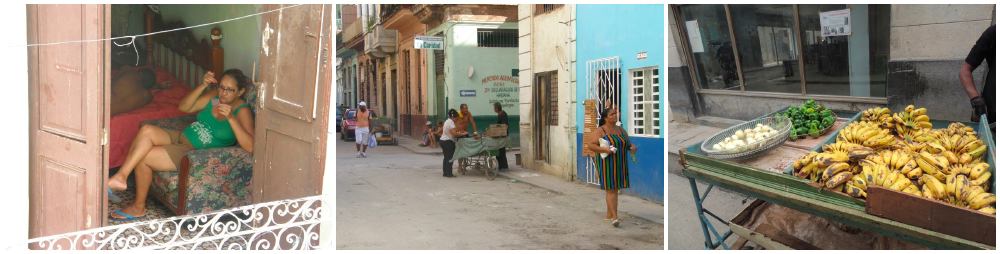 From left to right: the balcony of the old Havana; Player - Karetiyeilia - on the street of the old Havana; Today on sale: garlic, bananas and ahi - sweet pepper photo: from personal archive
But, let's say, our average Kubano leaves stops from stops not chosen by Pestiro, and is forced to pay a whole sand every time. And he lives, for example, in Kochimar on the outskirts of the terrace. And it works - at the Research Institute at the end of Plai. So, he must make a refreshing morning promenade three kilometers before the P-11 stop, wait for this very mystical “PE ONSA”, get down there with all the other residents of Kochimar and neighboring Alamar, who also rush to work and have managed somewhat, get to the 23rd street in Vedadado, near the Caucasa Cafe to the Red P-1 “P-UNO” (Previously, of course, having waited for him)-and Voila, after some couple of hours he is at work, was two poorer at one end. This is one of the reasons why Cubans always and everywhere are late. And one of the reasons why in the windows of any state institution from the very beginning of the working day you see the faces that have befallen Zen. They waited - and you will wait.
Librat
All the Kubano Promedio, the average cubic, can spend all the remaining from the passage and payment of the communal apartment, can spend at his discretion - for example, on food. If, of course, he is fundamentally every day and even more so to feed children.
Before moving to the island for all the walls of familiar Cubans about the shortage and rice with an egg day day, for decades, I codded, smacking, but in my mind I divided by 10 and listened in a half. Here everyone likes to complain and embellish.
Yes, with milk and dairy products tight, yes, a pound of frozen beef costs half a monthly salary, yes, you will not find fish and seafood in Havana with fire-but in the end, the ubiquitous lottery with fruit vegetables. And, most importantly, there is a liberty!
The Libret system-that is, roughly speaking, the coupons-were introduced back in 1963. There are legends that in Soviet times, thanks to these coupons, Cubans could live a month for a salary without stealing.
There are legends that in Soviet times, thanks to the liberton, Cubans could live a month on a salary without stealingThey gave them not only products from the basic consumer basket - Canashest Basik - but also non -food products like a couple of trousers or one toy for a child per year. Today, such luxury had to be abandoned. Now the basket for a month includes: five pounds (slightly less than two and a half kilograms), three pounds of white and two pounds of brown sugar, 11 ounces (about 300 grams) of black beans, a quarter of a liter of vegetable oil for frying (usually soy and already used), four ounces (100 grams) coffee (mixed with crushed peas), one box matches and one 80-gram roll per day. Toothpaste on coupons - one for two.
Plus, “Proteina” is issued to this once a week. This is either a sinewy leg of chicken, or several tablespoons of soy minute, or similar to a cardboard of a cutlet in a panel, or a khamonada sausage, about which they joke “nothing from a hamon”, or a fish, which, however, never happens. Traditionally, on “Fish Day” in government stores, where they receive goods on libertes - they hang the plates “Pollo Por Pescado”, “Instead of fish - chicken”.
What are the difficulties with fish in the port Havana? - You ask. Everything is simple - it is forbidden for an ordinary Cuban to go out into the open sea on boats. This legislative initiative was called upon to suppress attempts to escape from the island of Freedom to the enslaved states. To be a fisherman and get permission to control the boat, you need to get a license, that is, according to a good Cuban tradition, to pass several instances, defend kilometers of queues and give out gifts to all the right people. But even after that you are not free to dispose of the catch at your discretion, because, of course, you have become a fisherman. So, I must hand over to the needs of Patria, the Motherland, a certain quota per month. This quota looks like a natural tax of 80%in a good situation. It did not peck - a fine and increased attention.
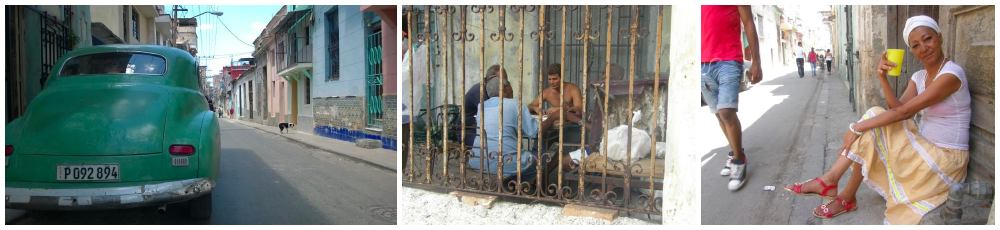 From left to right: on the way to the Kuatro Kaminos market; midday party in dominoes; Morning coffee on Hesus-Maria Street Photo: From Personal Archive
The state distributes the fish and other “Mariscos” in the most effective way: everything is tasty - to hotels and restaurants, where tourists will be able to pay seven dollars for fillets and 15 for lobster. And for the people, in the sandwiches: freshwater Clarias and Tenka, that is, the line, which in the mucus and give urine, occasionally bachelors - oceanic cod, lying squid and fish.
You can, of course, fish from the maleck - with a concrete embankment in Havana - and many do just that, especially in the rain, on the "high water" when the fish comes closer. But how much can you catch from the shore? And you can agree with the coast guard - they will let them into the sea at the sea, at four o’clock in the morning, but no further than two miles from the shore. In a word, if there is a desire, you can get fish. But this is either very labor -free or very tasteless, or just expensive - so ordinary Cubans have long come to terms with the fact that "there is no beautiful fish in the world than a chicken leg."
Ordinary Cubans have long come to terms with the fact that "there is no more beautiful fish in the world than a chicken leg"But back to the libetes - we have not yet bought everything. For children under seven years old, every other day they give out milk, as a rule, diluted from powder, or a liter of soy yogurt. In the season, several pounds of potatoes or boniato and green bananas for frying, from the market Bodeg, can be thrown through the season. Also, once every six months, the Cuban has the right to purchase a kilogram of salt for nothing. Sometimes even alcohol appears in libble - a small bottle of a white, very tough rum, which is lovingly called a “short Saturday”. Well, because for a long Saturday you need a bottle more allotically.
"Rescuers"
And also - it is important - five eggs per month are laid down on the liberton. Eggs here are called "Salvavidas", "rescuers" - this is the most affordable protein. “Previously, they gave 30 - one per day. Then - one egg for two days. Then - one by three. And now - here ... ”Maito shrugs his hands.
Maito and Maria Rosa are elderly teachers of Gavan University. He reads the course of the philosophy of society, that is, in the essence of Marxism-Leninism, it is the history of Cuba. I come to visit them in the Dyes de Octubre district, we are sitting on the balcony, drinking cold water with sugar, talking about politics and life. Maito admits that it is more difficult to give lectures every year, but "I have grown me like that, I believe, I can’t do otherwise."
Maria Roza asks what time is. I say 20:05. “Look,” she shows me to a plane in the sky, obviously, recently starting from the local Jose-Marty. - This one for Paris. My friend worked at the airport. After all, ordinary Cubans are not allowed there when without a ticket. And she worked. She somehow brought me the schedule of sorties, I remember it by heart. I always look and know where this flew. ”
Their daughter has been living in Moscow for a long time, works as a dancer. Actually, our first meeting took place - I brought the old people a parcel from Russia from my daughter. She managed to stuff three male pairs of male sneakers in a small plastic handbag - for dad and sale, two topics for her sister, sandals for mom, jewelry, vitamins with calcium, patch nails, chocolate sweets, cotton sticks in placers and rolled with a roll of 200 euros.
Maito and Maria Rosa then, in joy, called me to have dinner. It was my third trip, I still did not understand anything in Cuba - for example, how difficult it is two university teachers to set the table. There was a classic Creole cuisine: Congrey rice, that is, mixed with black beans, separately stew - from the same beans, thinly chopped cucumbers and tomato mugs, fried bananas, avocado with onions and a whole dish of fried pork chips. This dinner alone cost the owners at least three dollar, if not all five, but then, of course, I did not think about it. Maito himself prepared, Maria Rosa admitted that as a cook would not work and Peso, but she knows how to boil linen, and "white remains white."
Maito insisted that I ate more beans and pork - the most expensive on the table. And I ate gratefully, although I would let me in from beans, but I can’t stand pork at all. The chops were thin, like a gauze, sincerely seasoned and, to be honest, incredibly tasty. "Pork - your favorite meat?" I asked naively then. “Beloved? No. We do not have a loved one - there is “what is”, ”Maito smiled.
"We do not have a favorite meat - there is" what is ""Such a dinner - with chop, salad and stew - for the Cuban "Festive", prepare it no more than once a week, on Sunday. The usual meal is a rice that is the head here, with a banana and a fried egg, or a cheap sausage, or a crockete - a fruit -fried meat and minced meat and minced meat. For lunch - that is not notable from dinner. For breakfast - coffee and bread.
And the Cubans almost do not eat such fruits, and that's why. One good mango costs 7-10 pesos per season. Pigna, that is, pineapple,-12-15 pesos. Frutobomb, she is also a papaya, but this word here is indecent and means the female “in some places”-five pesos per pound. That is, good, I’m not afraid of this word, Papaya pulls on all 35-40 pesos.
 From left to right: the state store-Bodega-on the 26th street in Vedaado, Havana; Festive dinner - pork bisters; Vegetable market - Agro - near the Zoo stop in Vedaado Photo: From Personal Archive
At the same time, when products purchased by coupons end - and this happens very quickly - the Cuban has to buy basic goods for the full price. That is, say, according to the liberton, he took his rice, five pounds for 1.25 pesos. Further, when the rice has already ended, but the month is not yet, you have to buy for the usual price - four pesos per pound.
Several kilograms of rice, say, 40 pesos; oil of $ 2.10, that is, 50 peso bottle; Vegetables are also around 50 pesos, enough for a week; "Paw" of bananas, the cheapest fruits, on the sand, for twenty; beans for its full price - 12 peso half a kilo; Plus, at least a pound of pork for 40 pesos, or a pack of frozen chicken legs for 60, or, at worst, eight sausages for 25 pesos. Another flour and eggs with a margin of 1.1 pesos. And, of course, deodorant. The cheapest for 20 pesos or for outrageous four dollars, but which smells pleasantly. It is difficult to explain how important it is for a Cuban to smell pleasantly. Remember the Pyramid of Maslow's needs? Now, if he were a Cuban, below, even before physiological needs like shelter and food, would have been in large letters “deodorant”.
poverty of cube standard of life emigration