
Translated material
Dmitriev | Colta.ru
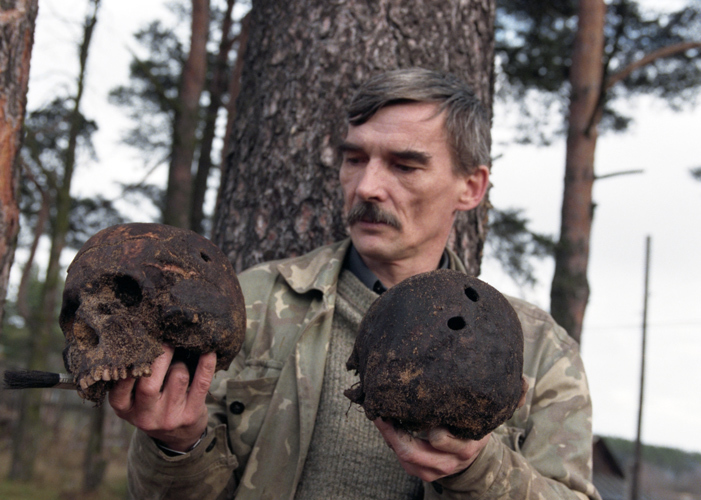
In December last year, Yuri Dmitriev was arrested in Petrozavodsk. The Karelian historian, the researcher of the Gulag, the discoverer of camp burials in the Red Bor, Sandarmokh, at the sequiric mountain on Solovki, the compiler and publisher of the Karelian "Books of Memory".
A lot has already been written about the legal side of the criminal case of Dmitriev, about the fabricated prosecution. But the accusations, God forbid, will be removed, Dmitriev will be justified and will receive the opportunity to return to his present case , from which he is torn off due to criminal prosecution.
This text is an attempt to find a conversation language about how Yuri Dmitriev works with memory; about Dmitriev as a phenomenon, about his intuition, research methods; In a sense, about the improvised, existing, without any canons, institutions of the Dmitriev school , in which his colleagues are involved in, as well as many other people for whom acquaintance with Dmitriev opens their personal path into the past.
Gift
There are seems to be remarkable fates, but you look - here the other could, managed.
And there are fate as ideal hits. You cannot imagine anyone else at this place.
Such is Yuri Dmitriev.
Journalists call him Hottabych, or even Gandalf. At first it seems funny and appropriate, and at some point it becomes too much, as if the writers do not very firmly know what to do with Dmitriev, which shelf to put it on, how to describe it.
He is about good-and about something unhealthy; In the former, to prison, photographs, he really looks like a sorcerer, which the jailers were overwhelmed, deprived of his strength, like Samson.
It seems to me that Dmitriev is a rational person who firmly knows what needs to be done. Like the head of the helicopter site in Komi that he cleaned the runway of a long-closed airfield for many years, where the Tu-154 accident then sat down. There are few such people, they are invisible, but existence will stop without them. And most importantly - there is no mysticism and magic in them, rather - an accurate mind and a special gift.
Search - among people involved to the north, this word is of particular meaning. In relevant universities, there are even search faculties, where there is a specialty “search”, a specialty “intelligence”.
The search engine is both a work and a gift in which skill, luck, sixth feeling, intuitive knowledge that the find is not located, but is also given the path to it is by no means literal, legs in the taiga.
I know this gift of a search engine in geology. The most interesting mineralization is always at the junction, on the contact of different breeds, and it is important to feel these places of contacts in the landscape, which are always almost the same, slightly different from neighboring rocks.
There is also an ominous gift from the search engine from the control and rescue service, from the KSS-to feel the places of trouble, those sets of circumstances that threaten death. Feel, to suggest, to foresee exactly where the group could die, what killed her. You won’t find otherwise, because the taiga is too great.
And the gift of Dmitrieva, who combines the stunning skill of the archivist, the persistence of the investigator with the developed instinct of the taiga , he is this nature.
In this gift-vocation and sad doom to search, in a sense he is too straightforward, instrumental, even enslaved; It cannot be turned off, sublimate, switch to something else.
Such people are living walking radars; Everyone is configured for something, on a certain wave, substance, trace.
With them it may not be easy in life: giftedness not only gives, but also takes away, deprives. They do not obviously important and incomprehensibly obvious; They do not know how to stop, dose feelings and deeds, they are total, sometimes - as selectively blind as they are selectively sighted, capable of providence, insights.
But they are the legendary figures of the north, the characters of the workshop folklore, local heroes; Actually, they, who can find, sew the fragmented, inhabited worlds of the North into something coherent; search engines, conductors, finders - primary agents of civilization; Pioneers, those who Torit the roads. And Yuri Dmitriev restores civilization where it has already come once - but in a sore, anti -cyvilization form of the Gulag, leaving the hidden ulcers of the nameless camp graves.
The marker of the space
Once, working in the Podorolar Urals, we stumbled upon a whole sheet of kilometers of the General Staff, dotted with strange names of rivers and streams: Alfashor, Betashor, Gammashor - and so on to omegashor. “Shor” in Komi’s language is “stream”. And the Greek alphabet is an invention of Soviet topographers, apparently tired of inventing names like “fast” or “long”. And I was struck by then that you can take a piece of space and use it for a simple joke, as if it were a sheet of paper; Write on top of everything - and the space, like paper, endures, for the natives do not have directive power to compose cards, their toponyms, their long memory, encoded in the names, do not “join” with a great history, cannot (or not allowed) to represent themselves using commonly used memorials.
Why did I remember this episode in connection with Dmitriev? Because he is a mark of space. He not only does some symbolic things, he, like a demiurge, directly works with being, with the country’s rewritten Soviet authority, not so much returning, not so much to create names, tragic chronotopes, which be places of memory. Encavedeshniki shot camp prisoners on the Nameless kilometer of the Medvezhyegorsk highway - an inconspicuous fishing line. But Dmitriev came, discovered the graves, found out the name of the nearby tract - and Sandarmokh appeared.
This is an extremely important story. All the northern camps - Karelian, Kola, Vorkuta, Norilsk, Kolyma, others, all their networks wandering after the mined resources of the camps - with rare exceptions existed in naked geography, and not in history. The story came to those lands in the form of a camp hut, and under the hut there was no historical, cultural layer; Nearby there was no cultural milestone to which the memory could be confined .
And when the camps were closed, the terrain returned to its natural existence, to the natural unconsciousness of nature that destroys evidence: the huts were rotted, the bridges were washed away, the roads were overgrown with forests, the shooting pits swam the earth, and the moss thicket.
This is a northern space that does not have a dollar genealogy, it is extremely difficult to historize, since it is too easily returned to the original state of nothing , by the midday of rivers and forests. And Dmitriev, if we speak very seriously, creates something from this literal nothing , creates the points around which can germinate, crystallize memory.
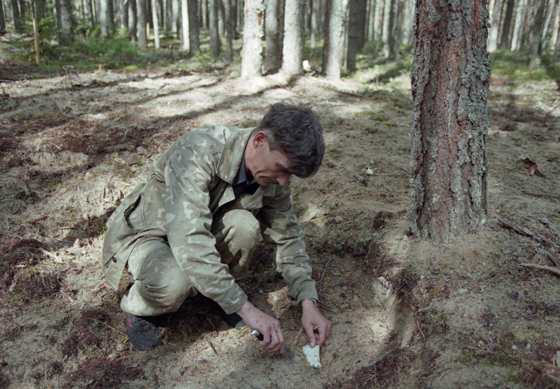 © Maysterman Semen / Photokhronika TASS Yuri Dmitriev at the burial place of the executed in 1937. Karelia. 1998
The wanderers of the archipelago
A week after the expeditionary helicopter flew away, memories of the city, about the large country left there, behind the taiga and mountains, begin to dull. A month later, you are surprised to look at your passport - what is this thing, why is it needed? After one and a half, they are forgotten, unclaimed, not having support in the surrounding world, impressions, smells, sounds: once in the evening in the tent we recalled how the orange smells - and could not recall: in the place of the olfactory image - its empty peel.
The opposite is true: I noticed many times that people living in the central regions do not feel, do not feel the north as part of their domestic Russia. This is somewhere there, far, I will take you to the tundra, under the wing of the plane sings about something ...
The Nazi camps are cut, paid to Germany and Poland, they cannot be purely geographically exposed from them. They are here, next to the train, two hours by bus, next to Berlin, next to Munich, hand over from Weimar, from Krakow, from Warsaw.
And the Stalinist camps are convenient for forgetting - they are either destroyed during urban planning, industrialization of the sixties, or are in the uncertain “there”, close to the abstraction of the polar circle, far from the eyes and memory.
The endless spaces of the North, Siberia, Kazakhstan turned out to be a “sinus”, where millions of people can be hidden, torn from roots, inhabited places, and the tradition of the memorial itself. It is no accident that in the north they say about the country itself - the mainland ; And there, it turns out, the literal Solzhenitsa archipelago , an indefinite periphery, the spaces of darkness, if you look at night from an airplane flying to Magadan.
Two deaths
Millions of prisoners killed or died in camps died not just away from their relatives. Their death, which took place as statistics in the reports of the camp administration - and physical acts, were not included in a certain common necropolis of the country, in that thin, self -bubbling web of mutual, distributed between the living, based on the totality of memories that complement each other, passing themselves in time; The totality supported, fueled by memorial infrastructure - funeral rituals, rituals of grief and remembrance, and most importantly - cemeteries, graves, places where the world of those who departed symbolically contacts and the world of the living.
In Russian folklore there is the concept of “laying dead” - those who died an unnatural death were innocently destroyed, did not receive a burial in the rite. The “layers” do not find reassurance, no matter how they die to the end, get stuck between this and this light, are alive, demanding a funeral established by the canon and the remission of the soul.
In fact, the dead of the Gulag, many of whom are also physically imperishable in the eternal permafrost of the North, and became such hollow dead. You can even say that they were deprived of not only life, but also death - that cultural, ritual death, which expresses the value of every human existence, the idea of the immortality of the soul and constitutes the foundation of memory.
The deprivation of death, a posthumous depth - this is what Yuri Dmitriev works with.
And it is very important how he does it. Because the truth is that everything was wasted - books, films, monuments - if the cemeteries are not called cemeteries if names are not returned to the dead.
People are those who bury their dead. If this norm does not work, we do not even fall into archaic, but in primitive times, when the body has not yet been considered as a container of the soul, did not require a special, ritual attitude.
And we - we did not bury our dead. We threw them in the taiga and tundra, in the steppes and deserts, where the Gulag camps were.
I do not know what kind of load this apostasy from cultural and moral duty (not to say betrayal) fell on the fate of the country, how it complicated and distorted it. But I think that this load, this sin is exorbitantly great.
And what intuitively accurately does Yuri Dmitriev is similar to cleaning, enlightenment, relief - fate, sowing, itself (I use this word, although I am not sure of it) the country's karma.
It would seem that this - well, found where the person is killed, and there is nothing , a forest and a bump. They can easily be imagined, they seem to be interchangeable. But no - this work of clarification is not for biographical details, although they are also important. Not only the human life becomes clear, not only justice triumphs - what is it here, what justice, not revenge comes - but something is nevertheless committed: dignity is returning.
After all, they threw it, like a dog, into a hole - namely, so that they did not find the name to erase, so that a person would not disappear.
And all this is weighed on some such scales that are related to our everyday life. If our fate is decided by someone, it is like Dmitriev.
Divine evidence
North, Siberia - ideal spaces for crime. It happens, you feel in the taiga: or as a clear understanding that you will break your leg in the route - and no one will ever find you; Or - like a temptation in the heat of a brutal quarrel: around - no one, there are no witnesses, and the taiga will hide everything.
The taiga will hide everything ...
Any detective is built around the body of the murdered. The body is the most important, God's evidence. It is difficult to hide the body, it is large, heavy, decomposes for a long time. But if the body is not found, there is really neither a crime nor a criminal.
The Nazis built a crematorium in the camps. The Gulag did not need crematoriums: the spaces of the camp empire themselves were such that there could be hidden, destroyed millions of bodies and there would still be a place.
Therefore, Dmitriev’s approach is so important: to look for bodies, to look for burials. Not satisfied with kenotaphs , symbolic graves; museum constructs.
Only bodies, only shooting pits cry about a crime with marginal force; And, it seems that this is why Dmitriev is so inconvenient, so bad for today's government, which is ready to erect a generalized monument on Sakharov Avenue, to recognize, albeit with reservations, victims of repression, but these sacrifices are, as if separated, abstracted from the crime committed against them. Dmitriev, on the other hand, is uncompromisingly proves precisely the crime of the Stalinist regime, the crime of Soviet power as such; Proves, sorry for the tautology, proof - presenting skeletons, skulls with shooting holes in the back of the head.
The silence of the dead
All that we know about the Gulag, we know according to the testimonies of the living, survivors. But there are still those who will never tell anything, those whose life will not be enough for the plot; He died - and that’s it. Perhaps, only under the uncomfortable sky of the North you clearly feel that in our debate about the past there is one more - invisible, silent side. The dead have their own truth, and this is true not survivors, which is worse than any story of the surviving.
In a sense, this truth argues with the truth of the survivors who returned. The dead did not and would not be able to remember, write, reflect; They, who did not survive, are cut off on the Gulag, they will never leave the camp, clogged there.
Time itself is cut off. And it is treated, healed - if he is healed at all - exactly to the extent that people on whom the debt of memory lies by virtue of kinship are ready not to reproduce his socialized, museum form, but to do the primary, simplest things - to search, to put modest monuments, to remember, to create family and personal traditions, restoring the destroyed conjugation in time and history of fate.
And Yuri Dmitriev - which is another great merit - does not fulfill this necessary, irreversible personal work for others, does not offer ready -made methods of memory consumption, but moves people to personal participation, and not with an example, but by the device, the logic of memory places, which Dmitriev sees and creates them.
Sandarmokh
The very first association that comes to mind when you find yourself here is Chernobyl. There is an invisible death flying with the wind, flowing with rains. Here - the same invisible, unbearable death, present as a glare or shadow.
Semyon Lipkin seemed to guess a note, chilling the tone of this place in the poem “Through the Lace”, although he wrote about the places of others: “And what shamanic mysticism will calm the hearts where it is terribly from each leaf, from the flight of the chick.”
Where terribly from the flight of the chick. This is about Sandarmokh. In 1937-1938, more than nine thousand people were shot here.
The death of death is discord. In Sandarmokh, they died with such a death, in such torment - with tied hands, clogged with scraps, thrown at each other in the back of the truck - which seems to have a direct move to the underworld. That there should be a bleeding hole in the universe, and not pine trees, hills, red nettles of autumn lingonberries on a gray -haired lamb.
Devil's place.
The place of such inescapable horror that culture has no approaches to it. In a sense, honestly, that there is no museum, photographs, things: only tombstones, crosses and chapel.
Sandarmoch needs to reach, get to the museum, there have not yet been any primary things, chaos did not become a cosmos, non-being-being.
There is another place that you immediately recall in the strange rhyme of memory, looking at the monuments of Sandarmokh, sometimes recognizably artless, tasteless, trimmed under the latest funeral kitsch; Only a simple, personal photograph in growth in an unbuttoned jacket is missing.
Exactly such monuments are now standing along the edges of the fraternal cemetery on the Mamaev Kurgan in Volgograd. They seemed to stop at the stylistic line of the Soviet ensemble, do not cross it, but look through. Monuments from national communities, regional administrations, Russian republics - they are trying to split reinforced concrete, not implying privacy - there is not a single personal fate here, all fate in a single merged, as Vysotsky sang - a whole Soviet memorial complex, to single out, to isolate certain subsidiaries due to the descendants, suitable for individual recalling.
The smart, accurate find of Dmitriev and his associates is that in Sandarmokh there is no common monument that would tighten attention, risked becoming an object of non -inventive worship.
As the Sandarmokh memorial is deliberately fragmented, and even seems to be at first glance - that a common monument is required here. But then you understand that it is his absence that is important.
Sandarmokh is developing, grows in the meaning precisely as the sum of private acts of remembrance, private searches; I would even say that Sandarmoch matures, slowly realizing himself, his meaning; очищается, будто бы отмаливается — но это не только про молитвы — именно суммой личных усилий живых потомков, обустраивающих для памяти место страшного преступления в его конкретике — не где-то там, а вот тут , за этим леском, за поворотом, за той сосенкой, у замшелого валуна.
Так возникает некое сообщество Сандармоха, сообщество помнящих и причастных, где ни у кого нет монополии на память (которая, например, чувствуется на Бутовском полигоне, опекаемом РПЦ, а потому в Бутове ясно первенствует культ церковных новомучеников).
Собственно, можно сказать, что история Сандармоха (и будущее его развитие) могла бы быть модельной для России: нам нужно обновленное сообщество — сеть сообществ — потомков репрессированных, готовых брать на себя ответственность за места памяти и, шире, — за политику памяти во всех ее проявлениях; но это вопрос не к Юрию Дмитриеву, а к нам, идущим следом, по проторенной им дороге.
…Расстрельные ямы Сандармоха помечены, очерчены пластиковыми цветами. И вдруг ты видишь, что эти цветы можно увидеть двояко: и как знаки памяти, и как красные флажки, которыми окружают опасные места, промоины, провалы: берегись!
И, когда думаешь о Сандармохе и Дмитриеве, опять же невольно вспоминаешь чернобыльских ликвидаторов, тех, кто «глушил» реактор, принял на себя самое жесткое излучение.
Есть радиоактивные элементы, чей период полураспада недолог, а есть те, что распадаются веками и тысячелетиями.
И нам избывать это долгое излучение, очищать, делать пригодным для жизни пространство, изувеченное ГУЛАГом.
PS
Курю у Ленинградского вокзала. Поезд в Петрозаводск через полчаса. Завтра очередное заседание суда.
Подбегает заполошная женщина:
— Молодой человек, не хотите поработать охранником?
Говорю, что нет.
Она спрашивает других мужчин, говоря одновременно по телефону:
— Да нет, нет… Запил он. Завтра смена, а выходить некому, нет охранника, запил он, сволочь…
Внезапно я проникаюсь странной благодарностью к этому неизвестному мне человеку, который ушел в запой и не явится завтра на пост открывать и закрывать шлагбаум, переписывать у посетителей данные паспортов.
Их стало слишком много, охранников и охранителей. И чудо, что история Сандармоха, открытого Дмитриевым в 1997-м, случилась вовремя , Сандармоху были даны годы, чтобы проявиться, случиться, закрепиться, — его уже не вычеркнуть, не стереть.
Поразительно, какие силы брошены на то, чтобы упрятать в тюрьму Юрия Дмитриева. По масштабу задействованных ресурсов и фальсификаций выглядит все так, как будто мы видим не кампанию против историка, исследователя ГУЛАГа, а травлю журналиста, активиста, раскрывшего совсем свежее преступление. Будто бы преступление совершено не восемьдесят, а пять, десять лет назад и к нему прямо причастны те, кто бросил Дмитриева за решетку.
Это, пожалуй, самое жуткое ощущение от дела Дмитриева, которое словно фиксирует близость — коснись рукой — давних массовых убийств, вдесятеро сокращает временную дистанцию от 1937-го до 2017-го; тридцать седьмой год оказывается в каком-то вечно актуальном, нерешенном, неразрешенном состоянии, словно тут временнáя петля — удавка; как и родные — с погибшими в лагерях, нынешняя российская власть так же кровно, сущностно связана со сталинскими палачами и убийцами и не может от них отречься в силу уродливого, монструозного родства.
И не случайно в этом деле чувствуется почерк конторы с названием из трех букв. Это они подбрасывали диссидентам наркотики, подстраивали ложные обвинения в изнасиловании, в спекуляции валютой. В терминологии восточногерманской политической полиции Штази это называлось Zersetzung — «деморализация», «разложение». Секретные методички Штази сегодня опубликованы. Вот, например, основные положения специальной директивы МГБ ГДР № 1/76 от 1 января 1976 года , где перечисляются наиболее эффективные, с точки зрения Штази, методы Zersetzung 'a. Among them:
— систематическая дискредитация общественной репутации, достоинства и престижа путем сочетания правдивой, поддающейся проверке и способной создать дурную репутацию информации с ложными, но правдоподобными, неопровержимыми и также дискредитирующими сведениями;
— целенаправленное разрушение убеждений, связанных с определенными идеалами, примерами для подражания и т.п., порождение сомнений в персональной точке зрения;
— порождение недоверия и взаимной подозрительности внутри групп, объединений и организаций;
— использование анонимных или под псевдонимом писем, телеграмм, телефонных звонков и т.п.; компрометирующих фотографий, например, с реально имевших место или же инсценированных встреч;
— целенаправленное распространение слухов о конкретных личностях из данной группы, объединения или организации.
Мне кажется, здесь приведено полное и точное описание того, что произошло с Юрием Дмитриевым.
Человеком, который спасает всех нас.
Сергей Лебедев,
Москва — Петрозаводск — Медвежьегорск
On September 30, Colta.ru holds a unique lecture marathon “New Hope. Culture after the 17th. " Join! You can read about the marathon here , buy tickets - here .