
Translated material
Occupation and protectorate
What is the future of the United States and China prepare North Korea?
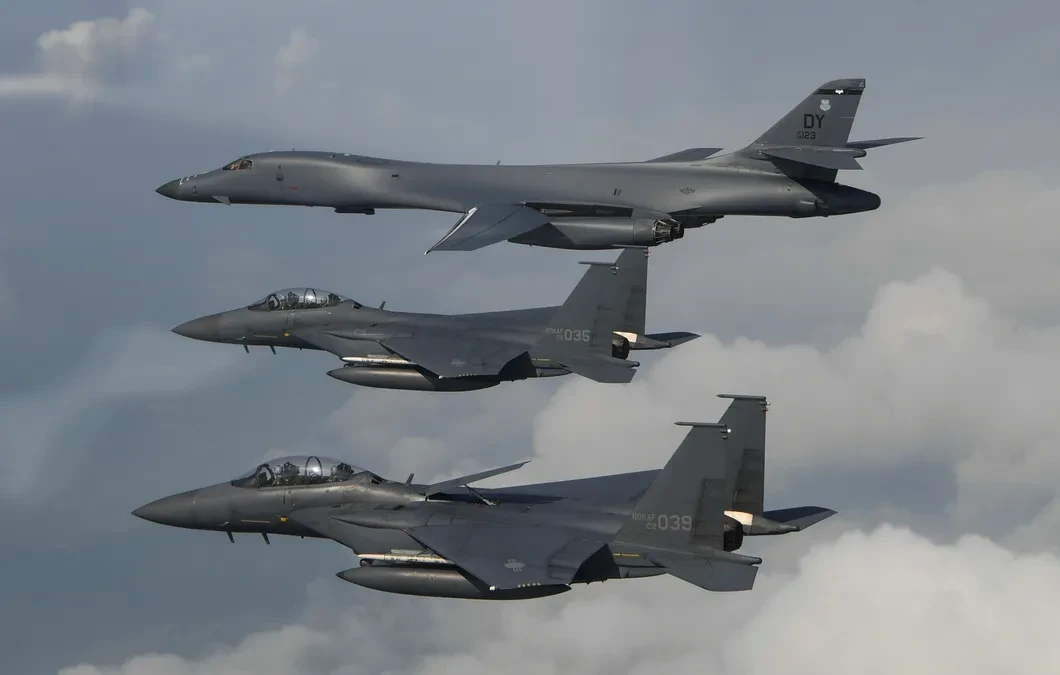
A strange story occurred on September 23 in the sky off the east coast of the DPRK, to which the American supersonic strategic B-1, accompanied by F-15 fighters, approached the closest distance in this century. Airplanes deliberately flew within the visibility of the tracking radar, which the DPRK received from the USSR in the 80s, and at the same time were behind the zone of defeat of Korean anti-aircraft missiles SA-5 of Soviet development of the 60s. But the action of intimidation, to the amazement of the Pentagon, it seemed, failed - the North Korean side did not respond. Her radars did not spot enemy aircraft, and Kim Jong -un did not soared into the sky for interception. And the Americans came to the conclusion that for some reason they simply did not notice their provocation of Pyongyans.
Experts now talk about serious gaps in the Air Defense System of North Korea. The Americans had to specifically spread a message about the flight of their bombers indicating their route-and Pyongyang finally penetrated. A menacing noise rose in the North Korean press, a video was released in which the anti -aircraft gunners famously knock down American combat aircraft of the last models, and at the same time, Karl Vincon Aircraft Medical Air Forces are drowned with one blow from the submarine. South Korean intelligence, in turn, recorded a hasty transfer to the east coast of the DPRK of combat aircraft and additional air defense systems.
Region on the verge of war?
Extremely dangerous overstown of the atmosphere of the Korean peninsula has been continuing since mid -summer: in July, the DPRK is not without flaws, but quite successfully twice experienced a prototype of the intercontinental ballistic missile. At the end of August and September, Pyongyang launched medium-range missiles through Japan-according to their indicators, they can potentially strike the American island of Guam in the Pacific Ocean, where, in particular, the US Air Force with the very B-1 bomber.
Finally, on September 3, the DPRK conducted the sixth and most powerful nuclear test of a hydrogen warhead for a ballistic missile. Following this, the Foreign Minister of North Korea publicly suggested that in the near future the leader of the country Kim Jong -un could give an order to explode a hydrogen charge over the Pacific Ocean. He did not bring details, but it is probably about thermonuclear testing in the atmosphere with all the frightening consequences. The Americans have already stated that they would regard such a step as the act of war.
In September, at a session of the UN General Assembly, the DPRK Foreign Minister openly threatened the Americans with a missile blow on their territory. “This is becoming more and more inevitable,” Warmed Lee Yong Ho. The head of the Committee of the Chiefs of Staff of the US Armed Forces, General Joseph Dunford, paradoxically agrees with his opinion. The DPRK, he believes, will very soon have an intercontinental missile with a nuclear warhead and with the possibility of impact on the United States. “This is only a matter of time,” the general admitted, speaking to the senators on September 26.
Meanwhile, one of the leaders of the ruling party in South Korea said on September 27 that the case was going on to war - the United States will not wait calmly until Pyongyang will create potential for impact on their territory.
According to the politician, his country is on the verge of a bloody conflict, fraught with millions of human losses.
How much does gasoline cost in Pyongyang
China feels very uncomfortable in this situation - the threat of an uncontrolled large -scale collision grows right at its borders. The Trump administration exerts powerful pressure on the PRC - she is sure that Beijing can restore Pyongyang, being his main economic partner and the only military ally. But the problem is that North Korea ceased to obey the Chinese comrades - Kim Jong -un mercilessly burned the Proktina lobby in the country. The Pyongyansk press openly condemns the PRC for indulging Washington, for joining sanctions against North Korea.
The UN Security Council measures are really harsh: any supply of military technologies and weapons, as well as their purchases from the DPRK, are prohibited. Since this year, North Korea cannot be bought by coal, iron, lead and their ores, seafood, textiles, which previously gave the country up to 90 percent of export revenues in the currency. After the sixth nuclear test, a ban on the supply of gas condensate was introduced to the country, tough limits were set to sell oil and oil products to Pyongyang - in general, they were reduced by a third.
A few diplomats from Western countries and representatives of international organizations in Pyongyang are now extremely neat and, if possible, imperceptibly for the North Korean special services, they are asking for what is changing in the DPRK after the latest sanctions. So far, one thing is noticeable - a crazy increase in gas prices at commercial gas stations. Compared to the beginning of the year, they jumped three times, assures the South Korean Ministry of Association - the main structure that collects and analyzes information from the north. As of the end of September, for a liter of gasoline in Pyongyang, more than $ 5 is already asked for the American currency. After the introduction of sanctions, the country's leadership sharply limited the supply of fuel to commercial structures and due to this replenishes strategic state reserves.
So far, other sharp changes have not been noticed, but the sanctions, undoubtedly, drive North Korea into a corner, doom its economy to slow fading. This can push the country's leader Kim Jong -un to harsh unexpected steps in order to turn the situation, scaring Washington, Seoul and Tokyo the threat of a real war in the region.
Pyongyang proceeds from the colossal difference in the price of human life in the DPRK and in industrialized democracies, which, in his opinion, may result in negotiations on advantageous DPRK conditions.
Joint occupation
China takes this into account: there were signs that he was ready to at least talk with the United States and South Korea about the overthrow of the current regime in Pyongyang as a result of a joint operation and on the establishment of a new system of power in the DPRK, which arranges all parties. According to the Japanese press, Washington and Seoul have previously proposed to hold such consultations more than once, but Beijing considered it inappropriate. Now his position seems to have changed: the director of the Institute of International Relations at the University of Beijing, Jia Bspo in September, published a lengthy article in English, in which he discusses the establishment of a joint protectorate over North Korea after the elimination of the Kim Jong -Yun administration military means.
According to him, Beijing, Washington and Seoul need to agree on basic things: first of all, to create a system for maintaining order on the territory of the DPRK South Korea or an international contingent with the UN mandate. The introduction of American troops, the director argues, is unacceptable. But Beijing, as it seems to him, may agree with the transfer of the nuclear potential of Pyongyang to the US nuclear potential.
We are talking about creating refugees for refugees on the Chinese-Several Korean border, about holding free elections in the DPRK under international control, etc. Apparently, this is not the personal opinion of the expert, but the option approved by the authorities, which Beijing is ready to discuss. Pyongyang is made to understand: China is able to take part in the operation against the DPRK or at least agree with it.
Meanwhile, in mid-September, US defense minister Jim Mattis said that he was negotiating with Seoul about the return of American tactical nuclear weapons to South Korea, which was bred in the 90s. It is, apparently, about winged missiles and low -power air bombs, which can be used at any time for paralyzing spot strikes along the DPRK.
Mattis also stated that the United States is able to neutralize the worst military remedy of Pyongyang - thousands of artillery trunks and missile plants, concentrated in bunkers and caves at a shot from Seoul. According to estimates, they can release up to 300 thousand missiles and shells in an hour in an hour. It was this factor that claims that he kept in the early 90s of the United States from a preventive strike on the DPRK, when it just started its nuclear program.