Date
Author
Глеб Яровой; Фото Автора

Preserved copy
Translated material
What will happen to the Sunni Bor in Karelia
The story of the Sun Bor
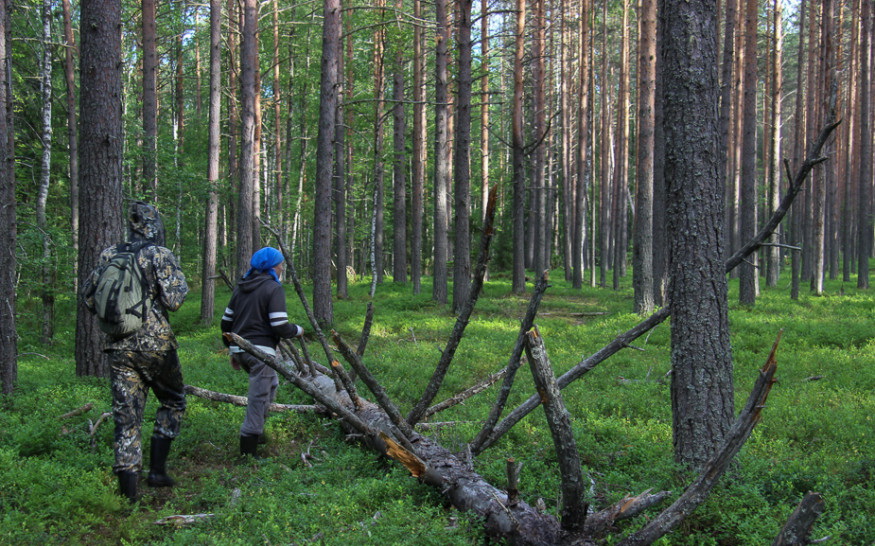
In 2011, Saturn Nordstroy received a license to develop a sandy career near the Karelian village of Suna. Local residents, for whom the forest remained the only accessible place for collecting berries, mushrooms and medicinal herbs, tried in all legal ways to prevent the boron into a quarry. In 2015, when Saturn Nordstroy was going to start cutting down the forest, ecologists discovered Red Book plants in Bor. The development of the career was postponed, however, after receiving the necessary permits from Rosprirodnadzor, the equipment stopped into the forest. Locals interfered with the passage of forestry equipment and the work of forest rollers, and then set up a camp in the forest to monitor the situation. Trying to relieve social tension, the regional government agreed to a moratorium to develop a career and created an interdepartmental working group. The Ministry of Nature Management and Ecology of Karelia held several round tables with the participation of the population, the developer and experts. All the time, while negotiations were underway, the “Sun partisans”, mostly pensioners and volunteers joined them, were on duty around the clock in the tent. “Partisans” spent 10 months in the forest, from the summer of 2016 to February 2017. After the appointment of Arthur Parfenchikov, to the post of acting head of Karelia, the long -term conflict managed to resolve: the license to develop a sand career in the Sunsky Bor was withdrawn, the protesters turned the camp.
Ecologists: "We must create a comprehensive natural monument"
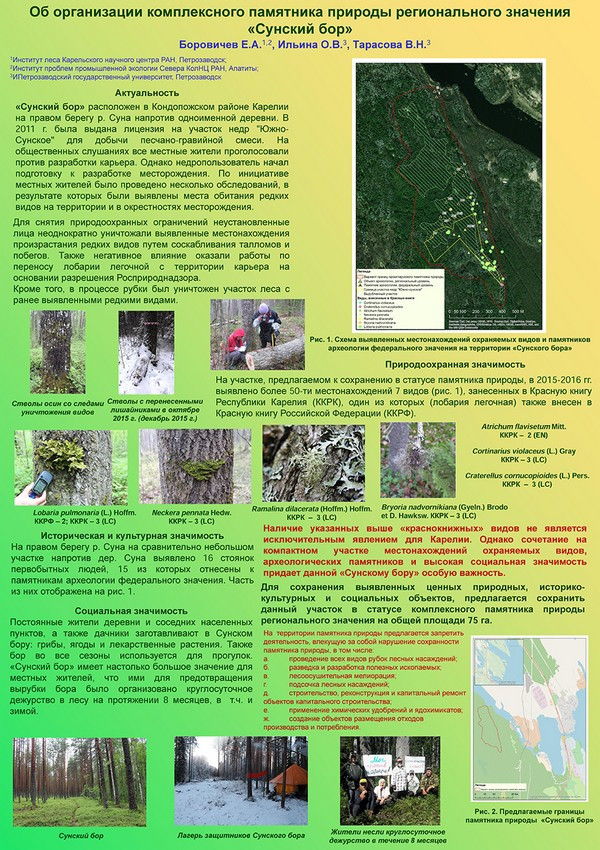
The idea of creating a comprehensive natural monument in the Sun Bor was first sounded during the conference "Boreal Forests: condition, dynamics, ecosystem services." The conference was organized by the Forest Institute of the Karelian Scientific Center of the Russian Academy of Sciences, it took place in Petrozavodsk from September 11 to 13.
Experts - representatives of the Institute of Forest of the Karnz of the Russian Academy of Sciences, the Institute of Problems of the Industrial Ecology of the North of the Kola Scientific Center of the Russian Academy of Sciences (Apatity), the University of Petrozavodsk and the Environmental Protection Organization - are sure that Sunsky Bor - this is more than valuable nature and red -blown plants.
“The combination on the compact section of the whereabouts of protected species, archaeological monuments and high social significance gives the Sunsky boron,” scientists say. They defended this idea to the scientific community.
According to the ecologist Olga Ilyina, the task of creating a protected natural area on the site of Bora was replaced by a more ambitious goal:
- The idea of creating protected areas [ of a specially protected natural territory ] arose for a long time. The initiative belonged to local residents. When it became known that the license [for the development of a sandy career on the site of the boron] was recalled, we began to discuss this idea with the Ministry [ nature management and ecology of Karelia ], and with biologists, and with archaeologists. Then everyone agreed that giving the boron the status of a protected territory would be a good decision. Only not just the protected natural territory, but the integrated monument of nature, taking into account both archaeological features and the social significance of the place. Evgeny Borovichi from the Forest Institute agreed to help local residents in preparing documents for submitting to the ministry. What we are doing now.
The Ministry of Nature Management and Ecology: "We support the idea"
The representative of the ministry, the head of the department of state environmental examination and specially protected natural territories, Ivan Kiprukhin explained to the 7x7 correspondent , which is the main difficulty of implementing the idea. According to Kiprukhin, the process of creating protected areas takes a lot of time, because you need to go through a lot of approvals. Only at the level of local self -government should you agree on documents three times: first, the justification materials are discussed, then public hearings are held, then the draft resolution on the creation of protected areas is approved.
“ The initiative group of local residents really addressed us on the issue of creating protected areas,” Kiprukhin said. - Since we do not have additional funds for examination and scientific examination, they intend to make it at their own expense. As far as I know, they ordered it. The initiative group with us on these issues consults, we will help. In general, we support this initiative, but this is not a very fast process.
According to the official, on the site of the boron theoretically possible economic development, that is, The development of a career, because the place itself is listed as the approved field, but in reality this will not happen:
- We all see that the vector turned towards the creation of protected areas, so the unit of the ministry, responsible for Subsoil use, knowing the situation, will not include this deposit in a special list of deposits for development. A license was withdrawn from the developer , and they will not give a new license to anyone.
Locals: "Bor defended, we must raise the village"
Local residents support the idea of ecologists, but believe that only on the creation of a monument of nature, albeit complex, cannot be stopped.
Tatyana Romakhina, a local resident, activist of the Sun Partisan detachment, believes that more ambitious goals should be set:
- Now the main task is to make a protected natural area. So that no one from us could pick up the boron, which we later defended with blood. Thank you very much to scientists who help us with this. But we want to go further. I will not disclose all plans for now, but we are now registering the Sun Bor public organization. When we register it, we will put our ideas into life - from tourist routes to the Bor to the creation of a cultural center in Suna. The final goal is to raise, revive the village so that people live better. For this, Bor was protected.