
Translated material
The dog of God Nudens
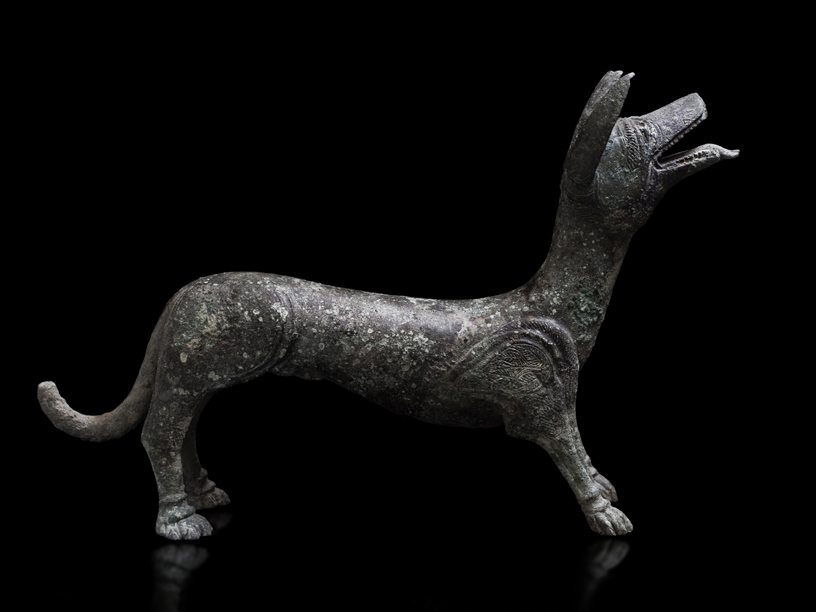
In Gloucheschir, amateur archaeologists discovered the treasure of the Roman era, which includes a curious artifact-a bronze figure of a dog with a protruded tongue. Probably, it is connected with the cult of the god Nudens, whose large sanctuary was located on the territory of Gloucester in the Roman era.
Pete Kidell and Andrew Bowl have been searching for antiquities with metal detectors for forty years, but before they had never managed to make such a significant find. “As soon as I realized that objects have historical significance, I contacted the local archaeological team, which was equally excited. - says Korsuwell. “This is a great honor to be able to contribute to the local and British history.” The archaeologist Kurt Adams arrived on the call of treasure hunters, who came to the conclusion that the treasure dates back to 318 - 450 years old The exact place of the find in the press is not reported.
The figurine of the dog, which we will talk about more than below, and a couple of coins are the only whole products in the treasure. Everything else is fragments of bronze products: statues of a person, blood vessels, shackles of chest, spoons, key, linings in the form of heads of animals and people - and many more pieces of copper of incomprehensible origin. On one of them, an inscription is preserved, read as (V?) Mconia. It is assumed that the founded treasure is an antique scrap metal collected for subsequent remelting.
Fragments of bronze products from treasure
Now, experts of the British Museum are working with found objects, who should clean and restore finds. When this work is completed, the museum’s assessment committee will have to determine the cost of artifacts, after which the corresponding remuneration will be divided in half between the treasure hunters and the owner of the land plot.
As we have already said, the dog’s figurine aroused the greatest interest among the found objects. A skillfully executed dog stands and looks up, as if expecting the owner to throw her ball. Her mouth is open and her tongue is stuck out. There are holes in the paws, stomach and side of the dog, with the help of which, once the figure was fixed on a non-preserved stand.
Dog's head
Dog figurine from different sides
In the UK, earlier figures of dogs with a stuck tongue were already found. The National Museum of Wales stores two bronze dogs about five centimeters high. Only they do not stand like a dog from Gloucester, but sit. The figures were found in Llis Awel in the Welsh County Konui. There are also two bronze plates in the museum, on which dashed deepening forms the image of the dog. They were found in the same site. All these items date back to the period between the end of the 1st century BC. e. and the end of the 4th century n. e.
Dog figurines from Llis-Awel
Drawing a vast tablet with a dog image
All these dogs are associated with researchers with the Celtic god Nudens (Nodons, Nudons). The large sanctuary of Nudens in Gloucester was located on the territory of the Lindi Park estate near the mouth of the Severn River. Excavations of this place began in the 1920s Mortimer Wieler , at that time-a young scientist from the National Museum of Wales, and later-the famous British archaeologist. Wieler determined that the temple complex in the Lindi Park was built shortly after 364 BC and acted until the 5th century. e.
Ruins of the Nudens Temple in Lindi Park
It consisted of the building of the Sanctuary itself, surrounded by a gallery, in which ritual processions, hotels for pilgrims with separate terms were probably held, as well as a building where the pilgrims had to sleep in order to get healing from illness or divine prophecy. An example of such a communication with God in a dream is well known on the other end of the ancient world - in the Asklepy temple in the epidaurus.
Wieler found nine statues of dogs in the Temple of Nudens, both stone and bronze, one of them is depicted with a human head. Some statues seem like Irish wolfhounds, so that dog breeding historians consider them the most ancient images of representatives of this breed.
One of the dogs of Nudens in Lindy Park
The analogy with Greek Asclepius helps to explain the connection of the dog with the god of healing, the scientist again helps. The sacred animals of this God was not only a snake, but also a dog. Dogs were kept in the temples of Asclepius in the epidavra, Athena, in Leben in Crete, and later in Rome. Pausanias reports the legend that the baby Asclepiy was thrown by the mother, who gave birth to him from Apollo, then the baby was fed by the goat, and the dog guarded. The dog was depicted at the foot of the throne of the statue of Asklepy in the epidateur. The statue has not reached us, but we can well imagine it in antique coins. It was believed that the dogs living in the temple, licking the wounds of pilgrims, healed them. It can be assumed that they could play a similar role in the Celtic cult of Nudens.
Other offers were found in the lines of the Lindi Park. Among them are 320 bone pins, about 300 bronze bracelets and more than eight thousand coins. Bone pins are also found in other Celtic cult centers of Britain. The pin symbolized pregnancy and successful birth, so that they were received as a gift to God's barren and pregnant women. In the Lindi Park found a stone figurine about half a meter height, depicting a goddess sitting on the throne with a horn of abundance in his hands. Maybe this is the Divine wife of God-centered nadens, patronizing women in labor?
Some finds from the Lindi Park indicate clearly for the connection of Nudens with healing. A hollow bronze hand makes Asklepy again, as a gift from the sculptural images of the healed parts of the body. They also found a print, which the ancient optometrist marked the eye of his eye, and a bone plate with an anatomically accurate image of a woman.
Mortimer Wheeler also found a bronze statue of God, who stands on a chariot drawn by four horses, and holds a club in his right hand. On a bronze relief from the Lindi Park, God also rules a quadriga, while holding a whip, on the sides of it are young men with torches, and below are the new anchors. In these images, researchers find the features of Nudens as a solar god, and the Tritons indicate His connection with water.
The water element was also represented on the mosaic floor of the temple, where you could see different sea creatures. The mosaic was created in the 4th century and was the gift of the temple from Titus Flavius Senilis. There were also reliefs depicting a sea deity with a sink and anchor, as well as fishermen and newns. At one of these reliefs, the fisherman catches fish. Researchers see salmon in it and suspect the connection of this image with the Celtic cult of “wise salmon”. These suspicions are strengthened by the fact that the all-knowing “salmon from Llin-lliu” is the hero of the legend “ Kiluh and Olven” from the Welsh collection “Mabinogion” was associated just from the Severn River, on which the sanctuary of Nudens stood.
Bronze plates with reliefs
Found in Lindy Park and initiative inscriptions. For example, such D (EO) m (arti) nodonti flalvius blandinus armatura v (otum) s (olvit) l (iBens) m (erito) "God Mars Nodon - Flavi Blandin Armature, the vow performed willingly." As we see, in Roman Britain Nodos was associated with Mars. We should not be very surprising. Mars is almost the most popular god, if we assess the number of “barbaric” deities identified with him. The fact is that military affairs was a rather late function of Mars, and earlier he was the god of the rural community, partly agrarian, partly a defender, averting various disasters.
Dedicated inscription Flavius Blandin of Armature
However, Nudens were identified not only with Mars. We saw him standing on a chariot, like a sunny god. Communication with dogs makes it possible to recall the god of the forest and hunting of Silvan. And one inscription from Windows contains the dedication of DEO N (ODONTI) Neptu ... “God Nonons Neptune”-we recall the mosaics and reliefs from the Lindi Park with shells, anchors and news. And in two inscriptions from the Lindi Park, Nudens also identifies with Mercury.
Another inscription from the Lindi Park is applied to a bronze tablet with a barking dog. The author reports: Pectilus votum quod Promisisit Deo Nudente M (Arti) DEDIT "Pekul to God Mars Nudensa gave a vow that promised."
Route of relief with a dedication inscription of Pekul
An unusual inscription Devo Nodenti Silvianus Anilum Pertedit Demediam Partem Donavit Nodenti Inter QUIBUS NOMEN SENICIANI PETMITAS SANITATEM DONECTEM Usqve Templvm Dentis dentis dentis “God Nudens. Sylvian has lost the ring. And he gave [for his return?] Half of its value. Of those who bear the name Senitian, let no one be healthy until he brings him to the temple. ” Apparently, Sylvian suspected Senitian of theft of the ring. It is interesting that the Golden Ring with the owner's inscription Senitin was found in 1785 in Silchester, more than 100 kilometers from a lead-park, more about the history of this ring can be in the essay “Prototype of the Ring of Elmity” .
Inscription
Among the deities of the Celtic peoples, witnessed by written sources, the etymological analogue of the British Nudens is the Irish Nuad Airgetlam (Nuaada Srebrruki), the king of the tribes of the goddess Danu. When Nuada lost his hand in the battle, he lost the throne, as the physical injury deprived him of the right to be king. God Dian Kekt made a silver hand for Nuad, and the son Dian Kehta Miah raised flesh on this hand, which allowed Nuad to become a king again. In connection with this story, we can recall the bronze hand found in the Lindi Park.
And in the already mentioned legend, “Kiluh and Olven” was a character Lludd with a silver hand (Lludd Llaw Eraint), in other Welsh tales there is a more ancient form of its name Nudd, which is also etymologically related to the name Nudens. We add that one of the etymologies of the toponym Lindy builds it to the Old English * Lydan-Eġ “Lluda Island”. Outside of Britain, the similar name of the deity - Neadatus - is found in the initiative inscription of the Roman era, which was found in the Mainz.
Celtologist Viktor Kalygin in his Etymological Dictionary of Celtic theomers suggests that the name nōdon (t) S comes from *noodonts < *neudont-s “giving an update”, which is the addition of Indo-European roots *neu̯o “new” and *dō- “give”. Also, they try to compare this name with the Gothic word NUTA "Fisherman", recalling the fishing symbolism on the relief from the Lindi Park. Another etymology builds the name Nodos K *nudons, formed from *nood to “grab”, with the possible influence of the root *SNAD “Protection”.