
Translated material
Who will stop a person with a knife
Attacks with cold weapons for random passers -by, car attacks on nothing suspecting pedestrians - international terrorism clearly changed tactics. Is there an antidote - The New Times asked experts
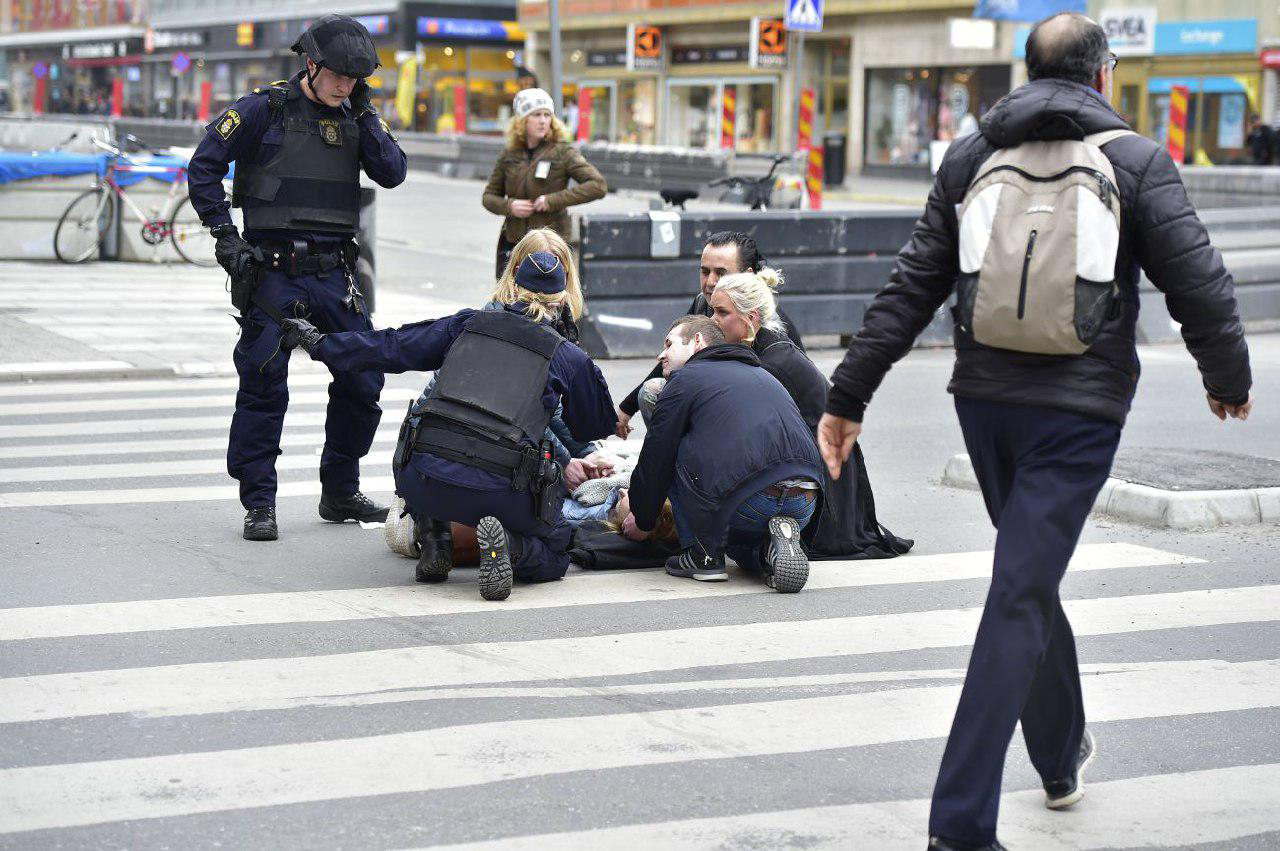
At the site of the attack in Stockholm, April 7, 2017. Photo: ya62.ru
Chronicle of several days: September 28, Moscow: an unknown man strikes with an object similar to a knife, two passers -by - the victims are hospitalized; October 1, Marseille (France): at the city station, an unknown person inflicts mortal injuries to two girls with cold weapons; October 1, Edmonton (Canada): The unknown person enters the car into a group of pedestrians, after which he attacks the police officer with a knife - 5 people were injured ... On October 4, the director of the FSB of the Russian Federation Alexander Bortnikov declares the concern of the special services a new dangerous trend - the "autonomous jihad". The place of the crime, where the weapons of the murder were knives and “jihad mobiles”, which completely cut into nothing of the unsuspecting people, have already managed to become Surgut (Khanty-Mansi Autonomous Okrug, RF) and Finnish Turku, London and Flint (Michigan, USA), Paris, Hamburg, Stockholm ...
How to resist the single terrorists interpreting the canons of Islam as the revenge of “kafiram”-neur, whether the Ummah is able to influence them*-this time he did not turn to the anti-terror experts, but to the Islamic scholars. The interlocutors of the magazine are a professor at the European University in St. Petersburg (EUSPB) Alfrid Bustanov , professor, editor-in-chief of the international magazine Manuscripta Orientalia Efim Rezwan and a researcher at the University of Amsterdam (Netherlands) Danis Garaev .
Methods of surveillance
NT: international terrorism in the person of the so -called “Islamic state” ** *recently inflicted a sensitive blow in Syria and Iraq. In response to the calls to go to the places of hostilities to war with the infidels, point blows and demonstration shares from the IGsa adherents came directly in the places of their residence. What is this talking about? What to do with it? And is it possible to do something at all? ***
Efim Rezvan: In fact, a change in terror tactics, this “transition to knives” indicates that special services really make tremendous efforts to reduce the turnover of explosives. And even if these explosive devices have learned to make home -grown terrorists out of derivatives of improvised means, the circulation of these funds was clearly more complicated. What remains the terrorists? Press the machines and cut with knives.
But you are right: the tendency to change the tactics of terrorism can be seen clear, and now, in fact, you can not do very much - we want it or not, we will have to live in this world further. The only way to track those who seem potentially dangerous is to track them over the network. These people go to some sites daily, enter into correspondence, receive regular information. But on the other hand, the network, if the special services take this method of surveillance of terrorists as a basis, can soon stop being anonymous space. But I am also afraid of this.
Here, more recently, China took a rather serious step in this direction - now it is impossible to leave any comments without fully authorized.
Nevertheless, I am sure that the emergence of "autonomous terrorism" is a derivative of network technologies. And that means the struggle with him lies exactly in the same area. So, I repeat, the main task for law enforcement agencies is to carefully monitor those who are interested in the radical directions of Islam on the network.
Efim Rezvan: “The only opportunity to track those who seem potentially dangerous is to track them over the network”
NT: By the way, how widely the IG ** managed to spread their ideas among young Muslims in the Russian Federation, given that the IG ** *website has recently been launched in Russian? *
Danis Garaev: Well, on August 19, it happened, as you remember, the massacre in Surgut, which was arranged by 19-year-old Arthur Gadzhiev. This story suggests that we are dealing with a systemic problem. Those who want to commit this kind of crime can do this regardless of whether or not the ISIS representatives have ** site in Russian. After all, Russian and world media are literally overwhelmed with information about how, according to which scenario to perform such terrorist attacks.
NT: Responsibility for all cases of "Autonomous Jihad" was taken by IS ***. How coordinated were these shares? *
Garaev: There is no good reason to believe that everything happens here on command. Rather, this is a manifestation of the initiative from below - at first, radicalized youth themselves is looking for ways to join IG **, and already at the next stage, organizational or consulting work from representatives of this organization may follow.
After all, IG ** is already such a bricolage that is accidentally assembled from various pieces. For some, this can be a counter-cultural uprising of a migrant from the city outskirts, and for someone-a nationalist impulse against the policy of the Western powers in the Middle East. Strategies and motivation of terrorists can be very different.
What can Ummah
NT: *Can traditional Islamic institutions somehow influence the mood of young and aggressive people? After all, the opinion of Ummah for them probably means something? Well, it means logic? *
You see: you see, the situation gets out of control, not only because the media constantly translate stories about the “exploits” of terrorists, but also due to the crisis of ideology: if earlier a bright future was associated with the ideas of Marxism, now - mainly with religious aspirations. Yes, the Ummah, the traditional community, is interested in the religious, national environment there are no excesses, but it is impossible to expect that Ummah can change everything at once. Moreover, the traditions in Islam are different - in Indonesia, for example, Matriarchy, and there women solve all the main issues of society.
GARAEV: And who even said that the radical-Islamists have ever been considered the opinion of the Ummah? And on what basis should we assume that any person who calls himself a Muslim should already be under the control of some Islamic institutions?
If we look at the biographies of terrorists, we will see: many of them, to put it mildly, do not adhere to Islamic norms of behavior. For example, the Tunisian Anis Amri, who made pedestrians in Berlin in December 2016, was known to the German police as a drug dealer, and he himself repeatedly used ecstasy and cocaine. Moshamed Laujezh-Bolel drank alcohol in July of the same year and also took drugs in July of the same year. And remember the terrorist attack on Paris in November 2015. Its participants were the owners of the bar from the suburbs of Brussels, which 2 weeks before the tragic events in Paris was closed - the police found that drug trafficking was being held there.
When we are talking about the so -called jihadism, it is not at all about Islam. No one should be embarrassed that people who declared themselves the supporters of IG ** and committed terrorist attacks, despite the ban on Islam, traded drugs and consumed alcohol. And therefore, I have the right to ask the oncoming question: how in such a situation, Islamic institutions can affect Muslims, whose path from drug dealers to terrorists sometimes occupies a very short period of time? Moreover, in this short period of time, they may not intersect with any official structures at all.
Danis Garaev: “If we look at the biography of terrorists, we will see: many of them, to put it mildly, do not adhere to Islamic norms of behavior”
Alfrid Bustanov: If you still talk about traditional Islamic institutions, then they often turn out to be helpless. Yes, Friday sermons are held, conferences with the participation of respected religious figures are held. But today all this is absolutely not effective. Imam’s preaching in the mosque most often few people listens. Conferences are held in order to master the money. The effectiveness of Fatva *** is not in political, but ideological terms also very low.
Now the young people who are interested in Islam are provided either to themselves and the dialogue with the Internet, or the numerous channels of modern communications - starting with Telegram and so on ... And there the choice of information is endless. Especially if a person knows more than one language. After all, for example, now there is a lot of information in English. Social disorder, the mood in the media space, which connects any event in the world with the conspiracy of the Islamists, as well as the helplessness of traditional institutions in the face of modern political technologies - here, I would say the most important factors that make it difficult to fight radicalism.
Alfrid Bustanov: “Imam’s preaching in the mosque most often few people listens. Conferences are held in order to master money "
Garaev: The meaning of traditional Muslim institutions in the prevention of extremism should not be exaggerated. For example, Syria and Egypt are foci of what is commonly called traditional Islam, its world centers. However, this did not save them from extremism. By the way, in Russia, the region, which has become a hot point, is the North Caucasus, that is, the place where the Muslim tradition and traditional Muslim institutions in the form of Sufi fraternities survived even in Soviet times.
On the other hand, the regions of the world that can be called highly secularized - Europe and Central Russia are no less important supplier of militants and terrorists.
Russian muftii very tightly cooperate with special services and anti -terrorist units. Another question is - how tightly do they cooperate with the so -called Muslim street? With lower Muslim movements?
By the way, the recent rally of Muslims of Moscow dedicated to the events in Myanmar is talking about the degree of authority of Islamic institutes - thousands of Muslims took to the streets and criticized Russian muftis. The muftii just self -confused.
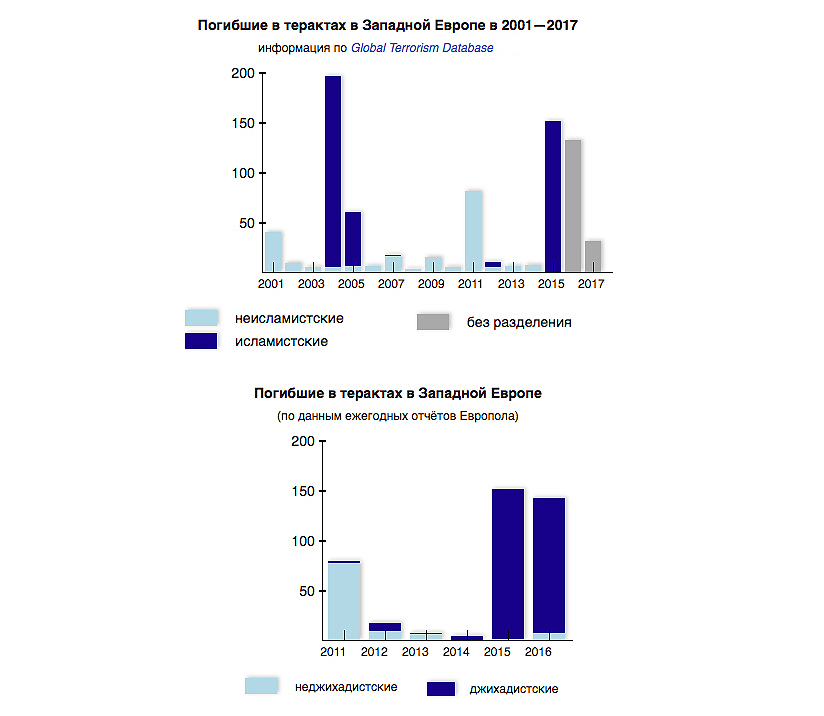
Source: ru.wikipedia.org
Causes and consequences
NT: *Suppose special services will strengthen on the network surveillance of adherents of radical-Islamism? And what - there will be a radical improvement in the situation? *
Rezvan: When we talk about the fight against network technologies of terror, we mean the struggle not with its causes, but with the consequences. There are almost no hopes that the situation will radically improve in the near future. Because the causes of terrorism are not on the network. They are different. In the Islamic world, everything is constantly changing. Look, it seems that the Arab Spring has come to the decline, and meanwhile now in Morocco, which has always been considered a stable and calm state, the same flywheel is slowly gaining momentum, and difficult times are waiting for this country. But the reasons why this flywheel is spinning is the same: young people are not able to get an education, profession, find a job and realize themselves and so on. That is, the causes of terrorism in any case are socio-economic in nature. And we are fighting with the investigation.
Bustanov: When the theme of the so -called Islamic radicalism rises, I immediately want to ask: who said that this is a question for Islamic scholars? In fact, we here primarily deal with social problems, and not religious fanaticism. But it is worth getting into the media space, as it is instantly stained in the corresponding colors - and already in the mass consciousness the topic of terrorism is associated with Islam, with crowds of people near mosques, migrants, with aggressive men with black beards. Examples of this cannot be counted. And this picture over the past 20 years has been firmly eaten into the information field and consciousness of people.
It is not necessary to make monsters from Muslims, from labor migrants who certainly carry a threat of terrorism. Moreover, in our country, where Islam is a part of Russian culture, where there are centuries -old traditions of joint coexistence of Islam and Christianity. If we talk about the Islamic threat everywhere, then we cut it on the living, on the very basic statehood.
“It seems that the Arab Spring has taken a decline, but now in Morocco, which has always been considered a stable and calm state, the same flywheel is slowly gaining momentum, and difficult times are waiting for this country”
Garaev: The key question “What to do with terrorism” - it actually directly concerns the theme of the popularity of violence in general. Well, take these stories with regular explosions of violence in American schools, when a broken schoolboy with weapons in his hands bursts into the classroom and kills classmates and teachers. How can this be stopped? So it is tempting to say: yes, no way. But if nothing is done, then the situation will only aggravate.
So far, I would suggest the media to stop, albeit indirectly, to heroize terrorists, savoring every episode of their attacks. Take a look: after all, it is! The attacks become bright media stories, almost colorful militants, in which a certain unknown marginal from the outskirts would like to take part. In the media, he actually receives a scenario of how to act.
From the editorial office. From 1970 to 2015, according to Global Terrorism Database, 12,593 attacks were committed in Europe, of which Islamist - only 54 (less than 0.5%). At the same time, 5380 people became victims of Islamist terrorist attacks during the specified period of time - 5.6% of the total number of dead. The fact that it was at the hands of the Islamists that the largest number of people who have become victims of terrorist attacks are perishable, with all the obviously manifested in the last two or three years, when the attacks began to mainly be performed by adherents of the so-called “Islamic state” ** . So, in 2016 in Europe, 142 people died at the hands of terrorists, of which 135 became victims of Islamists. A year earlier, in 2015, 130 people died in Paris only as a result of the attack in Paris. The attacks of 2017 show: in terrorist attacks, explosives and firearms are now used less often, but they have become much more common. And at least the number of wounded as a result of terrorist attacks, especially car raids, is quite comparable to past years, when the priority was at the “Shahid belt” filled with explosives.
Issay-scholars, if summarize the results of the discussion, indicate: to hope that the supporters of the "autonomous jihad" will form the Ummah, it is pointless-they live in their conceptual field. On the other hand, measures are proposed that can today become at least a prevention of terrorism, this is an increase in control of radical Islam adherents on the network and a factual more stingy and restrained filing of information about media terrorist attacks. True, underwater stones are already visible here: strengthening the control of special services for suspicious traffic and users of the network is fraught with the establishment of total Internet control, which we are already observing, as Efim Rezvan correctly noted in China. As for the media responsibility for “heroization” (it must be assumed to be precisely extremely detailed, with all the details and nuances, news feed) terror and terrorists, then not everything is so simple here: many anti -terror experts will tell you that the more the population knows about the motives, methods and tactics of terror, the better it is prepared, including psychologically, to the best. Unforeseen circumstances, the more careful and carefully, people behave in a public city space, which today in itself is a risk factor.
*One way or another, this topic is for a long time. As Efim Rezvan correctly noted - to everyone, both Europeans and Russians, now live with it. Experts expressed their recommendations, the task of the rest is to listen to them at least.** Umma is a religious community in Islam.
** “Islamic State”, IG, ISIS - an organization banned in Russia as a terrorist.
*** Fatva-in Sharia (fikhe) a legal position or a decision on any social, political or legal issue, issued by a mujtahide, a lot, a mufti, a fakikh or Alim.