
Translated material
"This project we declare that there are young composers"
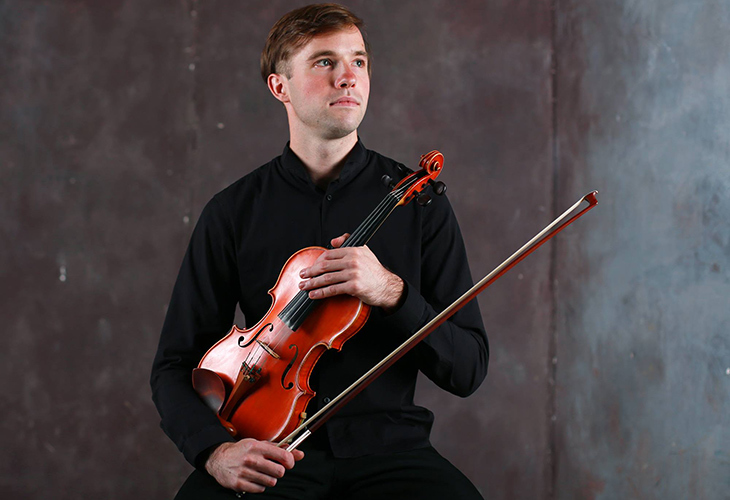
Three discs “Anthologies for the music of young composers of Russia” were published on the Fancymusic label . The works of the authors from Moscow, St. Petersburg, Nizhny Novgorod, Kazan, Rostov-on-Don, Ufa, Perm are performed by two youth St. Petersburg teams-a hammer and Festino chamber choir. The author of the project is the violinist and composer Arthur Zobnin told Ekaterina Biryukova about the generation of 20-year-old composers and the concept of “Russian void”.
- Arthur, the first question, of course, about the principle of selecting participants in your anthology. What criteria were you guided by? Age? Style? Or each creature pair?
- During the selection, the age, of course, was of importance, since it is the "anthology of the music of young composers of Russia." But perhaps the quality of music and the attitude to a particular composition of the groups that recorded this music were even more important. It was quite difficult for a hammers to be able to choose an essay, because in five years we have formed a large repertoire list in which there are many worthy plays. The individuality of the author and a specific essay was important.
- The age of composers is 20+?
- Yes.
- Did you have the idea of a style diversity? Composers Ilya Demutsky and, say, Kirill Shirokov are different planets.
- Of course, it was important to imagine a fairly wide panorama. In addition, it was important to put these stylistically different phenomena nearby. When this happened, it turned out that besides the differences there is something unifying.
 © Fancymusic
-Just wanted to ask-is there something common generation?
- Eat. Moreover, there is also what could be called the "new Russian composer school."
- Even so? Can you designate how this new school differs from the old? Old, as I understand it, is a generation of 40-year-olds?
- I think yes. In general, we are now observing a number of musical phenomena that are trying to speak under the flag of patriotism and Russian cultural identity. In many ways, these are absolutely conjunctural impulses. When the rewritten textbook of Harmony of Metord is equated with the Russian musical tradition, the question arises: do people who do this understand what this tradition is generally and what is behind the concept of “Russian” in art? It is obvious that Russian cultural identity manifests itself in deep things, and not in external ones. In particular, the authors of “anthology” are an image of thinking, a degree of emotionality, a way of working with material, a substantive side. A special place is occupied by plays, the aesthetics of which in one way or another can be associated with the aesthetics of the “Russian void” (a concept introduced into the musical context of Nastasya Khrushcheva).
The aesthetics of 20-year-olds are really different from the aesthetics of 40-year-olds. First of all, I think this was influenced by the context in which these phenomena were born. If in the 90s it was very important to enter the European music market, establish ties with the European musical community, then in the 2000s and 2010s the issue of identity arises more acutely.
- What kind of "Russian void"? Tell us in more detail.
- First of all, this is a whole community in social networks. They publish photos related to this concept. These are Russian open spaces, weed grass, roads that go into the distance, heaven with clouds, foggy ravines and so on - everything that is associated with Russian void for authors. In a broader sense, this is a melancholic experience of post -Soviet reality. The new aesthetics is born in a comparison of the void and latitude of fields, abandoned Soviet plants and agricultural vehicles and urban hi-tech and energy. It is this contrast that generates what can be called the aesthetics of the “Russian void”.
- And the era of the Internet does not interfere with searches of identity?
- On the contrary, it helps. The same group “Russian Void” “VKontakte” - it allows you to see how much in common all of us living in Russia are.
I think that this cultural identity of Russian music is now important for Western musical institutions. But there are phenomena that are inexpensive in the West: I think that Nastasya Khrushchev and Kirill Shirokov, for example, are very Russian phenomena, they can fully be aware of those who exist in the Russian - post -Soviet - context.
Now we are observing a number of musical phenomena that are trying to speak under the flag of patriotism and Russian cultural identity.
- Is the recording of discs now an effective way to promote music?
- We live in an era of electronic technology, when the main method of legitimation of a musical phenomenon is a high -quality sound recording distributed on the Internet. At least that's why this project is very important. He legitimizes the whole generation of composers. This is very important in the context of those conservative trends that are demonstrated as a whole in the Russian musical environment - to make such a project. We declare this project that there are young composers.
- And how do young composers survive at all, and even in such quantities? You say that you are in a hurry to work. What kind of work?
- I teach. My situation is somewhat easier, since I have not only composer, but also performing education. Therefore, my income is teaching and performing fees. In general, the status of a composer in the Russian Federation is a sore subject. Several instances, including the youth branch of the Union of Composers of the Russian Federation, is working for the situation to change for the better. But in general, we were still hanging in some intermediate state. The system of state orders that existed in the USSR is completely destroyed, and some replacement has not yet been found. All successful projects related to modern composers are the result of an individual initiative. Systems for protecting their rights, systems, for example, obliging state concert organizations to include modern music in their programs. There is no widespread system of the composer in the residence, although there are positive shifts. There are no orders of festivals. There are no systems that would protect the rights of composers through publishers. In general, if you are a composer, you must be a producer, performer, organizer, publicist in one person. Then there is some chance.
- Fine. I go to work.
- Thank you.