
Translated material
Unpredictable street
Spontaneous folk protests in Russian history have always been an extreme form of influence on power and often poured into street riots - according to the famous Pushkin definition, meaningless and merciless. The New Times traced how the element gained the features of the political struggle
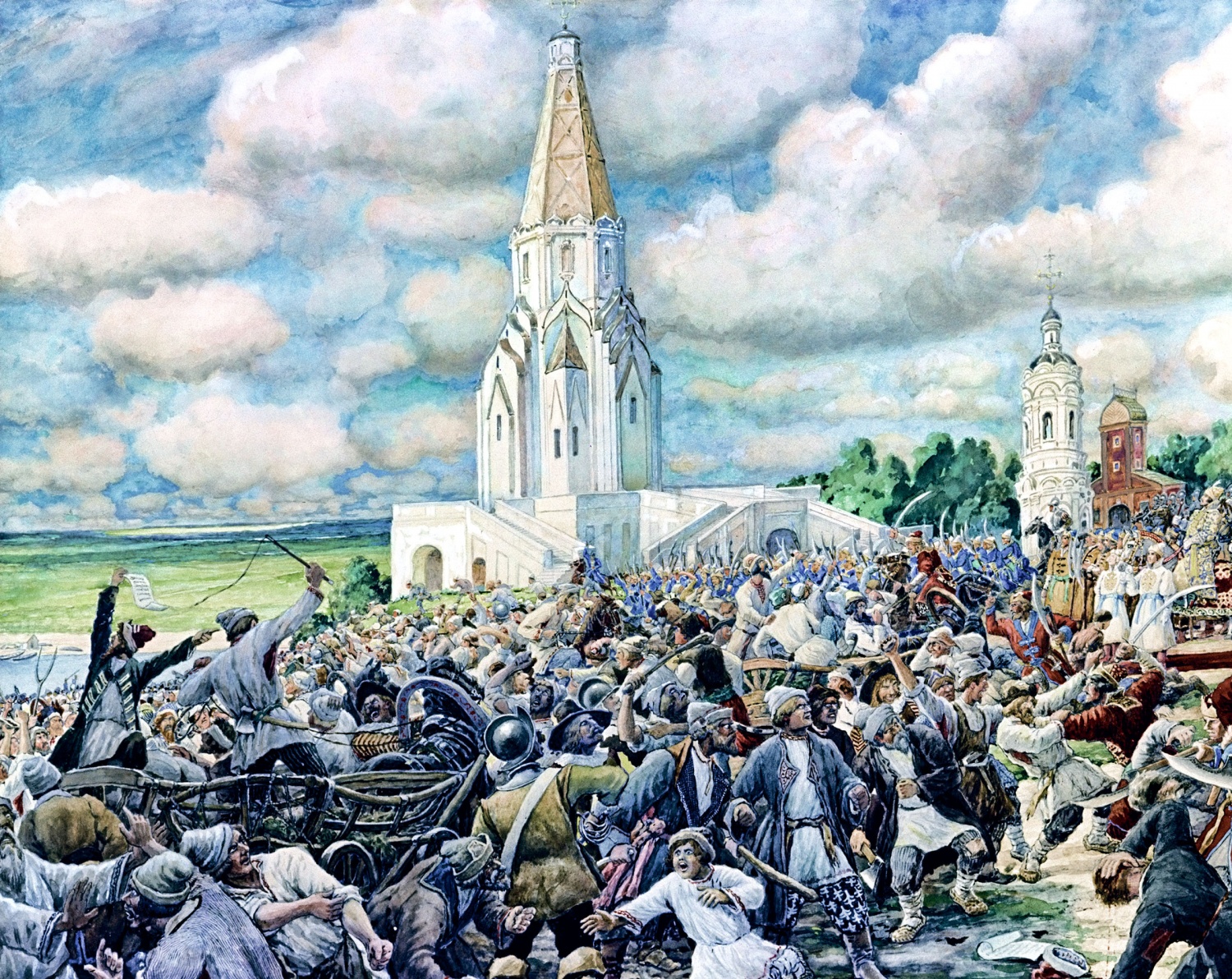
Ernest Lissner (1874–1941). "Copper Riot in Moscow 1662." Photo: RIA " * * News"
The traditional time of incidents and shocks in Russia is summer. The first major rebellion of citizens in the history of Moscow happened on June 26, 1547, at the very beginning of the independent reign of Ivan the Terrible. After a large -scale fire, the power in the capital for several days passed to an angry crowd, demanding immediate resignation and execution of the boyars of the Glinsky, relatives of the king’s king. So even the grandmother of the sovereign, Princess Anna Glinskaya, in his old age had to flee to Lithuania. The latter, however, was little reflected in the foundations of the autocracy - in the second half of his reign, Ivan the Terrible gained the glory of one of the most bloody tyrants in world history.
"Came and noisy"
Almost exactly 101 years later, on June 2, 1648, under the young Alexei Mikhailovich Romanov, the father of the future Emperor Peter I, Moscow people, mostly artisans, archers and the poorest citizens, brought to the rage of “strong people” - corruption, growth of taxes (especially for salt), self -confusion and enrichment of the head of the government of Boris Morozov and the enrichment of the head of Boris Morozov and His protege, the Moscow chief Leonty Pleshcheyev, began to smash the houses of rich boyars, killed several influential royal close people. And they would have killed more if some of them had not hidden in the chambers of the king. According to various estimates, about two thousand people died from a fire that flashed the next day. But if, following some historians, these events, called the "salt riot", and can be called "revolution", then in consequences - only conservative. After all, the Zemsky Cathedral, which gathered at the request of Street, adopted a set of laws soon, which finally established serfdom and unlimited autocracy.
The next time they “came and rustled” - this time on monetary grounds - July 25, 1662. Earlier, in winter, the first default in the history of Russia happened when, as a result of the unsuccessful attempt to replace silver money with the authorities with the copper course of the copper ruble to silver, fell to the mark of 15: 1. The power of Alexei Mikhailovich was quite strong: the state managed to get rid of only a demonstration opal of several minor officials. Support from Sagittarius and other “security forces” this time, unlike the previous ones, turned out to be one hundred percent. The “Copper Riot” was brutally suppressed - among the victims and the dead, thousands of people were.
On September 15, 1771, the so -called “plague riot” began - the last in a series of Staromoskovskiy unrest. The Orthodox community was then outraged by the behavior of the Moscow Archbishop Ambrose. Without an example to some current colleagues, he was an enlightened person and, during the erupted epidemic of the plague, forbade to apply to the miraculous icon, which, according to Muscovites, was supposed to save them. The archbishop rightly feared the further spread of the infection. He was killed. The subsequent three -day battles of government units with the rebellious Posad were personally commanded by Count Grigory Orlov.
"At the most difficult moments, the word" thief "in the head of a Russian person could not be combined with the first person of the state"
There is no one to complain
The most important difference between modern protests is the complete absence of the protesting tsarist sentiments. Typically, the prologue of the “Russian rebellion” involved the appeal of the people to the king with the petition, which should contain complaints about the “traitors-bear” and the demand for their execution after the “fair court”.
The king automatically stood over the fight, he personally, his chambers and everyone who was in these chambers, always remained inviolable. The rebels could burst into the Assumption Cathedral in 1547 and kill the uncle of the sovereign Yuri Glinsky there. Moreover, in 1771, the crowd did not cost anything to deal with Father Ambrose in the Don Monastery. But the royal palace always remained the Holy of Saints. The 16-year-old Ivan the Terrible, of course, was very scared and then recalled all his life how he granted his new residence in the Sparrow Hills with a demand to execute his close relatives. But the crowd did not even think of killing him himself. The maximum of insolence is to take the sovereign for the button during the conversation and then hit with him in the arms. This happened with Alexei Mikhailovich in 1662 during the “Copper Riot”, but it was worth pissing to the Streletsky regiments - and the tone in the relations of the people and the authorities changed dramatically.
The position of the “third party”, which is “higher than suspicion” and is not indifferent to anyone other than itself, almost automatically turned the Russian king into a political beneficiary of popular unrest. It is no accident that the absolute power of Alexei Mikhailovich, who, at the end of the reign, like his contemporary of Louis XIV, compared his own courtiers with the sun, originates precisely in the June uprising of 1648. Supposed to execute some, protecting and complaining others - only so the young king was able to gain subjectivity as a politician and ruler. There were no complaints about the sovereign and when he, by his own decree, tried to forcefully conduct the robber's exchange of old silver money for copper. The subjects then, as they say, did not even beg where and who actually deceived them. Folk rumor wrote everything to the counterfeiters, led by the main royal nobleman Ilya Miloslavsky, who allegedly began too many “left” coins. The authorities staged a demonstration struggle with counterfeiters, punishing the like lower and medium performers. The obvious fact that the minting of a copper coin began the state itself, that the “sovereign word”, in fact, was made fraud when copper was declared equal in value to silver - in the patriarchal Muscovy, all this turned out to be out of public attention.
At the most difficult moments, the word “thief” in the head of a Russian person could not be combined with the first person of the state. Even the antimonarchic performances of the beginning of the last century of direct attacks against the king’s person rarely contained. At the level of jokes - yes, but the public anti -monarchical requirement was the non -permanent "Down with autocracy!" In this regard, the slogan "Putin is a thief!" From the point of view of Russian history, it is almost unprecedented, with the exception of the last two decades. Current street protests indicate that at the beginning of the 21st century, a significant part of Russians still managed to overcome faith in a good king, who “will become like a word”, will punish bad corrupt officials and give an increase in the salary-this is rather from the repertoire of the missile rallies, where the authorities in the old fashioned way are driven by unmanned state employees and endowed with their own own "Feeding" of small service people.
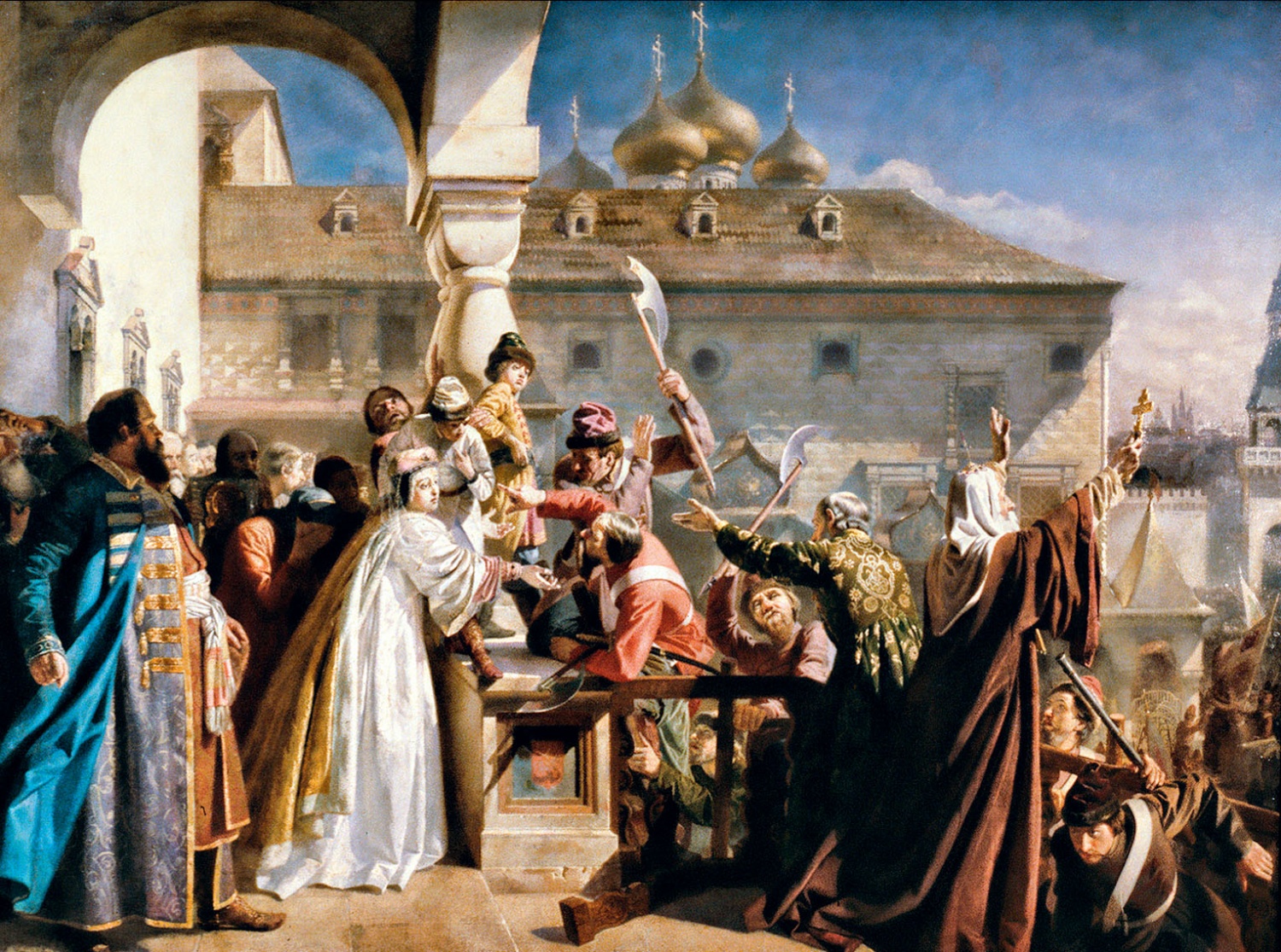
Nikolai Dmitriev-Orenburg (1837–1898). "Streletsky rebellion 1682." Photo: RIA "News"
Moscow festivities
In June 1648, the “salt riot” began during the church holiday: a crowd of citizens directly on the street tried to stop the royal motorcade in order to present their requests personally to the sovereign. The nobles who were traveling behind the king defiantly torn and threw into the face the petitions that stood along Sretenskaya Street, which was just accepted by the sovereign. Stones flew in response. Some of the royal servants soon had to pay for their noble rudeness not only with property, but also with life. On the same day, a merchant Nazariy Chistoy, who led one of the tax departments, was scored in his own house to death: his disfigured corpse was thrown into a cesspool. A day later, in the frontal place of the Moscow mayor Leonty Pleshcheyev, they was torn so that his head was turned into porridge. The action that began quite peacefully due to the inadequate reaction of the authorities, who used to accelerate the crowd of Sagittarius, turned into a pogrom. The unrest lasted more than six months and passed not only in Moscow, but also in Kursk, Solvychegodsk and other cities.
Each uprising was accompanied by murders-at first the crowd spontaneously crushed someone, then the authorities forced to give her someone to pieces or executed themselves, in order to reassure human anger. At the end of the uprising, the brutal reprisal was waiting for its organizers, participants and just accidentally turning up by the arm.
The unchanged companion of violence was robberies. After an unsuccessful petition, the rebel Posad made, as a rule, the following. Firstly, he publicly killed one of the high-ranking dignitaries. Secondly, he robbed the wealthy “thieves” from among the same dignitaries. Not much versed, by the way, which of them to which Kremlin group belongs. Thirdly, the sovereign warehouses took stormed by storming. And either this scenario managed to stop the troops loyal to the government, or the picture of a society that went crazy, completed the next large fire. The slogan “Breeded!” Later nominated by the Bolsheviks! He was quite traditionally Staromoskovsky. As the eyewitnesses of the 17th century rebellions from among the foreigners living in Russia, the rebellious citizens carried out of the boyar chambers everything they could take away. Some immediately tried to sell the loot for nothing on the street. Everything that could not be carried away was simply destroyed.
Wine, like blood, literally poured along the streets. Looking ahead, let's say that this was not only in the XVII century, but also in 1917. The German traveler in Muscovy, historian and geographer Adam Oleari described how, during the “salt riot”, Muscovites drowned in alcohol plowed with alcohol. By and large, the same thing, only on a much large scale, took place throughout the country in the fall of 1917: ruined wine warehouses, broken containers, crowds of drunk people on the streets, drowned and drowned in cellars - all this, according to many evidence, served as a household background of the October Revolution both in the capitals and in the province. (It should be noted that with all the attempts of the current official propaganda to accuse the rallies of rallies of violating public order during the mass shares, there was not even close to the mass actions. The fact that neither alcohol or pogroms are no longer associated with mass protests - one of the most important signs of colossal civil progress, which demonstrates today's spontaneous opposition in Russia.)
“The crowd crushed someone, then the authorities forced to give her someone to pieces or executed themselves in order to calm the human anger, and at the end of the uprising of the organizers and participants, a brutal reprisal was waiting for”
Russian Europeans
Today's Moscow students, middle -level managers, popular writers, journalists, civil activists, tens of thousands of those who went out and will take to the streets of their city - a fundamentally new phenomenon for their own country. And in appearance, and in behavior, and in the image of thoughts, they are already not much different from the citizens of the European Union. True, unlike the inhabitants of the Moscow German Sloboda of the 17th century, these Russian “Germans” have no other homeland and is unlikely to be. Therefore, they want their country to finally become the same part of the European order as neighboring Poland, Finland or the Baltic countries. These new Russians without quotes are the main support and the main participants of today's peaceful, European-free shares. So not similar to the familiar Murlo of the "Russian rebellion". They found internal forces to change and raise Europeans in themselves, at least with regard to their own life. But the state in which they live is still far from European values. This is still the same endless, stubbornly not wanting to change Muscovy, with the king and his “family”, boyar clans, the estate of the right of service people, the ostentatious luxury and arbitrariness of “strong people”, the slave, poverty and the misery of “ink”.
Will this new layer of strength have enough for, if not to win, then at least defend their right to exist in Russia - the subject of research of historians of the future. However, it is already obvious that if there is progress in Russian history, then it is not least connected with the civil protest that today's Moscow demonstrates.
First published in NT No. 25 (252) of August 20, 2012 .