
Translated material
We have, upstairs
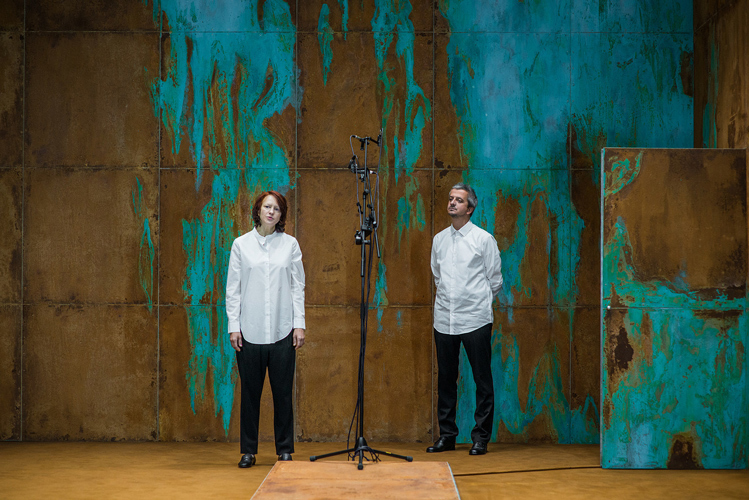
Among the sites accepting Konstantin Bogomolov, the electric power is more sharpened for the experiment; It is not surprising that the director created his most radical project here. The “Magic Mountain” echoes his Lithuanian masterpiece “My dad - Agamemnon” and the Lenkomovsky “Boris Godunov” , or rather, with their individual scenes. Nevertheless, this is the first performance, where Bogomolov completely refuses the narrative: his main plot is what is happening between the hall and the scene here and now.
The poster with the name of Thomas Mann is almost a draw. If in the Musketeers , free theatrical fantasy, almost in no way connected with Dumas’s books, the Bogomolov retained at least a set of characters, then here he did not need either the text or even the plot of the “magic mountain”. Only one detail directly comes from the novel, whose plot takes place in the Swiss tuberculosis sanatorium: this is an unsuspecting dry cough that you begin to hear, barely taking a place in the hall. You look around - it is possible to offer the patient a mint lollipop to the patient - but you do not see who coughs. Only a few seconds later do you understand that you have been inflated: the annoying sound comes from the speakers.
The time spent in the theater is not a real life, but rather a mechanical movement towards death.
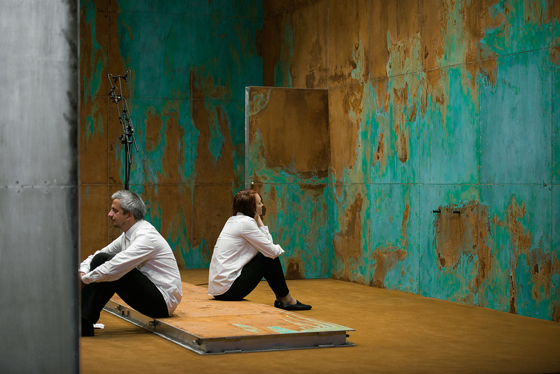
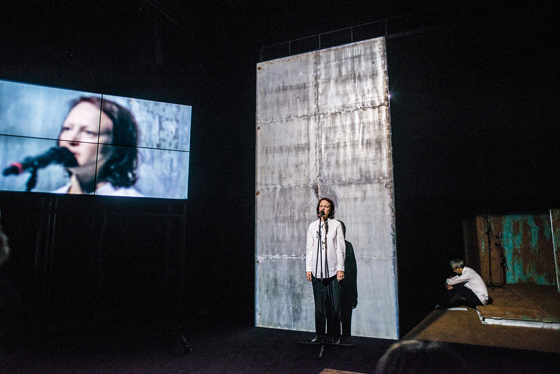
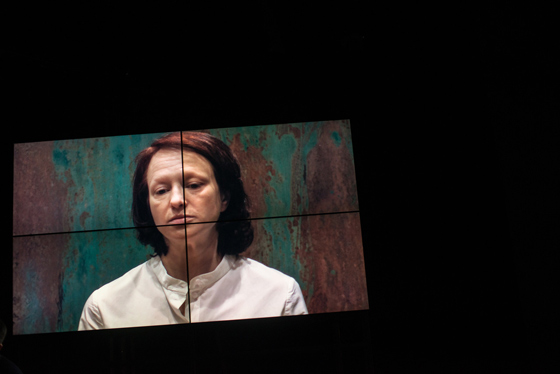
But with the start of action, the cough does not stop. “Magic Mountain” is the most chamber performance of Bogomolov, only two artists are busy in it: the director and brilliant prima of the electric theater Elena Morozova. Larisa Lomakina, the permanent scena of Bogomolova, built a close metal box for them, eating with rust (like a body - a disease, can not be noticed by a sensitive spectator). Out of an hour and a half, the first forty to five minutes in this box, almost nothing happens in this box: the director, hugging his knees, sits in the corner, and Morozova coughs-often and painfully. People in the hall also begin to cough - rather, involuntarily than on purpose: we will remember this very important circumstance. Every ten to fifteen minutes, the actress interrupts silence, goes to the advance and reads the landscape lyrics of the Russian poets-Nikolai Nekrasov, Nikolai Zabolotsky, Varlam Shalamov. And then again the torture begins with a cough.
 © Olympia Orlova / Stanislavsky Electrotheater
By the time the performance is sharply gaining pace, the most impatient manage to leave the hall. The director awards the remaining sabotage - five peppy sketches of his own composition. All the plots are about death: an interview with a brilliant musician who makes the audience listen to the silence, playing on the organ from corpses; Interrogation of a woman-mathematician who killed her young students, guided by the fact that the end is inevitable, and the best solution to the mathematical problem is the shortest; Buying an apartment with a view of the cemetery and so on. Bogomolov knows very well that good black humor is always more than humor: laughter is a reaction to an insoluble contradiction, so the comedy, paradoxically, is the best way to talk about death.
 © Olympia Orlova / Stanislavsky Electrotheater
To Tomas Mann’s “magic grief”, all this has more relations than it seems at first glance. The capricious theaters endlessly blame the unfortunate coughing spectators, but we must be the praying person in order to guess the theater with a tuberculosis sanatorium-and not with any, but with the Berggof from the Magic Mountain. The analogy, meanwhile, is very accurate: the patients of the Berghof, the prestigious high -mountain sanatorium, live in isolation, they have an atrophied sense of time, and practical skills are lost. In addition, they, just like the people of the theater, love to talk about their special situation: they say, “we have upstairs” - not like “on the plain”.
 © Olympia Orlova / Stanislavsky Electrotheater
While Bogomolov is drawn by a pause, and Morozov coughs around, involuntarily think that the time spent in the theater is not a real life, but rather a mechanical movement to death. The poems that sound between the pauses only strengthen this impression, because they talk about the opposite experience: the poet, observing nature, is extremely concentrated, every minute is performed for him. Mann wrote that the time rich in experiences flows very slowly, and boredom, contrary to the common opinion, makes him run faster. If you follow the director’s logic, it turns out that contemplation extends life, and the theater, its surrogate, is reduced.