
Translated material
Putin is against cryptocurrencies, as they breed scammers and terrorists, but in Russia they will create a system for regulating their appeal
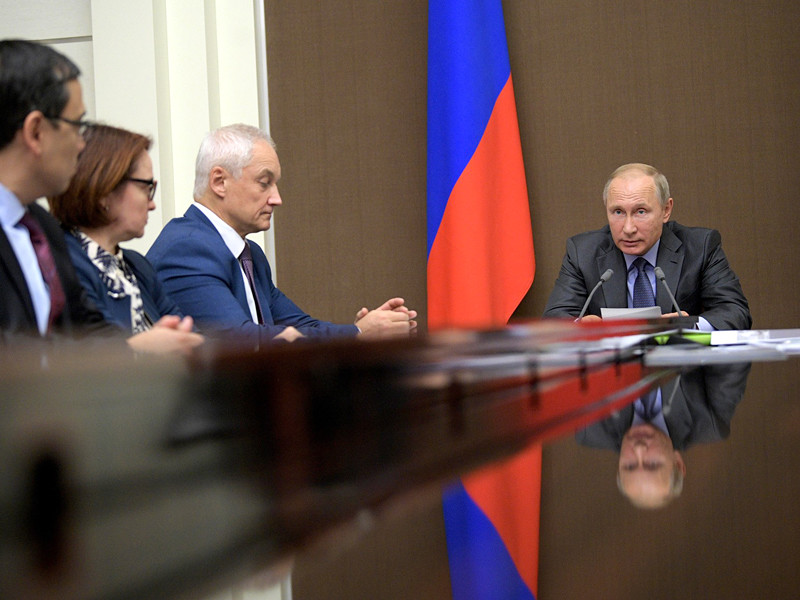
Russian President Vladimir Putin said that cryptocurrencies are creating the possibility of laundering of capital, tax evasion, financing of terrorism and disseminating fraudulent schemes. He made this statement on Tuesday, October 10, at a meeting on cryptocurrencies in Sochi, in which the assistant to the President of the Russian Federation Andrei Belousov, Minister of Finance Anton Siluanov, Chairman of the Central Bank Elvira Nabiullina, her deputy Olga Skorobogatova and CEO of QIWI Sergey Solonin took part.
The issues of introducing digital technologies in the financial and banking sphere are relevant for the whole world, since new opportunities are opened, the president said, proposing to discuss the application of cryptocurrencies in Russia, "referring to all versatile components of problems," RIA Novosti reports.
"Cryptocurrencies in some countries have already become a full payment, an investment asset. At the same time, the use of cryptocurrencies also carries serious risks. We know the position of the Central Bank, the chairman and I spoke several times on this topic," Putin said.
He listed such risks as "the possibility of laundering of capital received by criminal means, tax evasion and financing even terrorism and, of course, the dissemination of fraudulent schemes, the victims of which can be ordinary citizens."
Cryptocurrencies are produced by an unlimited circle of anonymous entities, their buyers can be involved in unlawful activities, moreover, there are no support for cryptocurrencies.
“In the case of a malfunction of the system or inflating“ bubbles ”, as it is fashionable to say now, there will be no legally responsible subject for them. This is such a serious thing that we must keep in mind, discussing this topic,” Putin said.
However, the President believes that in Russia it is necessary to establish cryptocurrency appeal, since it is necessary to "use the advantages that give new technological solutions in the banking sector, it is important not to heat up unnecessary barriers, of course, but to create the necessary conditions for further development and improvement of the national financial system."
Putin emphasized, “what is needed, based on international experience, to build a regulatory environment that will systematize relations in this area, to protect, of course, the interests of citizens, business and the state, to give legal guarantees for working with innovative financial instruments.” "It is known that many countries are looking for approaches to how to regulate the appeal of cryptocurrencies, they are just beginning to create the necessary legislative conditions, the legislative normative framework," Putin said.
In the discussion, whether to ban cryptocurrencies in the Russian Federation, they put an end to the state - the state will control their emission and appeal
Before the meeting, the press secretary of the President Dmitry Peskov said that according to its results, no decisions would be made. “You know that this topic actively appears on the agenda, cryptocurrency actually in many countries is already in use as a financial tool, but none of the countries still know how to reliably regulate this payment tool and the investment tool,” Interfax cited his words.
However, some decisions after the meeting were still made. As the Minister of Finance Anton Siluanov said, first of all, this is the decision that the state should take control of the issue and circulation of cryptocurrencies.
"The president announced the problems that are associated with cryptocurrencies. These are the difficulties of compliance with anti -wasching legislation and cases that are associated with the difficulties of identification. Therefore, they have agreed on the following - that the state needs to regulate the process of emission of cryptocurrencies, mining, process of circulation. The state must take this all under control," the Minister said.
He clarified that according to the results of the meeting, profile departments should begin to develop legislation legalizing the appeal of cryptocurrencies in Russia, regulating their mining, reports TASS. "I will not talk about specific parameters now, but overall agreed that the state should lead and adjust this situation at the legislative level," the head of the Ministry of Finance said.
Thus, as Kommersant notes, a point is set in the discussion about whether it is worth prohibiting cryptocurrencies in Russia. Responsible departments will develop regulation in this area, taking into account the risks voiced by the President.
Recall that the enthusiasm for cryptocurrencies grew in Russia since President Vladimir Putin met in June 2017 with Vitaly Buterin, the creator of Ethereum (ether), the second cryptocurrency after Bitcoin, and according to the first deputy prime minister Igor Shuvalov, Putin was completely "completely ill" with the digital economy.
In early September, the Minister of Finance Anton Siluanov said that cryptocurrencies are planned to legalize and regulate as securities and such a bill is expected by the end of 2017. He guarded that citizens of the Russian Federation can be allowed to this market through professional participants.
Nevertheless, opposition to the Bank of Russia can become an obstacle to the legalization of the cryptocurrency market.
The head of the Central Bank Elvira Nabiullin spoke out against the legalization of cryptocurrencies on September 14, calling them a financial pyramid that could collapse at any time.
Her deputy Dmitry Skobelkin, who met with representatives of the Chinese Central Bank, also warned about the pyramid scheme and emphasized that "China does not recognize the cryptocurrency as a means of payment", after which China declared the primary placement of cryptocurrency tokens, and the largest cryptocurrency exchange of this country reported closing .
On October 10, the Central Bank, together with the Prosecutor General’s Prosecutor General, advocated closing access to external sites that offer customers to purchase derivatives of cryptocurrencies. The Bank of Russia discusses the draft law with the Ministry of Communications, which will give the regulator the authority to introduce websites of organizations conducting illegal financial transactions on the Internet to the list of prohibited.
In early September, the head of Jpmorgan Chase Bank James Diamond called cryptocurrencies fraud, comparing the bought -by bitcoins with a b alsoy of tulips bulbs in the 17th century. After that, bitcoin and ether fell, losing 18.5 and 11 billion dollars of capitalization, respectively.