
Translated material
Nematode-Set

Material benefits in this world are unevenly distributed, and animals, in order to provide themselves with them, are twisted as they can. The tiny soil nematode Caenorhabditis elegans , one of the favorite laboratory objects, expands its feed base, the dummy bacteria, which then eats.
C. Elegans inhabit mainly rotting organics, where there are a lot of bacteria. Such resources are quickly depleted, so nematod populations are subject to sharp fluctuations in numbers. In search of food, worms are forced to constantly move, looking for rich hunting grounds. However, as the specialists of Princeton University showed, C. Elegans can make their habitat more homogeneous [1].
In the center of the Petri cup with a dense nutrient medium for the growth of bacteria, the researchers have grown a small round lawn of Escherichia coli intestinal stick. Next to this lawn, one nematode of the standard laboratory strain N2 was placed. Over time, the cup began to appear, and then the new colonies of the Escherichia sticks began to disappear. Since the bacteria themselves are devoid of mobility, the researchers concluded that they are tolerated by the worm. For the convenience of observing the E. COLI was marked with green fluorescent protein, and it turned out that worms contribute to the formation of new colonies in two ways.
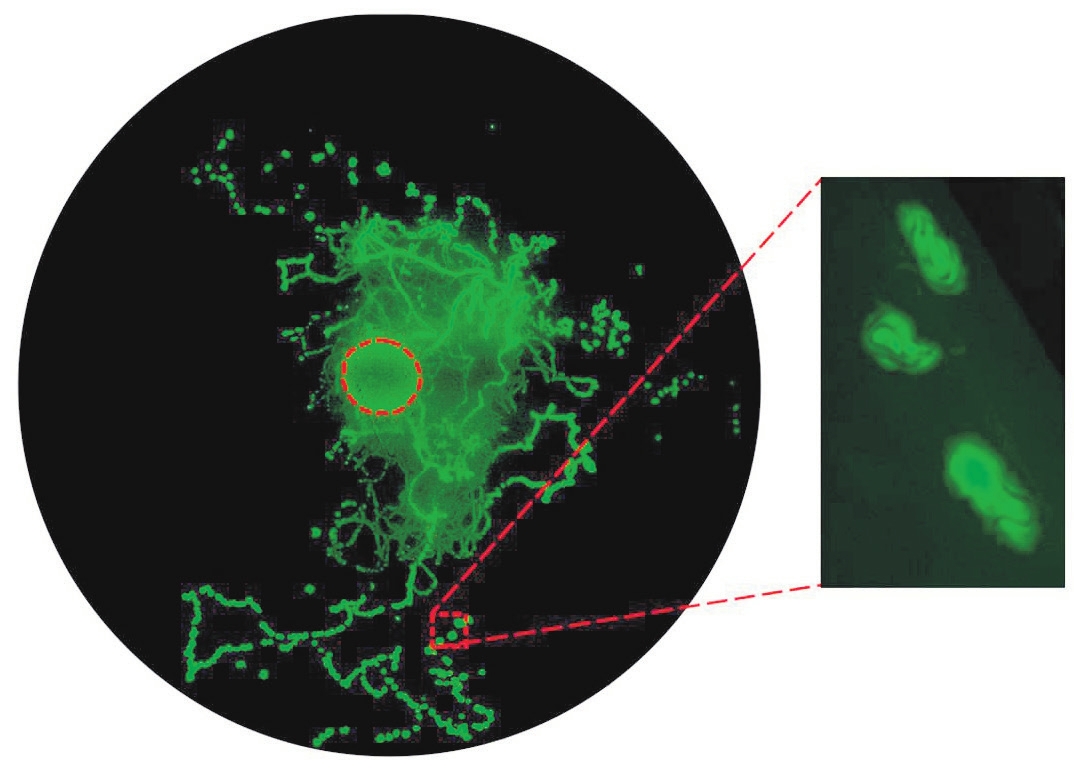
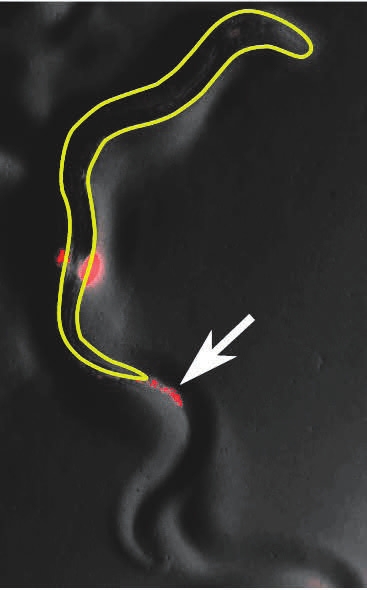
Rubbing bacteria in a cup, worms N2 reduce the density of the original colony and contribute to the formation of smaller ones. Such colonies are growing faster, since nutrients are more affordable for them. Such behavior can be called bacterial farm. The consumer (nematode) actually dilutes bacteria, improving their access to nutrients, thus contributing to the growth of their number and getting their advantages from this.
Alas, there will always be the twisters of other people's crops and herds. Not all C. Elegans is able to business. Researchers repeated the experiment with nematodes mutant in the SRF -3 gene. The mutation changes the properties of the covers of the worm in such a way that bacteria do not stick to them. SRF -3 worms move through the cup no less actively than N2, but bacteria are practically not tolerated. These differences affect the dynamics of populations of different strains: under the same conditions, the number of mutants is growing slower. If you provide the SRF -3 worms of the same area as N2 sow, mutants will actively multiply. Thus, the advantages of N2 are explained precisely by their farming.
The experiments showed that in a mixed population, mutants use the fruits of labia N2 to the same extent as the farmers themselves. On a cup with bacteria there is no spatial separation between hard workers and parasites, and their number grows the same. Farmers do not even interfere with the energy costs of breeding bacteria. True, the laboratory of large costs is not required, but in natural conditions the situation is different. There are not only edible bacteria in the soil, but also other microorganisms pathogenic for nematodes. Thus, farmers, setting bacteria, run the risk of getting infected and dying. Non -alpine mutants are more resistant to pathogens. The second problem of farmers is active food behavior, which prevents the reproduction of enough time. Scientists observed the consequences of this behavior in the laboratory. If you sow the colony E. COLI in a cup of larger diameter - not 9, but 15 cm - worms N2 settled bacteria over the entire area of agar. The number of Escherichia sticks increases markedly, the number of nematodes doubles. However, the value of 15 cm turned out to be critical for worms. On this area, the number of their population is maximum, with a further increase in the radius, it falls: in nematodes engaged in the study of accessible spaces, the birth rate is reduced.
The mathematical model developed by researchers showed that the presence of pathogenic bacteria and an active examination of the elaborate territories reduces the number of farmers compared to the situation when the area patrolled in search of food is small. In such conditions, in a mixed population, mutants receive advantages, who are less likely to get sick and who, at the same time, get the fruits of farm works for free. However, in a homogeneous population consisting of nematodes of one phenotype, farmers still reach a higher density than mutants.
WITH . Elegans and E. Coli - well -studied laboratory objects. The relationship between them is represented, according to scientists, a convenient model for studying similar processes in more complex systems. For example, the discovered patterns resemble scientists with seed spread and infection. Experimentally exploring these processes is difficult and long. And the “Nematode - Bacteria” system will quickly check the associated hypotheses. Researchers even draw a parallel between C. Elegans and the first farmers who carried the collected seeds to their settlements, waking up along the road, and over time, more and more wheat coloned along the favorite paths of people and next to their houses. Beautiful analogy.
Natalia Reznik
1. ThuPalli S., Uppaluri S., Constable G., Levin S., Stone H., Tarnita C., Brangwynne C. Farming and Public Production in Caenorhabditis Elegangans Populations // Proc Natl Acad Sci USA.2017. 114. 2289–2294. DOI: 10.1073/pnas.160896114
2. Www.pnas.org/content/suppl/2017/02/09/160896114.dcsupplemental