
Translated material
October has already come

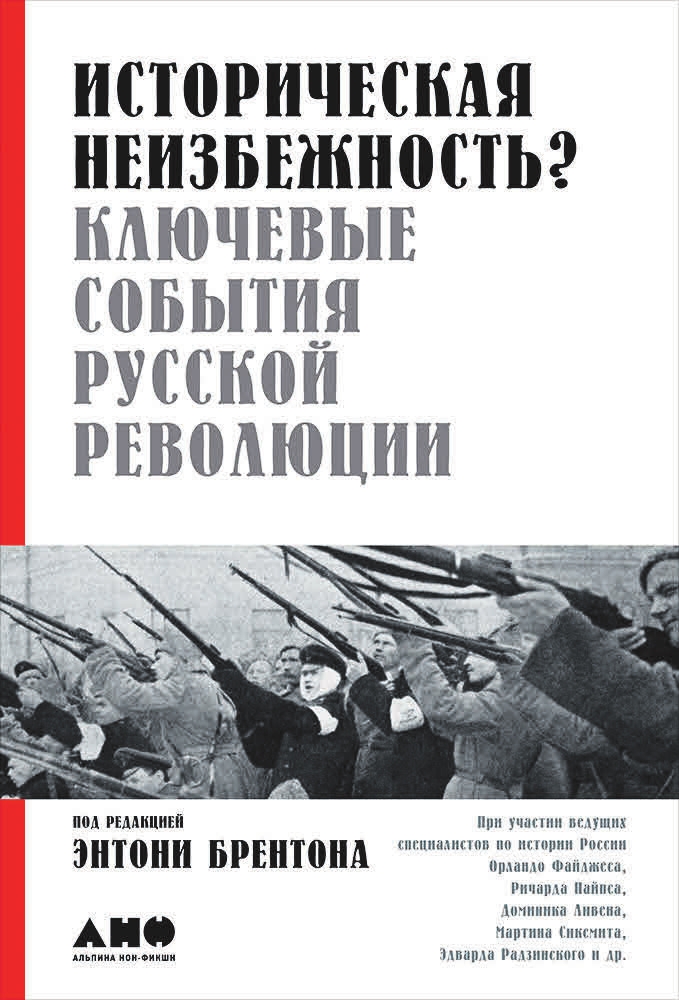
By the centenary of the event, which was called the Great October Socialist Revolution in a past life, and now the left is still called, and the rest-in different ways, the book “ Historical Inevitability” published in the Alpine Non-Fix? Key events of the Russian Revolution . " He showed the initiative, compiled and edited the collection of the former ambassador of Great Britain to Russia Sir Anthony Brenton.
With a feeling of deep understanding and sympathy, I read in the preface that Brenton spent a lot of time thinking about the key question of the Russian revolution: “What was it?” To answer this question, he invited professional historians to play an alternative story. According to the terms of the game, the authors in their texts answered (each in their own way) to the question whether the story could go on a different path at one of the chosen moments. This is a risky method of historical research, because it requires the scientist of the highest qualification, imagination and strict honesty. It is impossible to dry your beloved heroes or disguise unloved - the whole meaning of the game is lost. Because there is no victory in such games, you can only show the beauty of the game. This is a completely Castalian venture - useful and interesting.
 No one knows better than professionals that history happens once. It is irreparable, irreversible and non -alternative. But there is no predestination in it. The game makes it possible to grind all the cubes again and evaluate all the figures, weigh every chance again, take into account all the possibilities and at a different angle to see the reasons that led to the revolution.
“To believe in the inevitability of all historical events is a fatal error. This does not just contradict the facts, but also leads to moral decline and inaction in politics, ” writes Dominic Liven, senior researcher at the Trinity College (Cambridge) in the first chapter.
The project was performed by the forces of authoritative English -speaking historians and Edward Radzinsky, who, as usual, spoke on the salvation of the royal family. The epigraph is expected: “... a Russian riot, meaningless and merciless,” - however, related to the uprising of Pugachev, but they have a habit of applying to the rest of the periods of Russian history.
The book is 14 chapters. They, in chronological order, describe the history of the Russian revolution from defeat in the Russian-Japanese war and the events of 1905 to the death of Lenin in 1924. Among the heroes of the book are Stolypin, Rasputin, Nicholas II, Lenin, Kerensky, Stalin, Trotsky ... This approach resembles a stack of instant pictures - there is a genre, a portrait, a landscape. You can consider the pictures sequentially, you can - aton -free. The texts are self -sufficient. The word "inevitable" is repeated in every chapter with topics and variations.
The authors performed the idea of the editor in different ways. “Some led us along the way, very excellent from the one that the story ultimately went. Some focused on those points when the role of the incident was unusually large and even a slight change in circumstances could lead to a completely different historical result. Some talked about the incidents and misunderstandings that led to a certain result, allowing readers to reflect on how it could be. Others analyzed the widely advertised alternatives of the path along which the events ultimately went, only in order to conclude that in fact, not one of these alternatives was very likely. All these approaches, it seems to me, work, ” writes Brenton.
For the domestic reader, the Russian revolution is an obligatory part of the family history, regardless of what class the ancestors came out of. There are no indifferent. The victims prevail. Everyone craves justice and finds out who is to blame. “Historical inevitability?” Of course, does not answer all painful questions. It makes it possible to see the Russian revolution from the side - the eyes of well -mannered Europeans. And horror splashes in these eyes. All authors are united by this feeling. It is connected with the understanding that the Russian revolution is a key event of the 20th century. Everything that happened later was the Second World War, the Cold War and even perestroika - only the consequences of those days that shocked the world.
Until July 17, 1918, many decisions in the course of the developing Russian revolution were made by Emperor Nicholas II. It is mentioned in many texts. The Russian monarchy remained absolute to the end, and all the decisions - whether to join the war, to whom to command, to gather, to gather the Duma, who will be the next emperor - were accepted only by Nikolai. In the article “The Last Tsar”, Donald Crawford describes in detail the actions of the emperor and the events of February-Marot 1917. From this text, it follows inevitably that Nicholas II has made catastrophic decisions sequentially sequentially. He even renounced in such a way that a constitutional crisis began in the country. Any power was illegitimate. From his own diaries and memoirs of contemporaries it follows that the last emperor did not even understand what he did. Chaos came.
But the Bolsheviks were not confused. So far, intelligent and responsible people, like Rodzyanka, Milyukov, Guchkov, Nabokov-father, Prince Lviv, were horrified by what was happening, the Bolsheviks took the soldiers who did not reach the front, the sailors of Kronstadt, who always loved to wake up, unemployed. By March 1917, about 150 thousand people were fired from the Putilov factories. And they were all unhappy and were already sagitized against the old order.
The text of Sean Makmikin “Lenin goes to the stage” is decorated with a quote from Winston Churchill, where the British prime minister calls the leader of the Russian revolution “bacilli of the plague”, which the Germans delivered from Switzerland to Russia in a sealing car. The propaganda of the Bolsheviks was carried out with German money. Berlin’s calculation was simple: if mass riots begin in Russia, then it will leave the world war faster. So it in a certain sense turned out. The Theobald von Betman-Holweg, the Chancellor of Germany, and allocated 5 million marks in gold to the return of Ilyich and the beginning of the activity of Germany. The question of what would happen if the German office had not given money, is not considered in the book.
If you read the entire book in a row and entirely, it seems that individual heroes could once act differently, but the combined actions of different characters inevitably led to a disaster. From this it becomes somehow uncomfortable.
Ekaterina Buz