
Translated material
Trillion for pins
Duties for Internet purchases and other minor budget tricks for 2018–2020
Photo: postpredstvo15.ru
The budget for 2018–2020, which until November will be discussed in the State Duma and the Federation Council, fulfills the main promise of President Vladimir Putin: taxes will not be increased before the new presidential elections. Moreover, and after the election, the Tax Code will not change - in 2018 no one even encroach on the VAT rate, the question of increasing which was considered almost resolved six months ago. So far, this is not necessary: almost invisible body movements in 2018–2020 are planned budget revenues by more than trillion rubles. For minor inconvenience, such as the threshold of duty-free purchases in online stores in € 20, and this tricky arithmetic is worthwhile, which together redistributing additionally about 100 rubles. for each citizen of the Russian Federation per month.
Commentary on comments
The federal budget is a topic that is almost impossible to comment seriously. This is exactly the case when individual details do not create the paintings on their own and do not allow us to judge what is happening as a whole - but the principles of budget policy demonstrate exclusively reliably.
Typically, the fall of each year is full of comments on the budget of three types.
Comments of the first type are based on aggregated budget indicators: “In two thousand such a year, the costs of defense have grown in comparison with the previous year and decreased for education.” As a rule, if these comments say something directly-they are more or less far-fetched: the factors that affect these numbers are dozens, and in the budget classification of the Russian Federation, expenses, for example, on the repair of schools, are never considered expenses for education.
And after the election, the Tax Code will not change - in 2018 no one even attaches to even the VAT rate, the question of an increase in which was considered almost resolved six months ago
The second type of comment is assumptions about who and how much federal money will steal. He, too,, as a rule, has a minimum of reality. Corruption in the Russian Federation is a system -forming phenomenon, a private consequence of this is the fact that only very archaic and non -systemic clans of corrupt officials, usually medium -sized, know that they intend to steal. For the rest of the corruption in the Russian Federation, theft of budget money is a process and lifestyle, so the amounts of the stolen is not only planned, but often simply not calculated in advance: why? Corruption is a relationship, it is a business, but the money received during its course is only one of the dimensions. No serious businessman will seriously calculate, “how much does it cost”, although Forbes will not without curiosity look into the list. A serious corruption in his own eyes is the same. Finally, the third type of budget commentators are interested in the volume and directions of budget redistribution of money removed from the economy: this is quite far from the needs and business and ordinary person, but gives a more adequate idea of how the state through the tax system in the future will make distortions in the development of markets and society.
Where does the money come from?
A feature of the budget for 2018–2020 is the firm promise given in 2013 back in 2013: taxes in Russia will not increase in this political cycle (that is, until 2018). In the theory, the increase in taxes since 2018 has not violated the spirit given by the president publicly: the most part of the next year will have to be in the elected period. But in the package of budget bills there really are no substantial amendments to the Tax Code, and tax rates are determined by them. Moreover, even with a slightly more close consideration, one can come to the conclusion that taxes in the Russian Federation, according to the draft federal budget, are even reduced in relation to GDP. Suppose, it is really reduced - for example, Rosneft will receive new tax benefits in 2018 for the development of Samotlore, the oldest large oil deposit. Moreover, a serious increase in tax collection (recall that you can leave them) is not inherent in the budget. But how can I increase the tax burden for the rest of the economy without changing anything in essence?
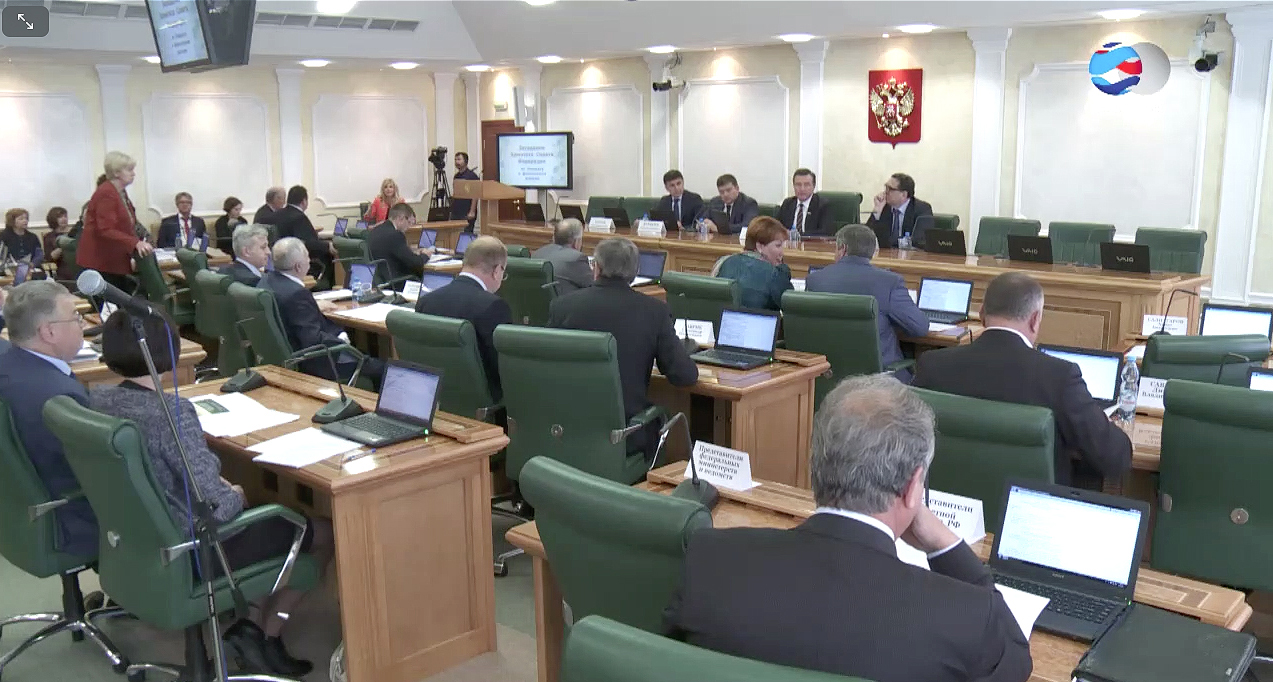
Meeting of the Federation Council Committee on Budget and Financial Markets, September 25, 2017. Photo: budget.council.gov.ru
An inconspicuous application to budget No. 2, an explanatory note to the draft federal budget “Assessment of the amendments of the federal budget revenues in 2018–2020 in connection with a change in legislation” gives only part of the answers on how this is done. But sophisticated tricks are clearly visible from it, to which the government resorts to increase tax redistribution. Moreover, very considerable: in the amount of the sign of Appendix No. 2, which the specialist only notice, talks about additional revenues to the budget for 146 billion rubles. In 2018, for 204 billion rubles. In 2019 and 563 billion rubles. in 2020. This is a “additive” to budget revenues that would have developed if the legislation had not changed: in the amount it is even more than a trillion rubles, since part of the changes are negative, these are the amounts that the budget is ready to lose in the coming years.
The first part is a change in tax and budget legislation that does not affect the actual taxes. In 2018 alone, the budget will receive 54 billion rubles from them. The largest amount of additional revenues is excise taxes: formally it is not taxes, but by raising very slightly (by 50 kopecks per liter from January 1, 2018 and another 50 kopecks from July 1), the state will receive 25 billion rubles. Almost out of nowhere will it be able to at the same time transfer income equivalent to a new additional excise tax on diesel fuel in 1 rubles. from a liter.
Another 12.6 billion rubles. It will be obtained from “changing the procedure for determining the unit of conditional fuel and the corrective coefficient used in the calculation of NPPs when mining fuel and gas condensate” - in general, this is an additional tax on Gazprom: these amounts will easily return to the gas monopoly on the gas supply chain on the free sector of the energy market, and the consumers of electricity will pay for this. Finally, 16.5 billion rubles. They are formed in 2018 due to “expanding the determination of average distillates at the vacuum gas-sail fraction”-this, if you do not understand by ear, and this is sacred to understand, the struggle with the refinery that discovered in 2016-2017 the opportunity to save on taxes a little. The refineries are unlikely to avoid the temptation after this to make a good profit on consumers, this business is already low -hearted.
The largest amount of additional revenues is excise taxes: formally it is not taxes, but by raising very small (by 50 kopecks per liter from January 1, 2018 and another 50 kopecks from July 1), the state will receive 25 billion rubles. Almost out of nowhere
Well, on trifles. A new differentiated excise range for cars with an engine of above 200 hp. He will give the budget in 2018 14 billion rubles. - We can consider this a new tax on luxury, although we do not introduce new taxes.
Another 33 billion rubles. The federal budget will receive from the redistribution of income tax from the gas project “Sakhalin-2”-now 75% of the collected will go away in favor of the center, while earlier than 15%-to the center, and 85% to the region. Big money entering Sakhalin’s budget at one time played a decisive role in the presence of the defendant Khoroshavin, the ex-governor of the region, a collection of jewelry written supplies from noble metals-and nobody liked this in Moscow.
If you make all taxes to taxes, it turns out more than 200 billion rubles. In 2018. However, Appendix No. 2 is not only about the newly received income, but also about the refusal of the state from some income. So, in the form of extension of VAT benefits for 2018–2020, 31 billion rubles were donated to air passengers. -Apparently, in order not to repeat the incidents similar to “VIM-Avia”. Tobacco concerns of Russia and smokers, the transfer of the terms for increasing tobacco excise taxes will not be removed by the state from them in 2018 16.7 billion rubles. Therefore, the total cost of changes is 150 billion rubles.
A new differentiated excise range for cars with an engine of above 200 hp. will give the budget 14 billion rubles. next year - you can consider this a new tax on luxury
The second part of unexpected income is provided with “other changes in the legislation of the Russian Federation and regulatory legal acts of the Government of the Russian Federation”: these are additional income for 92 billion rubles. Here, in general, all about things that are not directly related to taxes, but perfectly placed on the shoulders of consumers.
28 billion rubles. In 2018, it is planned to get from the “introduction of utilization fees for the means of production at an adulonic rate of 7%from 2019 from 2019” from the sounding from 2019. ”
23 billion rubles. will be obtained from an increase by 15% of the rates of utilization fee for cars. 10 billion rubles. - From the abolition of benefits for the import of “industrial products of investment engineering industries” to Russia: for a wildly sounding term “investment engineering” there is a sluggish attempt to protective customs duties on imported machines and production lines. 5 billion rubles. - From the increase in fees for the use of radio frequencies in Russia by 25% - this is not very large, but an increase in the prices of honeycomb communications.
Now everything that you buy in the amount of less than € 1 thousand is not subject to duties, from July 1, 2018 it will be taxed. With a high probability, customs duties will be collected when buying by the bank itself. They are small - from 5-10% for clothes and electronics
Internet purchase tax
It is in this list that “lowering the threshold of duty -free import of goods by individuals to € 20, starting from July 1”. We are talking about fifty-fold reducing the threshold for purchases in foreign online stores: now everything that you buy there in the amount of less than € 1 thousand are not subject to duties, and will be taxed from July 1, 2018. With a high probability, customs duties will be collected when buying by the bank itself. They, the right word, are small - from 5-10% for clothes and electronics. Given that the main problem that causes the growth of purchases in foreign online stores is the extreme stupidity and greed of Russian online stores, this measure to lobbyists will not really bring changes. And, perhaps, it will even make life easier - Amazon will finally understand that in the place called Russian Federal, a lot of things want to buy and send goods to Russia is legally, and not the “gray zone”. This operation should give the budget in 2018 30 billion rubles. - Not a lot and not a little. Consumers will go a little - but if it is convenient to pay, they will pay, in fact this is a penny. The creators of Russian online stores will be a little happy-they will not yet understand that the difference of 5% of the customs duty among foreign competitors does not save their business, based on three to four times the overestimation of purchase prices. He will receive a little budget: you have to feed the newly acquired Sevastopol for something? He refuses to feed himself, he is a city of naval glory of Russia, and not some Penza or Kurgan there.

Photo: kr.wsj.com
And in general, nothing special is found in the “Appendix No. 2”. In total, the changes in the tax burden by steady-this is 0.15% of GDP in 2018, 0.2% in 2019 and 0.51% in 2020-any favorable fluctuation in oil prices will give the government more. Yes, and there is no need to tease geese, increasing taxes, it is easier to act exactly as described.
And do you think that there is one application in the package of budget bills? As if not. There are 313 of them today. Environmental fees, investment tariffs of ports, subtleties of accounting in energy companies ... In general, while you read these applications, not only the March 2018 elections will be held, but the whole future summer. There is already the next budget, and three more hundreds of new inconspicuous applications. After all, trillion rubles, indeed, is not such a large amount for a large economy. And tax rates are so, while it can be left alone: after all, people do not love when they are increased.
And do you think that there is one application in the package of budget bills? As if not. There are 313 of them there today. Environmental fees, investment tariffs of ports, subtleties of accounting in energy companies