
Translated material
A bright flash of a new star was seen in a small Magellan cloud
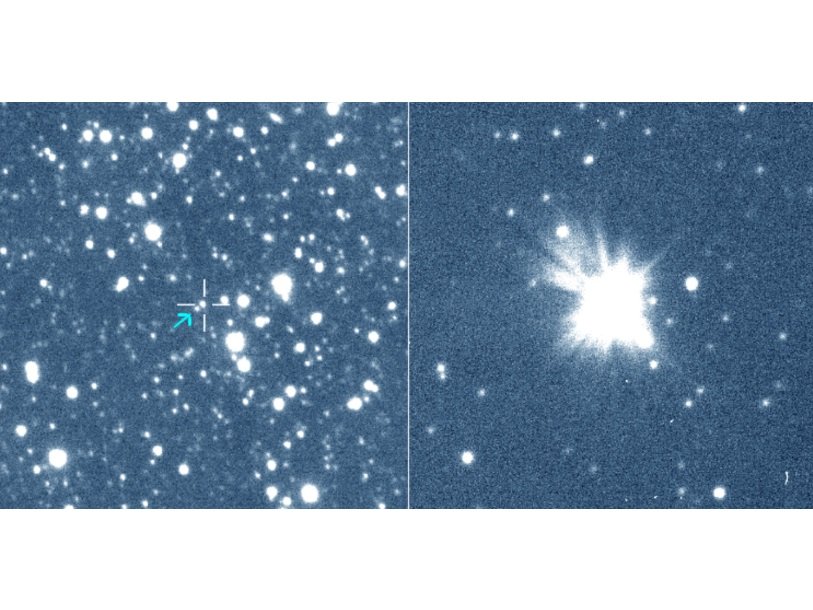
In the small Magellanic cloud, the galaxy-satellite of the Milky Way, the astronomers found , perhaps, the brightest flash of the new star.
The new in astronomy is called stars whose luminosity suddenly increases by thousands or even millions of times. Such stars are close double systems consisting of a white dwarf and the star of the main sequence (similar to the sun). Their orbital period is only a few hours. During their evolution, the substance continuously flows from the companion star into a white dwarf, forming an accretion disk around it. The substance of the disk is inhibited due to friction and gradually settles on the surface of the white dwarf. Gradually, the temperature and density of the surface substance in a white dwarf increase so much that nuclear reactions of helium synthesis begins in it, which, due to the high density of the substance, proceed with great speed. In fact, a thermonuclear explosion occurs on the surface of the white dwarf, the star shell is dumped, which is observed by astronomers in the form of a new outbreak. After the outbreak, the accretion of the substance from the companion star can be continued, which after a certain time leads to another flash.
In our Galaxy, the Milky Way is about 35 new per year, but in the small Magellanic cloud the first time the outbreak of the new occurred in 2012. The current new one was discovered on October 14, 2016 and received the SMCN 2016-10A designation. Using the SWIFT orbital observatory and a number of ground telescopes, a group of scientists found that SMCN 2016-10A turned out to be the brightest new, discovered in the small Magellanic cloud, and one of the brightest that have ever been observed in any galaxy.
Data on radiation in the X -ray range indicates that the mass of a white dwarf, which has become a source of flash, is close to the maximum and further intake of the substance from a neighboring star can lead to an explosion that the white dwarf will destroy, that is, an explosion of supernova will occur instead of the new one.
The study will be published in Monthly Notices of the Royal Astronomical Society, the preprint is available on the Arxiv.org website.