
Translated material
Pre -election. Generosity to the regions
Thirteen regions of Russia will receive half of the subsidies allocated by the Ministry of Finance for 2018, to equalize budgetary security. According to the RBC news agency, referring to the materials to the federal budget for 2018–2020, it is expected that 645 billion rubles will be allocated for this type of subsidies in 2018.
This is 5% more than in 2017, and Dagestan will receive the largest volume of subsidies (more than 59 billion rubles, 6.6 billion rubles more than this year). In second place in the volume of subsidies will be Yakutia (and it will have a greater increase in volume: in 2018, she will be transferred 43.9 billion rubles, which is 7.3 billion rubles more than in 2017). In third place in terms of subsidies, according to the media, the Kamchatka Territory will be (it will receive 39.3 billion rubles).
The five recipients of the largest subsidies will also include the Altai Territory (27.1 billion rubles) and Chechnya (27 billion rubles).
By the way, at the end of September, the head of Chechnya, Ramzan Kadyrov, called for increasing the amount of subsidies to align the budget of the republic, taking into account high birth rate in Chechnya. He wrote about this on his Instagram and informed reporters following a meeting with Deputy Prime Minister Dmitry Kozak.
 River Kadyrov dances / choiz.me
“This is an increase in expenses for the social sphere - healthcare, education and others, which must be taken into account when calculating subsidies for leveling the budget,” Kadyrov explained. Kozak, according to Kadyrov, assured him that the authorities of the republic "would provide comprehensive support and assistance."
Sergey Kheestanov agreed to talk about the principles of allocation of subsidies with “Polit.ru”, associate professor of the Department of Stock Markets and Financial Engineering of the Faculty of Finance and Banking (FFBD) of the RANEPA, macroeconomics of the General Director of the Otkritie Broker company. According to him, in the issue of highlighting subsidies, the term is determined by the proximity of the moment to the elections.
“It's no secret that the distribution of income in regions is extremely uneven. There are several rather wealthy regions-the same Khanty-Mansi district, the Tyumen region-and there are a significant number of regions that are subsidized. Moreover, it is interesting that it is strongly dotable, that is, those who have a significant fraction of the budget are formed by subsidies, also relatively few.
Typically, the generosity of the federal center in the transfer of budget transfers to regions increases immediately before the elections. Accordingly, the present is no exception: it remains relatively a little time before the presidential election, and the decision of the federal authorities to increase transfers to problem regions is quite logical.
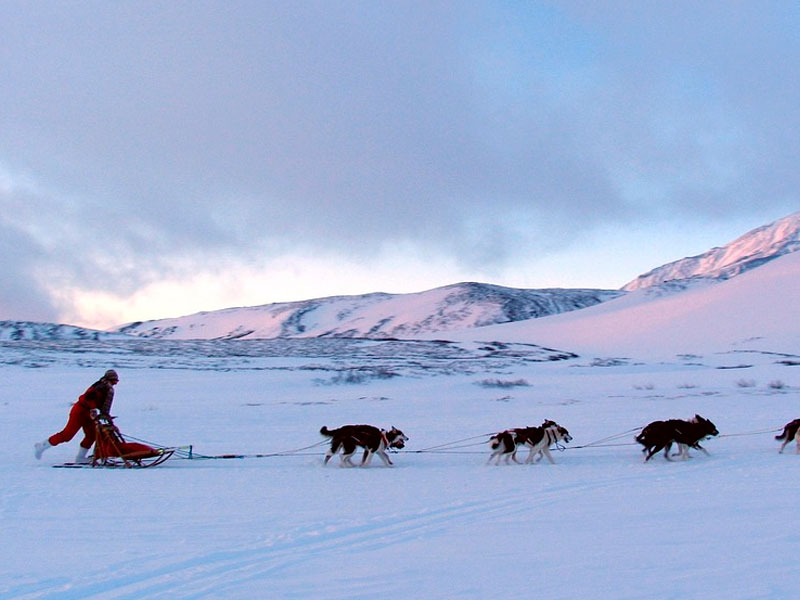 Kamchatka. Dogs in the harness / pixabay.com
Most likely, an increase will really be, and on average it will not be very large-somewhere around 5-10%. But for individual regions - such as Dagestan, Chechnya, and maybe the Kamchatka region - most likely, the increase will be significant. And such a policy, when the generosity of the federal center increases before the elections, in general is traditional: it has been observed for several years, even, one might say, not the first decade. This is a purely cyclic decision, connected, as they say, "with an electoral cycle."
By the way, this is known not only in Russia-a similar policy is characteristic of most countries, somewhere to a greater extent-to a lesser extent. Almost always - provided that the ruling party or its representative expects to defeat the elections - before the election, the generosity of the federal authorities increases. When the elections pass, everything returns to its own circles. This is quite traditionally in the world in the world, statistics on this subject have decades.
So, we are not talking about systematic subsidies in order to improve the situation in economically weak regions - this is precisely a separate measure related to the elections. The fact is that we have long for a long time (I even find it difficult to remember exactly when this happened) there was a redistribution of income in favor of the federal center. That is, most of the taxes that are collected quite efficiently and are not much dependent on the economic situation are entered the federal budget. And in local budgets there are just those taxes that are very dependent on the economic situation: this is part of the income tax, some property taxes.
It turns out just as in the fable about the bear and the man about the tops and roots: the “appetizing” part, as a rule, goes to the federal center, and the local authorities remain income that either fall strongly or those that are difficult to recover quite. The same transport tax, for example - it causes great indignation. We remember that there were serious protest performances in Kaliningrad, because of which this tax had to be reduced (by the way, the then governor of the Kaliningrad region paid for this).
In a word, the regions are left by those taxes that are either difficult to recover, or they are very falling into a crisis, and the center depart much more stable. Moreover, this redistribution occurred, in my opinion, even before the cancellation of the elections of governors-and it actually strengthened the financial vertical of power. Well, since this happened for a long time and the economy has already been adapted to this in one way or another, what we see now is precisely the decisions related to the elections, ”said Sergey Kheestanov.
Answering the question of whether there should be any changes in the income redistribution system, he expressed the opinion that there is no reason for such expectations: “Is it to expect changes in redistribution? Why? Everything is happy with everything, so, it seems to me, there are simply no slightly rational arguments in favor of such changes. ”
Speaking about the regions that can become the recipients of the largest subsidies, and commenting on the regions called RBCs, Sergei Kheestanov noted that the allocation of more significant subsidies to the specific territories is understandable, and called the likely criteria for which such regions may be taken away.
“Dagestan will probably become such a region. This is due, on the one hand, with the fact that it is a strongly subsidized, a large share of its budget is formed from subsidies; And on the other hand, it is significant in terms of the possibility of deterioration of the situation. The list usually includes Chechnya; Of the remote regions, in my opinion, the Kamchatka region will enter.
The media talk about Yakutia? It may also well be: there were difficulties with communal infrastructure, and perhaps the region went towards the region based on this circumstance. Because there, especially in the winter, any communal accident threatens almost a disaster, ”explained Sergei Khestestanov.