
Translated material
The system of rings for the first time in history was found in a transneptun object
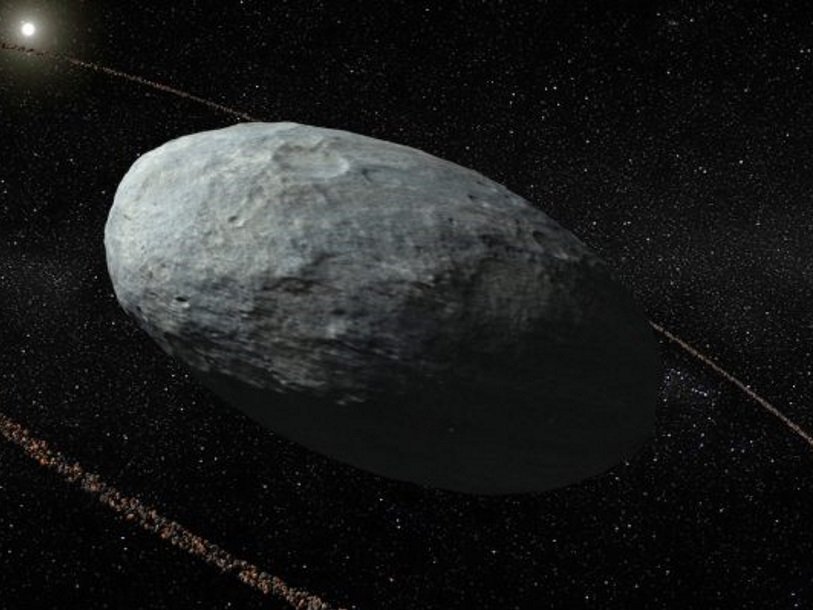
Astronomers opened a system of rings surrounding Haumaa - a dwarf planet, the orbit of which lies outside the orbit of Neptune. This is the first case that the rings are found in a transneptunal object.
The planet Haumaa is about the size of about the island of Greenland. It makes a turn around the Sun in 281.83 years, and spends only 3.9 hours on the turn around its axis - record quickly even for such a small celestial body. Due to such a quick rotation, Hauma is strongly flattened at the poles and extended at the equator. The dwarf planet was opened independently by two groups of astronomers. One of them included Michael Brown, David Rabinitz and Chadvik Trukhillo, who discovered the planet in 2004, in the other-Spanish astronomers Jose Luis Ortis and Pablo Santos Cruz, who opened it in 2005, but informed his colleagues earlier. The planet received the name in honor of the Hawaiian goddess of fertility. In 2005, the Brown group opened two Hauma satellites: Hiiaak and Namaka.
The new opening was made by the group of Ortis and Santos Cruze from the Astrophysical Institute of Andalusia in cooperation with colleagues from a large number of other countries. A complete list of authors of the scientific article reporting the ring around Haumaa has 93 people. The ring lies in the plane of the equator Haumaa. The objects of the ring make one turn around the dwarf planet during the time when Hauma manages to turn around its axis three times. The width of the found ring is 70 kilometers, and the radius is 2287 kilometers. Scientists were also able to clarify the size of Hauma. If earlier its maximum diameter was considered to be 1960 kilometers, now it is established that it is 2322 kilometers. The density of the planet is 1885 kilograms per cubic meter, which is close to the density of Pluto.
Although the Haumaa ring looks much more modest than the rings surrounding the planets, its find suggests that other dwarf planets and asteroids can have such rings. Previously, the rings were known among Saturn, Jupiter, Neptune and Uranus. The hypothesis of the presence of a system of rings in Pluto has been advanced repeatedly, but did not receive confirmation during the study of Pluto by the new horizons. Probably, the satellite of the Rey titan has its own three rings. In 2013, two rings were opened by Harigro-a centual asteroid, whose orbit lies between Saturn and Uranus. In 2015, the group’s observations under the leadership of Jose Louis Ortis suggested that another centaur, Hirona, has two rings.
The opening is reported in an article published by Nature magazine.